
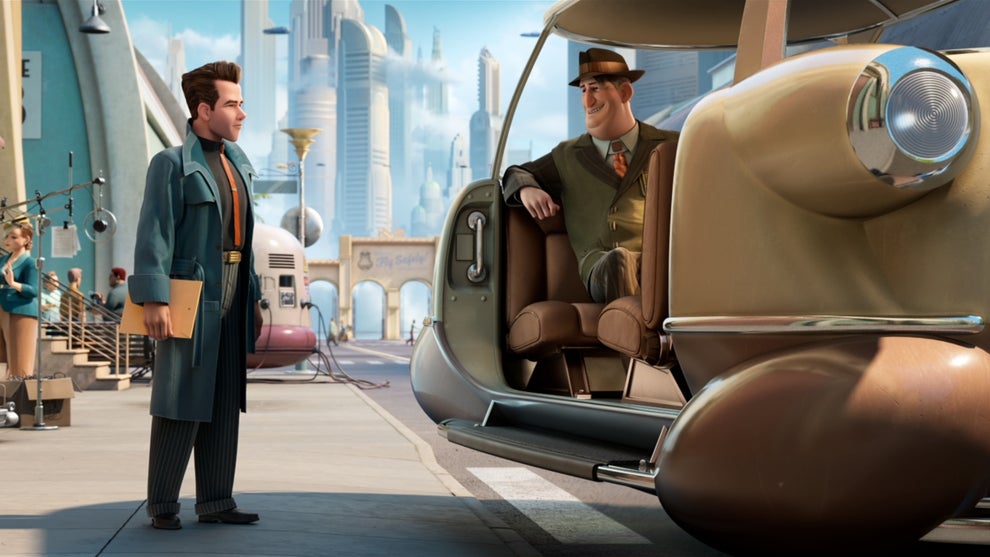
“Ray Gunn” is – finally – here.
The project began in the early 1950s as an idea by Brad Bird, a talented veteran of “The Simpsons” and Steven Spielberg’s “Amazing Stories,” at Turner Feature Animation. It was inspired by him hearing the B-52’s song “Planet Claire” on the radio. Bird first thought it was Henry Mancini’s theme to “Peter Gunn.” But as the song progressed, he realized it was something else, something spacey – retro and futuristic all at once. Instead of “Peter Gunn,” Bird imagined, it could be … “Ray Gunn.”
Ideas flooded his imagination – sleek skyscrapers that were hundreds of stories tall, flying cars that could have been designed by Preston Tucker sharing airspace with rocket packs, aliens and humans all part of the same, glorious melting pot – and a script followed, co-written by Matthew Robbins (who had worked with Bird on an “Amazing Stories” episode). “Ray Gunn” would take place in a future as imagined “before World War II and the atomic bomb made the world a smaller place, and the future less than rosy,” Bird wrote in an introduction to the fifth draft of the screenplay, dated June 1996. Even the holograms would be in black-and-white.
But as Bird moved onto “The Iron Giant,” which would ultimately be his directorial debut, then to Pixar for “The Incredibles” and “Ratatouille,” before blossoming in live-action with “Mission: Impossible – Ghost Protocol” and “Tomorrowland,” “Ray Gunn” remained on the back burner. Until now.
A few years ago, Bird re-engaged with the property, bringing it from Warner Bros. (where it had been entombed following their acquisition of Turner) to Skydance Animation, which was now being run by Bird’s old pal John Lasseter, giving the script a new polish and pushing it into the undiscovered country of computer animation with teams in Spain, Canada and Connecticut. (It had originally been intended as a traditional, hand-drawn feature.)
Now, decades after it was first proposed, “Ray Gunn” is finally seeing the light of day. And it’s a doozy – as zippy and imaginative and full of ideas as Bird’s very best work, a visually stunning, thematically rich masterpiece that pushes the boundaries of Western animation with wit and verve. For years, “Ray Gunn” existed only as a dream, a tantalizing what-if. Now that it’s here, it’s better than we could have possibly imagined.
“Ray Gunn” wastes no time in establishing the particulars of its world. With a blast of Michael Giacchino’s jazzy score, we are introduced to the sprawling, glittery city of Metropia, “where everything is streamlined within an inch of its life” (according to that early draft). Flying cars race by, elevated trains with giant propellers ferry citizens and everything feels both futuristic and charmingly old-school.
This intro is important, too, in establishing the social hierarchy of Metropia – it’s the first time we understand that there might be something dingier at the heart of the gleaming utopia – as we continue down to ground-level and see a cleaning crew that is arriving for their overnight janitorial shift. They’re all aliens. And one of the aliens is Eyera (voiced by Tom Waits), the three-legged, one-eyed partner of Raymond Gunn (Sam Rockwell), the last remaining human private eye in the city. (Most detective work has been outsourced to insect-like spying robots. They’re more reliable than flesh-and-blood gumshoes, it seems.)
They’re on a case and are meant to be obtaining some sensitive documents, an effort that is derailed first by a pair of thugs on jet packs and then by a spy drone. Plus, the owner of those documents comes in and makes a fuss. It’s here that, through brief snippets of dialogue and action that reveals character alongside thrills, Bird establishes that Gunn is a man with a conscience – he’s compelled to do the right thing, even if it is in direct opposition to his personal success.
Soon, we learn that Gunn’s detective agency is nearly bankrupt. He doesn’t even have a decent blaster – the double-meaning of the title made perfectly clear when he visits a gun shop and walks away with a one-of-a-kind weapon.
The main thrust of the plot involves Ray and Eyera being hired by a corporate mogul (Alan Tudyk, a mainstay of recent Disney animated features) to watch after a tempestuous pop star named Venus Nova (Scarlett Johansson, both speaking and singing). Of course, the mystery soon reveals itself to be grander and more labyrinthine, involving Venus’ deadbeat husband (Bobby Cannavale), a Sydney Greenstreet-style mob boss (Matt Berry) and a conspiracy that… Well, we should probably stop there.
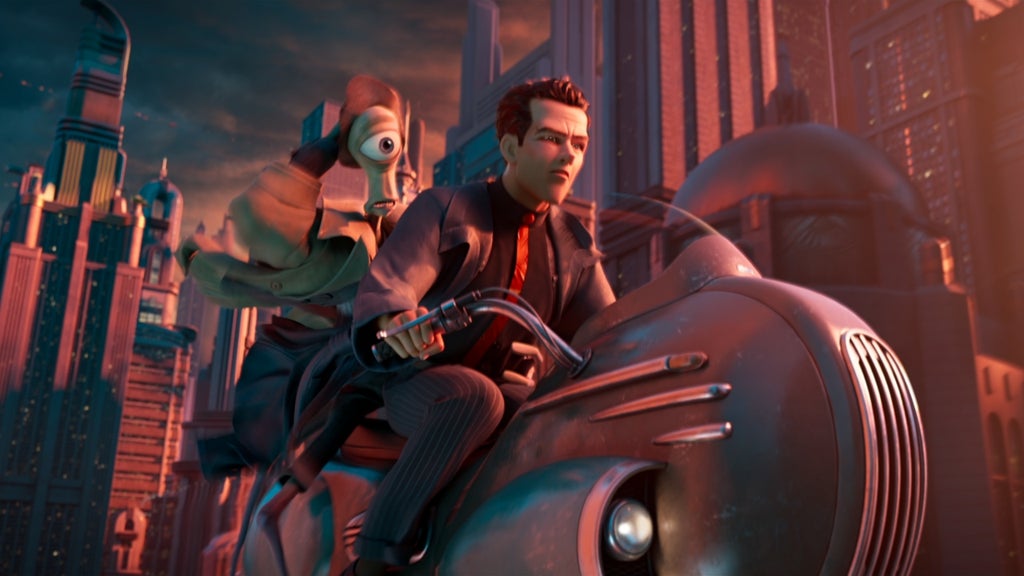
Bird has always been known for his staging, which eschews the simplicity of modern blockbuster filmmaking for more dizzyingly complex choreography – think the way that Tom Cruise dangled outside of the world’s tallest building in “Ghost Protocol” or George Clooney dispatching a gang of marauding androids in his boobytrapped house in “Tomorrowland” or pretty much anything in his two “Incredibles” movies. Here, he takes that to an entirely new level, with scenes that take place in runaway elevators and through the skyways of Metropia.
There’s always a sense of escalation to go along with the complication – Ray desperately needs to rent a jetpack from a City Bike-style dispenser; the last one is taken by somebody else when Ray’s not looking; he finds a crummy one disused in a planter; he can’t get his money to be read by the machine; and on and on.
And it’s all accompanied by some of the greatest lighting and camerawork in recent memory (cinematographer Erik Smitt has outdone himself). There’s one moment where Gunn motions to a building behind him. The camera moves a fraction of an inch, gliding over before coming back to Ray’s conversation. It’s subtle and hugely impressive. There are countless instances where your jaw will be on the floor.
One of the complaints often leveled against Bird is that his work is elitist somehow. Comparisons have been drawn between “The Incredibles” and, to a degree, “Ratatouille,” along with “Tomorrowland,” and the Objectivism of Ayn Rand. This, of course, is hogwash; the chef at the center of “Ratatouille” reminds viewers that “anyone can cook” and the touching final moments of “Tomorrowland” show a fantastical world that is open to everyone. Still, the sociopolitical dimension of “Ray Gunn,” where aliens (obviously immigrants from other worlds) are deemed second-class citizens, should dispel this tired commentary from continuing. At one point Venus marvels that Ray’s partner is an alien. She says that it’s brave. Still Ray, as always, is governed by what’s right. There’s some additional commentary about the state of the world but digging into these themes so early (it doesn’t hit Netflix until December 18) would be criminal.
There are times when you feel like “Ray Gunn” maybe shouldn’t work as well as it does – it mixes the daytime noir of something like “Chinatown” or “The Long Goodbye” with the ratatat, Howard Hawks-y dialogue of “His Girl Friday,” with the intricate, world-building futurism of “Blade Runner.” (Truly, a bouillabaisse that only Bird could have concocted.) But it does. All in harmony. Muscular action set pieces follow tender, emotional moments; high comedy rests alongside contemplative melancholy; it’s an edge-of-your-seat thriller that also features caricatured creatures and flying motorcycles. “Ray Gunn” plays like symphony with many movements and not a single note out of key.
It has been Bird’s mission, since he started making movies, to bump out the boundaries of what animation means to Western audiences. Here, unlike in the East, it’s an artform often infantilized. Critics and execs dismissively refer to it as a “genre,” instead of a medium. This seems to be changing, ever-so-slightly, as the West more openly adopts things like anime and projects like Laika’s “Wildwood” garner PG-13 ratings.
And “Ray Gunn” is a profound step in that direction. It never talks down to its audience, never coddles or comforts them. There are serious implications to characters’ actions. People die. But it never comes across as didactic or heavy-handed. Should the family want to watch “Ray Gunn” together, they can. But it’s an animated feature that isn’t interested in merchandising or theme park opportunities or possible bedsheet sales. “Ray Gunn” is a profound work of art.
“Ray Gunn” stands as one of the rare passion projects that was worth the wait. Never once will you think, He wanted to make this for 30 years? There are so many tantalizing ideas, lovable characters and unforgettable set pieces crammed into its 119-minute runtime, that you’ll want to race back to this strange, enchanting world again and again. (The film will be playing in select theaters, at the beginning of December, in 70mm. Make it a priority or regret it forever.) Long ago Bird established himself as one of the most exciting, talented filmmakers of his generation. With “Ray Gunn,” he’s finally been able to make his dream a reality. And somehow, the reality is even better than the dream.
“Ray Gunn” will play in select theaters starting Dec. 4 and premieres on Netflix on Dec. 18.
