
Some documentaries begin with a question. “Rescue” begins with a nightmare.
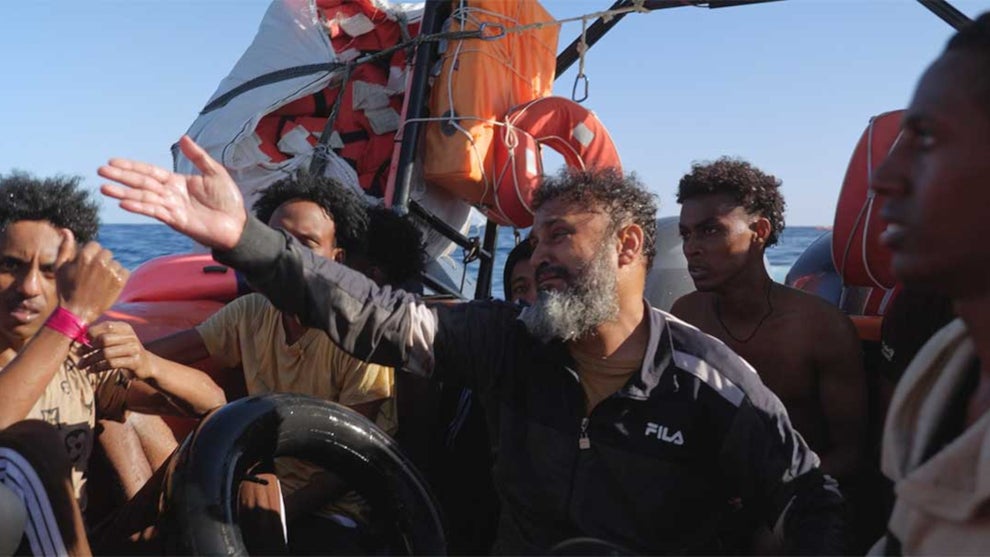
In the waters off the Libyan coast, director Sine Plambech and her crew are aboard the Geo Barents, a rescue ship operated by Doctors Without Borders. They encounter a rubber boat packed with refugees in distress, with a situation that escalates quickly when a second boat carrying armed Libyan militia members approaches. The militia begins intercepting the defenseless migrants, but in the frantic struggle that follows, some people are pulled from the water and taken away.
Others manage to reach the safety of the rescue ship. Among those rescued is Hani, a husband and father who soon realizes that his wife, Roro, their young son, and their two-month-old daughter have been kidnapped.
One of the most devastating introductions to a documentary (maybe even film in general) that I’ve ever witnessed, “Rescue” made its world premiere at the Toronto International Film Festival this week. Watching in horror, the movie’s opening sequences could easily have stayed focused on the broader Mediterranean migrant crisis, but Plambech seems intent on capturing the more intimate moments in real time. The movie quickly evolves into a portrait of one family’s desperate fight to stay together in a convoluted system clearly designed to keep them apart.

An anthropologist moonlighting as a filmmaker, Sine Plambech (returning to TIFF this year after 2018’s “Heartbound”) follows Hani in the months after the film’s brutal opening. The larger political picture is never far away as the documentary examines everything from European border policy to Libyan militias and the ransom economy surrounding refugees. The central theme points toward the enormous financial arrangements between the European Union and North African countries intended to stop the flow of mass migration in the open seas.
Hani’s determination, rather, becomes the film’s driving force.
The most remarkable development comes from Roro herself during captivity as she manages to conceal a cellphone in her baby’s diaper, creating a tenuous line of communication with Hani. Their messages become a lifeline, allowing fragments of information to pass between two people separated by violence and circumstance. For Plambech, the phone also becomes an extraordinary, albeit dangerous, window into a world that would normally remain inaccessible.
Leaning on this strength to further the story, “Rescue” doesn’t simply tell audiences about the migrant crisis…it shows how easily individual lives can disappear inside it. Migrants intercepted at sea can become invisible, pushed into detention centers and exploitative networks beyond the reach of public scrutiny for cable news talking points. Plambech’s cameras happen to be there when Hani’s family is taken, and she keeps filming as his search drags on.
The result is a documentary with the tension of a thriller but none of the artificiality.
“Rescue” occasionally becomes so dramatic that it seems almost impossible to believe it is unfolding in real time. Roro’s hidden cellphone, Hani’s increasingly desperate attempts to find his family, and the uncertainty surrounding their fate could easily belong to a scripted political thriller. But there is no screenplay here, as Plambech and team have the patience and access to let an extraordinary real-life story unfold.
That restraint tends to keep the film’s political arguments from becoming overly preachy and drawn out. “Rescue” makes clear that the language of border control and migration deterrence can muddy the waters of the overall human consequences of political interference. The machinery may be bureaucratic, but its effects are painfully personal as fear and desperation come into stark focus.
The film is ultimately a story about persistence in the face of quantifiable danger. Hani’s refusal to give up and Roro’s tenacity to stay in contact transform an overwhelming humanitarian crisis into something deeply familial. Director Sine Plambech presents a story that’s equal parts harrowing and intimate, and the result is often astonishing, with revelations that linger long after the credits roll.
