
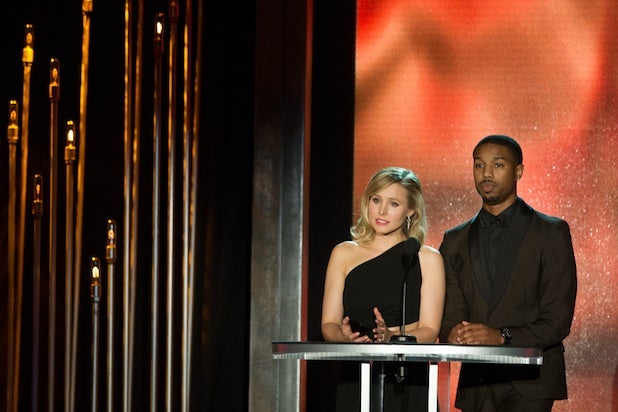
And the Oscars go to …
…small lead-free pyrotechnic devices, layered material systems and layered shading systems, brushing and patching tools, stylized animation toolsets and innovative rules and heuristics underlying metadata and timecode matching.
Among other things that most of us don’t understand.
Those are some of the accomplishments saluted in this year’s Scientific and Technical Academy Awards, which will be presented in a special ceremony on Tuesday, April 28.
Unlike the Oscars, which this year will be given out for specific achievements from 2025, the Sci-Tech Awards recognize 27 individuals whose work has spanned years. The winners are chosen in a multi-step process by the Scientific and Technical Awards Committee.
This year’s Sci-Tech Awards come in two forms: Technical Achievement Awards, which consists of an engraved plaque, and Scientific and Engineering Awards, which take the form of an acrylic trophy. The Academy sometimes gives out a Sci-Tech Award that brings an Oscar statuette, but none will be awarded this year.

Twenty five of this year’s honorees will receive Technical Achievement Awards and two will be given Scientific and Engineering Awards.
Here is the description of the winning achievements from the Academy release:
TECHNICAL ACHIEVEMENT AWARDS
To Brent Bell for the research and development of safe, reliable and effective small lead-free pyrotechnic devices used extensively in motion picture productions throughout the world.
Brent Bell at De La Mare Engineering, Inc. successfully modernized the industry standard for bullet hits by engineering a high-output, lead-free product line through extensive chemical research and the development of specialized and precise manufacturing processes.
To Josef Köhler for developing the first small lead-free pyrotechnic devices available at scale.
Josef Köhler Pyrotechnics set a critical precedent by overcoming significant chemical engineering hurdles to provide the film industry with a non-toxic, low-flash alternative that preserved the use of practical bullet hits while meeting rigorous new European safety and environmental standards.
To Ian Medwell for developing small lead-free pyrotechnic devices used extensively for motion picture production throughout the United Kingdom.
Sterling Pyrotechnics’ high-performance, lead-free alternative to traditional squibs provides the film industry with a non-toxic, repeatable solution for practical bullet effects that maintains technical compatibility with legacy devices.
To Andrea Weidlich, for her research on layered materials and implementation of the layering operators and BSDFs in Wētā FX’s Manuka renderer.
Weidlich’s research and the methods underlying Manuka’s layered material system have been influential across the visual effects industry and have allowed Wētā FX to raise the bar for photorealism.
To Luca Fascione for the initial design and development of the layered materials system at Wētā FX.
The Manuka renderer’s efficient and flexible system for layering materials has unlocked workflows that have allowed Wētā FX to scale to ever-larger productions while giving artists both creative freedom and physical accuracy.
To Vincent Dedun and Emmanuel Turquin for the design, architecture and engineering, and to Jonathan Moulin for the design and creative vision of Lama at Industrial Light & Magic.
Lama provides an artist-friendly approach to composing materials built from layers representing distinct physical phenomena. Its modular, carefully curated design allows look development artists to create unique, physically plausible appearances without writing shader code. Its ease of use has expanded and accelerated shading workflows at Industrial Light & Magic and led to broader industry adoption via its inclusion in Pixar’s RenderMan.
To Josh Bainbridge and Nathan Walster for the design, architecture and engineering of the layered shading system at Framestore.
Framestore’s layered shading system was among the first to enable its users to generate novel, realistic appearances in a modular workflow by combining material layers in a physically plausible fashion. Its development has enabled Framestore to deliver diverse looks across a broad creative catalog of filmmakers’ requirements.
To Bret St.Clair and Marc-Andre Davignon, for the design and engineering of the suite of brushing and patching tools, and to Pav Grochola and Edmond Boulet-Gilly, for the design and engineering of the Superdraw and Kismet linework tools.
These tools at Sony Pictures Imageworks enabled the large-scale application of a wide variety of custom artistic styles across animated features that inspired the industry.
To Baptiste Van Opstal, Jeff Budsberg, Michael Losure, John Lanz and Eszter Offertaler for their contributions to the stylized animation toolset at DreamWorks Animation.
From linework authoring and animation to novel brushing and stamping methods, this toolset facilitates the wide range of unique art styles and painterly effects seen across DreamWorks Animation films while providing artistic control at every stage of production.
To Benjamin Graf for the design, engineering and development of dxRevive Pro.
dxRevive Pro has transformed modern dialog restoration practices, combining noise reduction, layered separation and resynthesis to achieve results that maintain the realism, continuity and the emotional fidelity of on-set performances thereby reducing the need for ADR in the postproduction process.
To John Ellwood for the innovative rules and heuristics underlying the metadata and timecode matching, and to Jeff Bloom for the groundbreaking waveform matching in the Titan auto-assembly software for digital audio.
Titan pioneered the auto-assembly of digital audio, eliminating the need for sound editors to manually align their sessions, and stood as the benchmark for many subsequent systems.
To Marc Joel Specter for the design and development of the Kraken Dialogue Editors Toolkit, enabling precise audio assembly.
With an intuitive user interface and transcription utility that provides audio asset management, enabling direct access to edit decision lists and audio session files, Kraken expedites the assembly of audio files while providing visual aids to find and resolve issues.
To Justin Webster for the design and engineering of Matchbox, a system for audio and video matching that enables auto-reconform.
Providing detailed insight into differences between audio and video files, even in the absence of metadata, Matchbox enables rapid application of changes in post-production while preserving previous creative work.
To Paul Debevec for his pioneering work in high dynamic range, image-based lighting techniques.
Debevec demonstrated the advantages of high dynamic range image-based lighting, and, through advocacy of the approach, led the industry to embrace new workflows. This has enabled artists to work more productively and improved the realism of computer graphics imagery in feature films.

SCIENTIFIC AND ENGINEERING AWARD
To Jamie Caliri and Dyami Caliri for the design, engineering and continuing development of the Dragonframe software suite.
Dragonframe represents an expertly designed suite of integrated tools that has transformed stop-motion animation, eliminating fragmented, error-prone methods while enabling precision at scale.