
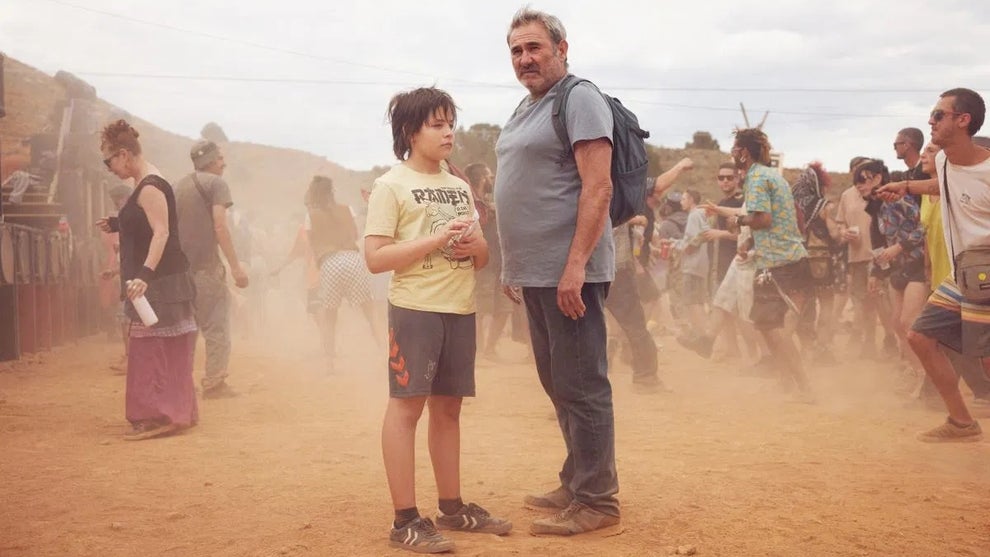
It took Óliver Laxe 14 years to bring “Sirât” from an idea in his mind to a double Oscar nominee. What started simply as a series of concepts and images (trucks driving across the desert, ravers dancing in a dense crowd) evolved into a religious odyssey about a man trying to find his daughter — and some semblance of peace — amid blazing heat and pulsating beats.
Across those 14 years, Laxe made two other films before diving fully into “Sirât,” an intense production that would bring Spain a Best International Feature nomination at the 2026 Academy Awards. It wasn’t easy getting those images from Laxe’s head to the screen — but the filmmaker has learned to live with the challenge.
“I think filmmaking is the art of frustration,” Laxe told TheWrap. “It’s how you deal with frustration. At some point, you learn to surrender. You learn to have more faith, to accept that life is giving to you and taking from you. ‘Sirât’ is about this.”

“The images of ‘Sirât,’ they are alive. In most projects, filmmakers, we are the worst enemies of our images. We put too much weight into images, we want to say too many things, we put too much ego in. So at the end, the images are tired. An image is something really complex, you know?”
Laxe, who wrote “Sirât” alongside Santiago Fillol, dove deep into rave culture for his film. The filmmaker went to various raves in Morocco and across Europe — France, Spain, Portugal, Italy. Here, he found a sort of spirituality develop amid moving bodies and techno beats.
“Ravers have a memory in their bodies of something that we were doing for thousands of years — praying with the body, making catharsis with the body. It’s a ceremony, a dance floor. It’s a ceremonial space. The body tells you things about you.”
Laxe found this culture initially at odds with his lead actor, Sergi López. López, perhaps best known stateside as the evil Captain Vidal in Guillermo del Toro’s “Pan’s Labyrinth,” stars in “Sirât” as Luis, a father who brings his son and dog to the Moroccan desert on a search for his lost daughter. While Luis begins the long trek to a secret rave deeper in the desert, radio reports clue audiences into an escalating World War occurring in the film’s background. López marks one of the only professional actors tapped by Laxe and his Oscar-shortlisted casting department.
Just as Luis takes some time to warm up to the ravers he’s fallen in line with, Laxe said that López, too, needed a moment to adjust to the culture at the film’s center.
“He had prejudices at the beginning. He thought that these people were like lazy drug addicts,” Laxe laughed. “But he found people really committed with values, with radical coherence. I mean, people who rave know about everything — about mechanics, building, medicine, languages. And the values, you know? They really take care of each other.”
“At the same time, Sergi is a punk. He’s an actor who’s not an actor, you know? He can build a mask — actors are really good to build masks — but some of them, they also can take off the mask, become a zero and connect with the fragility that these ravers have. That was the work with the Sergi — to kill him.”
On top of Best International Feature, “Sirât” picked up an Oscar nomination for Best Sound. Amanda Villavieja, Laia Casanovas and Yasmina Praderas make up the first female-led team recognized in this category at the Academy Awards.
The film features intricate, bone-rattling sound design as clattering trucks and clicking speakers make their way across the land. Laxe noted the importance of such a dense soundscape in “Sirât,” one that isn’t “separated from the image, from the story.”
“Laia, Amanda, Yasmina, they are great. We share the same rigor. We’re working nine months on the sound of this film. At the beginning, I was a little bit afraid because Laia, the sound engineer, she disappeared for two, three months. My producers told me, ‘Don’t worry. This is the way she works. She’s just building a library,’” Laxe said. “She gave me confidence.”
As “Sirât” progresses, Laxe and Fillol begin to take big swings, ones that almost guarantee a strong audience reaction. The director shared that there was some hesitation about how audiences would take some of the film’s harsher moments.
“We had a lot of fears,” Laxe said. “The fears were a sign that we were going to a good direction. We were going to a direction that was important to explore from the cinema.”
“I think this film transcends a theory of I like or I don’t like. It’s if the film penetrates you or not — this is the question — if the medicine goes to your body or not. It’s moving things. ‘Sirât’ is shaking things inside the spectator.”
“Sirât” is in theaters now.
