
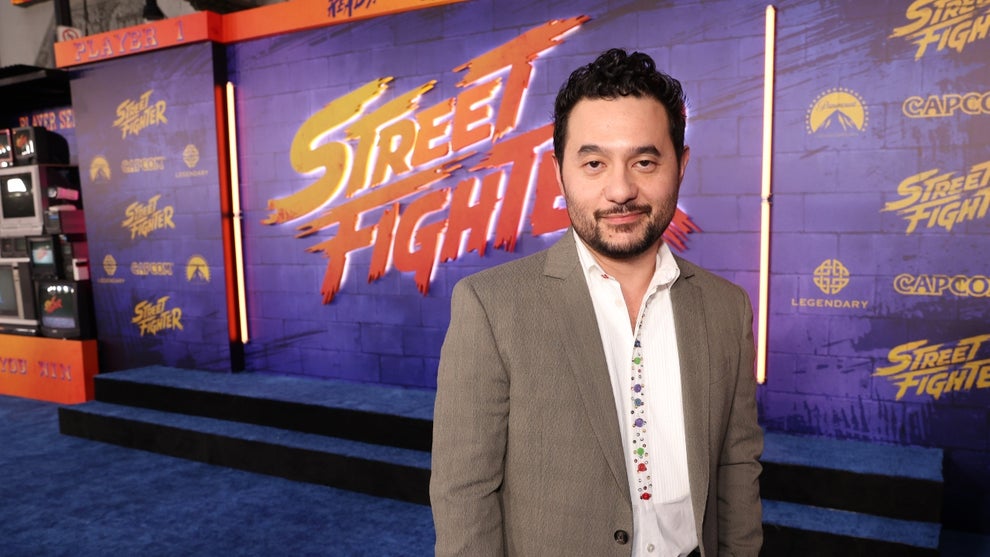
“Street Fighter” is here.
The adaptation of the beloved Capcom video game series, which began life as an arcade game back in 1987, stars actors Noah Centineo, Callina Liang and Andrew Koji, who appear alongside professional wrestler Cody Rhodes, singer Orville Peck and rapper Curtis “50 Cent” Jackson. Jason Momoa even pops up as a green CGI monster. The movie is set in 1993, with a nefarious villain (David Dastmalchian) setting up a fighting tournament for his own evil goals. It’s a lot.
Corralling all of this madness is director Kitao Sakurai, a veteran of “The Eric Andre Show” and André’s 2021 movie “Bad Trip.” Sakurai wasn’t the first director on the project. “Talk to Me” filmmakers Danny and Michael Philippou were originally handling the film, but dropped out to do their A24 follow-up “Bring Her Back.” And while Sakurai wasn’t the first person on the project, he was the one who got it across the finish line. He won the fight.
Looking back, it seems like he’s the only one who could have made “Street Fighter.”
Sakurai was born in Japan and grew up in Ohio; as a kid, the “Street Fighter” video games were hugely important to him.
“It was the first time I’d seen Asian people on a major pop cultural thing that reflected the manga and anime that I was actually watching at the time and it felt to me like the first entry point into American pop culture,” Sakurai told TheWrap. “That meant something to my heritage and what I was growing up on. These characters became baked into the culture, they took on the power of Greek mythology almost. For everybody in my generation, it became this powerful cultural moment.”
After the Philippous dropped out, Sakurai said he had to lobby for the job. Producer Cale Boyter, who works for Legendary, asked Sakurai if he had a take on the material. They had the bare bones of the story – that it would focus on the sibling rivalry between brothers Ryu (Koji) and Ken (Centineo) – but otherwise it was wide open. Sakurai connected with the story of the brothers, both because he felt like it was the heart of the “Street Fighter” brand and because “I just love stories about friendship and the ups and downs of tracking a relationship.” Sakurai told Legendary, “I know how to make that story and touch on something deeper than a pure tournament movie.”
Everything else fell into place afterwards, like “setting it in the ’90s and really leaning into a ’90s milieu and what that meant aesthetically” and the “gonzo tone,” which Sakurai said was “the major component of my take on it.”
“Street Fighter needed to feel weird, for lack of a better word,” Sakurai explained. He began searching for how to create that tone and thought about comedy and the magic of creating a character. He loved when characters feel “completely of themselves and completely speak with their own voice and the comedy comes from the clash of these character energies.” Sakurai saw “Street Fighter” as an ensemble and wanted to feel like the characters would clash, inside and out of the arena.
This is what led to him casting people “that weren’t traditional actors” – “martial artists and comedians and musicians.” Sakurai described them as “people that had different places within a broader cultural context and to us led to this feeling that feels like the game – within this pop cultural context you have these people that feel wildly different and that are all thrown into this insane soup and it creates this cultural energy almost. That was a big part of the spirit of the film.”

Watching “Street Fighter,” you get the sensation that these people would never have been in the same room together unless they were making a “Street Fighter” film, in the best possible way.
And key to Sakurai’s approach is a truly staggering amount of traditional 2D animation, done in the style of Japanese anime and handled by American animation studio Titmouse. These sequences are used for extended flashbacks and are quite striking. It’s honestly the most traditional animation in a Western feature in years.
Sakurai said that when they were starting work on “Street Fighter,” they didn’t realize “the extent to which animation would be used.” The flashback sequences, he knew, where important emotionally to set up the backstory between the two main characters. The team didn’t want to use digital de-aging or any of the traditional methods to indicate an earlier time period.
“It felt tonally cheesy. It didn’t feel right for the movie,” Sakurai said.
Instead, they “dug deeper” and remembered the connection between “Street Fighter” and anime, not only as a source of inspiration for the original games but also the beloved 1994 feature “Street Fighter II: The Animated Movie,” which featured animation from Japanese studio Group TAC. (In Japan, there was also a “Street Fighter” animated series.) “There’s a real history there,” said Sakurai.
He thought about the movies that influenced him the most – “Akira” and “Ghost in the Shell” – and they also looked at Quentin Tarantino’s “Kill Bill,” which used a similar anime-as-flashback device (although less extensively than “Street Fighter”). “We were like, Why don’t we explore this?” Sakurai recalled. They reached out to Titmouse, with their VFX supervisor leading the charge.
“The more we dug in, the more interesting it was and we leaned into this idea that was nerve-wracking in a sense because animation has such a longer pipeline than live-action,” Sakurai explained. “We were starting the animation during prep basically. With animation you have to really nail down exactly what it is.”
Not only did they have to have the shots figured out, but also things like having the costume department share designs so that there was a cohesiveness across the live-action and animated portions of the movie. Titmouse would review dailies of the live-action shoot, which would also influence the animation.

“That’s why the animation feels very integrated into the language of the movie because they were actually looking at what we were doing and basing their designs off of the production designs,” said Sakurai. “There’s a lot of back and forth to get to the style that we eventually landed on in the film.”
While the movie shifted during post-production, that also added complexity for the animated segments.
“There’s great difficulty because they would do these sequences and narratively, we wanted to tweak it. But in animation, you can’t really change shots so easily because hundreds of people are drawing frames,” said Sakurai. “You can’t be like, Let’s have them do this instead. It would have been much easier if we had done a contemporary, computer animation-based approach. We took a much more sort of punishing and difficult approach, but I think it’s really rewarding because you feel the human care that went into it and it was important for me in that ’90s throwback way. There is something about that feeling that I think works so well with the emotional tone of the live-action footage.”
As for whether or not Sakurai will be back for a “Street Fighter” sequel, especially considering the severe cliffhanger that the movie ends on, he said that yes, he would sign up for another tournament.
“Obviously I had such a blast making this movie and there really was this very special magical vibe, a lightning-in-a-bottle feeling, making the film. And so I think it’s something everybody would be passionate about and would love to come back to,” Sakurai said. It has been reported online that a sequel is already in the works, but he clarified that is not yet the case. (The movie just opened!) Still, he stresses that should a sequel be announced, he’d come back for more.
“I would love to, of course,” Sakurai said.
“Street Fighter” is in theaters now from Paramount and Legendary.
