
An emotionally suffocated housewife. A husband who couldn’t care less. An audition for a local theater group. A cheesy musical with amusingly bad songs. A director who brings out the housewife’s inner fire. An obviously artificial descent into madness. All these elements come together beautifully in the 1992 “The Simpsons” episode “A Streetcar Named Marge.” In Jesse Eisenberg’s new film “The Debut,” not so much.
Eisenberg wrote and directed the bittersweet 2024 comedy “A Real Pain,” and co-starred with Kieran Culkin as cousins on a heritage tour in Poland. It’s a sensitive movie, even when its characters aren’t, and it had something worth saying about the way different people process their grief and the grief of previous generations. “A Real Pain” is the kind of movie an actor often makes when they move behind the camera: an ambitious character study with a cornucopia of juicy scenes, which Eisenberg and his co-star eagerly devoured.
His second film, “The Debut,” is another actorly enterprise. It’s literally about how acting is the best thing in the world, with the power to tear us apart and put us back together again. Sometimes its message is even convincing. Not usually, but sometimes.
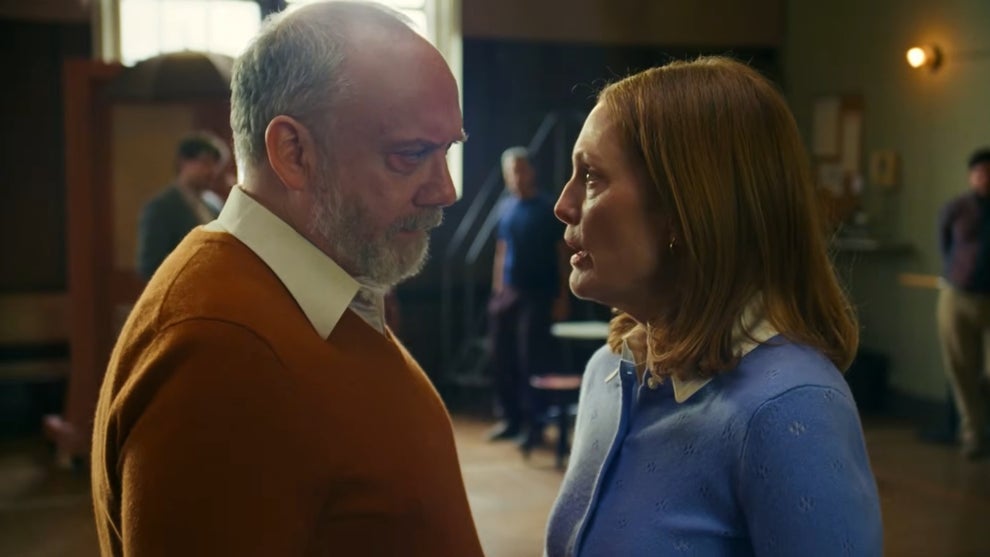
Julianne Moore plays Mona, a repressed stay-at-home mom who auditions for a local production of “Nosy Neighbors,” a fictional musical about the tenants of a ramshackle apartment complex and their hammy, ridiculous problems. Mona doesn’t get the part because she has no talent, but an aging Broadway diva backs out of the production at the last minute, so the director turns to Mona, because she’s literally the only other person who auditioned for the part.

It’s a strained plot point. The director, Jerry, is a consummate professional played by Paul Giamatti, who’s doing such an eerie impersonation of my dad, specifically that I suspect he broke into my mom’s house and stole his favorite hat and coat. But I digress. It’s hard to believe that a director with decades of experience in the theater would resort to casting the most inexperienced actor in New Jersey instead of calling in some old favors. Or at least trying for a little while before falling back on Plan B, Plan C and eventually Plan Z.
Then again there’s something suspicious about the whole cast and crew of “Nosy Neighbors.” They’re all extremely nice — like, “Stepford” nice — and have no lives outside of the theater, nor any opinions about anything except how wonderful Mona is. Jerry is the exception. Sometimes he’s nurturing, sometimes he’s a bully, but either way he forces Mona to come out of her shell, which looks a lot like becoming a great actor but is probably just an overdue, dangerously long nervous breakdown. Oh yes, and not one member of Mona’s family ever meets her new friends and co-workers. That’s a big red flag.
For about half of “The Debut,” every creative decision Eisenberg makes supports one theory: Mona has lost touch with reality, and the film will end with Mona alone in a dilapidated, condemned theater talking to a room full of mannequins. And possibly killing somebody. It would be a predictable conclusion but at least it would make sense.
But no, that’s just how life actually is in “The Debut.” Eisenberg chooses, boldly but not necessarily wisely, to direct this film like a cheesy community theater production where only a couple performers are trying to make it believable. Everywhere Mona goes feels artificial, not in a stylish way, but in a way that suggests positivity can never be trusted, which makes the film’s heartwarming moments impossible to accept. But there are moments when the actors shine through and, briefly, make some magic. Moore and Giamatti’s biggest scene, the one that brings the house down, is a clumsy cross between the bullying of “Whiplash” and the scene in “Good Will Hunting” where it’s not Will’s fault, by way of a standard acting exercise. It works because Moore and Giamatti are brilliant, not because it’s brilliantly conceived, but you can’t say it doesn’t work.

Still, it’s hard to focus on how excellent Moore and Giamatti are when you’re constantly distracted by how one-dimensional every other character is around them. Halle Bailey (“The Color Purple”) plays Mona’s co-star, Stef, who exists only to be bright and cheerful and help Mona on her journey. Stef’s one moment of genuine humanity, a fleeting glimpse into her own personal needs, comes so late in the film it’s practically a twist. Stef had interiority this whole time? I doubt anyone saw that coming. And although the moment is clearly intended to teach another character about how self-centered they are, the audience wasn’t being self-centered. We would have liked to have gotten to know Stef better. “The Debut” hides its nuances from the viewers, in a way that makes the nuance look shallow.
“The Debut” is an extra special present to Moore and Giamatti but it’s a gag gift for everyone else in the cast. Eisenberg’s decision to clothe this theater community with angelic halos doesn’t illuminate much about the actor’s experience. It just makes “The Debut” hard to buy into and easy to check out of.
Eisenberg deserves one important compliment, and it’s no small achievement. The songs he wrote for “Nosy Neighbors” are pitch perfect. There’s a reason nobody’s heard of this play and the often-embarrassing lyrics are the biggest clue as to why. Making something bad on purpose, in the best possible way, is a dance between the raindrops many writers have attempted before, but few get away with it. “All Backed Up,” the song Eisenberg reserved for himself, is about a clogged toilet and a broken love life. If there’s such a thing in the universe as “perfect cringe,” that qualifies.
There are many great films about small live theater productions and the impact they have on people’s lives. “Waiting for Guffman,” “Ghostlight,” “Sing Sing,” “In the Bleak Midwinter,” the list goes on. The list doesn’t include “The Debut” but I’d still like to thank the film for auditioning. It took moxie to try this hard, but it takes more than that to be a star.
