
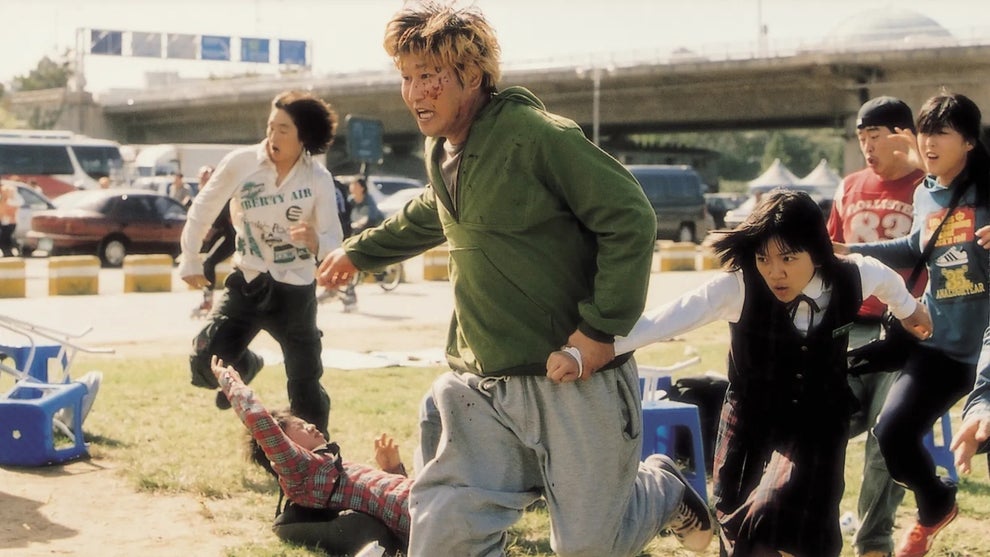
“The Host” has returned.
Bong Joon Ho’s third feature – and, arguably, his breakout film – concerns a creature that emerges from the Han River in Seoul and starts gobbling people up (and just murdering others). When the creature, a mutant born of a shortsighted United States Army effort to simply dump unwanted chemicals down the drain, takes a young girl, the girl’s family (including Bong regular Song Kang-ho as the fuck-up father) sets out to find the creature and get the girl back. Not only is the movie a modern classic – thrilling, exciting, deeply felt – but it solidified Bong, after 2003’s excellent “Memories of Murder,” as one of the most exciting, virtuosic filmmakers working today, more than a decade before “Parasite” would net him Best Picture and Best Director Academy Awards.
If you didn’t see “The Host” when it was originally released theatrically, now’s your chance.
Magnolia is re-releasing the movie into theaters this weekend in a gorgeous new 4K transfer, ahead of a 4K UHD Blu-ray in early December. (His next film, an animated movie called “Ally,” will be released by Neon sometime next year. Bong is also working on a horror movie set in a subway, which is set to be scored by John Carpenter.)
Bong said that he had always been interested in monsters – he was fascinated by the Loch Ness Monster and would look at supposed pictures of the mythical beast in children’s magazines. When he was in high school, his family home faced the Han River, where the monster appears in “The Host.”
“From my room window, every day, I would watch the river. I kept imagining, What if the Loch Ness Monster slowly emerged out of the Han River right in front of my home?” said Bong. “That felt fun and exciting to me, but also a little insane and weird.”
Later on, after he became a director, he latched onto the idea again, which he admitted was pretty risky. Not only was the movie expensive but there was concern over whether or not a giant monster movie, partially fueled by his love of “Godzilla” and “Ultraman,” was too childish. “We actually had difficulty and challenges finding financing because people had doubts about whether we would be able to properly portray the monster,” said Bong.
Given the mixture of tones and styles that make up “The Host” – at different times the film resembles everything from a domestic drama to a fairy tale – you could assume that Bong was deliberately attempting to subvert expectation and upend genre conventions. But he said that is not the case.

“I never intended to be a cinematic bartender, intentionally and deliberately mixing this and that genre and this and that ideas, it just comes out of what I think about and observe normally in my daily life. It’s what my taste is, sensibility is as a filmmaker, and that’s what ends up on the script. And it’s not something that I’m conscious of when I’m writing the script,” Bong said. Still, he admitted, the producers and marketers would read the script for “The Host” and ask, “What kind of genre is this, Director Bong?” “They would be unsure of what they’re reading, but all I can say to them is that this is what the story of the film is, and what I’m always thinking about is just the story, and I don’t intentionally think about mixing those ideas,” said Bong.
There was one thing that Bong did want to disrupt what was expected of him (and “The Host”).
“The only one thing I recognize where I intentionally try to break the rule of the convention of genre was, I really wanted to show the whole body of monster at the beginning of the movie under the broad daylight,” Bong explained. He called it a monster movie cliché to have to wait an hour or 70 minutes before you get to see all of the monster. “My intention was to reveal the monster within the first 10 minutes and I did have that kind of rebelliousness,” Bong said. “That was the only the part where I was very conscious about the genre and breaking the conventions.”
The monster was designed by Jang Hee-cheol, who would go on to create additional creatures for Bong in “Okja” (a sweet, genetically created super-pig) and “Mickey 17” (a race of oddly adorable insectoid aliens that the humans dismissively dub creepers). Bong first noticed Jang when he was designing things for videogames and was introduced to him by the movie’s production designer. “He’s a person who has a maniacal, obsessive passion about things and he has a very unique, keen sense of creature design. And he also has a very encyclopedic knowledge about animals and animal biology,” said Bong.
It was Bong who suggested several elements of the creature – he showed Jang a photo of a fish with a deformed back, part of a scandal in Korea in 2000 known as the McFarland Incident, when Albert L. McFarland, an American civilian who was employed by the United States military in South Korea, dumped 24 gallons of formaldehyde into the Han River. (This scandal served as the basis for the movie’s prologue and is the reason behind the mutant creature’s creation.) Bong also suggested that the monster not be a Godzilla-sized terror. “I asked him that the the monster be the size of a bus that’s so that the monster could hide behind a bus,” Bong said. Good note.

And you’ve never quite seen the creature until you’ve seen it in glorious 4K.
“I’m extremely glad that the film endured the passage of time, and after 20 years, will be returning to the big screen. I’m happy that that we will be returning to that feeling of showing this new pristine print of the film and going back to that time,” said Bong. “Of course, the 4K restoration is a digital process, but using that technology to going back to that film look and the feeling that I had the time at the premiere is something that I’m very satisfied with and happy about.”
He said that a week before we talked he had watched the movie, front to back, for the first time in nearly 20 years. While he was never tempted to alter the movie for its new 4K presentation (the way that, say, David Fincher repainted clouds in the background of “Seven” or turned around a Coke can in “Panic Room”), “there was one scene that that did bug me and that made me think, Oh maybe I should have cut that scene.” Sadly, he wouldn’t reveal which scene he would lose.
After “The Host” came out there was a flurry of activity that surrounded both the movie and Bong. There were rumors that Bong was working on a project with J.J. Abrams’ Bad Robot, possibly a western remake of “The Host.” And there was test footage that leaked of a proposed sequel to “The Host” that would not have been directed by Bong.
Bong said that one of the movie’s producers, Choi Yong-bae, was extremely supportive of the movie and as a gesture of appreciation, Bong gave Choi the sequel and remake rights. A sequel was put into development (that’s where the footage came from), with a young Chinese director at the helm. But nothing came to pass. “I personally hope to see a sequel made. I’m still waiting for it to happen,” said Bong.
As for the Bad Robot project, he said that it wasn’t anything to do with “The Host.”
“At the time, we met and talked about ideas and talked about doing something together. But it wasn’t actually the sequel for ‘The Host.’ I don’t know. I haven’t seen him in a while, I don’t know what he’s up to. But he’s one of the busiest men in Hollywood, so I’m sure he’s doing something,” said Bong of J.J. Abrams.
And just like that, his Bad Robot movie disappeared, like a malformed creature slipping back into the river.
“The Host” is back in theaters this weekend from Magnolia. Get your tickets now.

The Best Horror Movies of 2026 (So Far)