
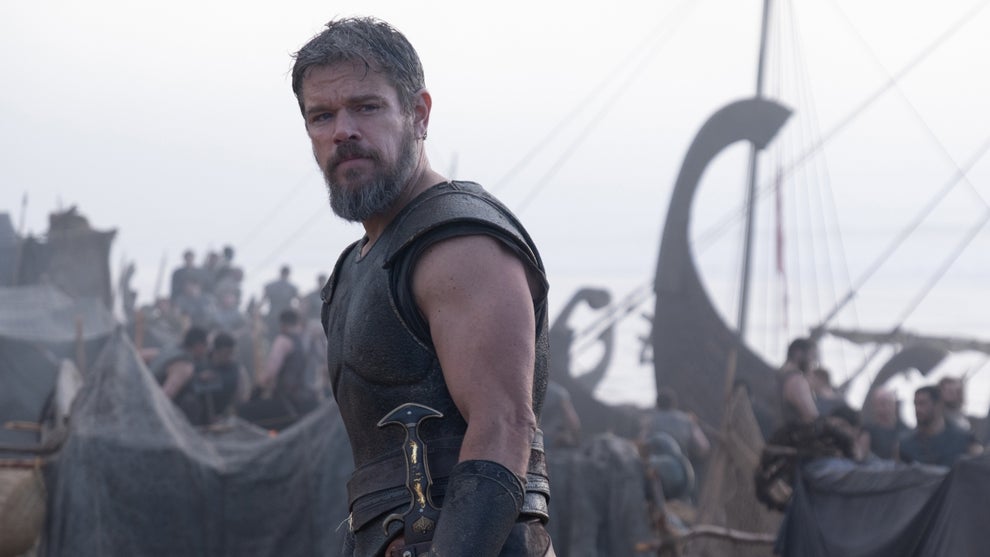
Christopher Nolan’s “The Odyssey” starts much like the Homeric epic on which it’s based, depicting a series of trials that befall Odysseus (Matt Damon) on his long journey back to Ithaca from the Trojan War. The film never sits too long with one adventure, quickly jumping from one epic sequence to the next.
Then it builds to one of the most thoughtful finales of Nolan’s career.
Nolan does a bit of recontextualizing in the third act of his latest blockbuster, drawing in a wider history than is directly present in Homer’s text. It also addresses age-old scholarly debates surrounding the material in an emotional, thematically rich conclusion to the big-screen epic.
So how does “The Odyssey” end, and what does it all mean? Read on to find out.
Spoiler alert: We will be discussing both the centuries-old epic and Nolan’s adaptation. If you’re still waiting to get the good seats, bookmark this page and circle back.

How does “The Odyssey” end?
When Odysseus returns home to Ithaca after his grand odyssey (get it?), he disguises himself as a beggar to assess what’s become of his home. While there, he speaks with his wife, Penelope (Anne Hathaway), about what the men experienced in Troy (not sharing his identity even with her).
Recounting the Siege of Troy, Odysseus shares that the reason he may not have come home yet is that he was ashamed of what his men had done. Nolan then flashes back to the siege in a much different light than it was seen in before. While an earlier moment in the film depicted a tense action sequence in which Odysseus’ men sneak out of the Trojan Horse and open the gates, this later flashback shows the horrific effects of the men storming the city, destroying everything in sight.
As Odysseus puts it, the Trojan Horse — remembered in songs earlier in the film as a great and heroic trick that brought the Greeks victory — is a horrific violation of Zeus’ Law. Throughout the film, Odysseus’ family and allies cite Zeus’ Law as an imperative to be kind to strangers, to do what is right unto others in case they are gods in disguise.
Through his great trick, however, Odysseus violated Zeus’ Law forever, disguising death as a gift and shattering a sacred covenant. In a way, he fears he has broken society itself.
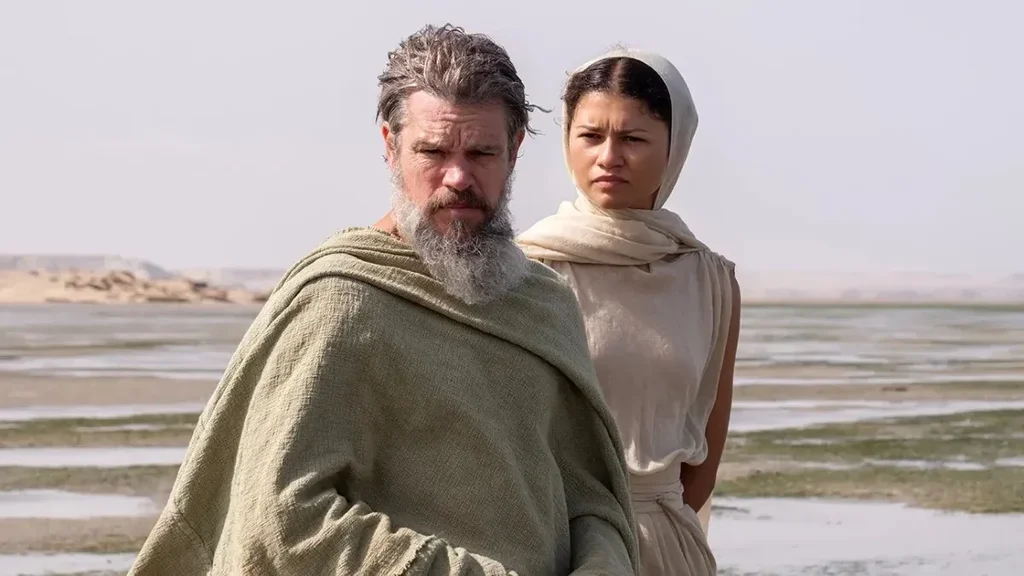
Who does Zendaya play in “The Odyssey”?
Prior to the release of the film, audiences only knew that Zendaya was playing Athena in “The Odyssey.” The goddess of wisdom plays a key role in the original text, helping both Odysseus and Telemachus in their shared quest to reunite their family and retake Ithaca’s throne.
In Nolan’s adaptation, however, Athena only appears to Odysseus, often standing silently near him throughout the epic journey. His recounting of the Siege of Troy to Penelope, however, further shrouds whether Athena actually presented herself to Odysseus at all or if she is purely a figment of his imagination. (While Calypso and Circe can be considered goddesses in Greek mythology, other figures like Zeus, Poseidon and Apollo never directly appear in Nolan’s film.)

The flashback depicts a moment in which Odysseus, amid the carnage, witnesses a young woman pleading for her life as she is dragged by Greek soldiers. This woman is also played by Zendaya. As the soldiers prepare to behead this woman, Odysseus looks away, instead witnessing a Greek chopping the head off of a sacred statue in Troy (presumably of Athena herself) and thus forever rendering the goddess, to him, in Zendaya’s image.
Athena’s presence takes on a new significance in the film, as Penelope asks Odysseus to wear a pin of the goddess on his person at all times when he’s away from home (allowing her to tell if people sharing stories of her husband actually saw him). The goddess thus becomes a symbol of Penelope to Odysseus, deepening his shame for her defilement and hesitance to come home.
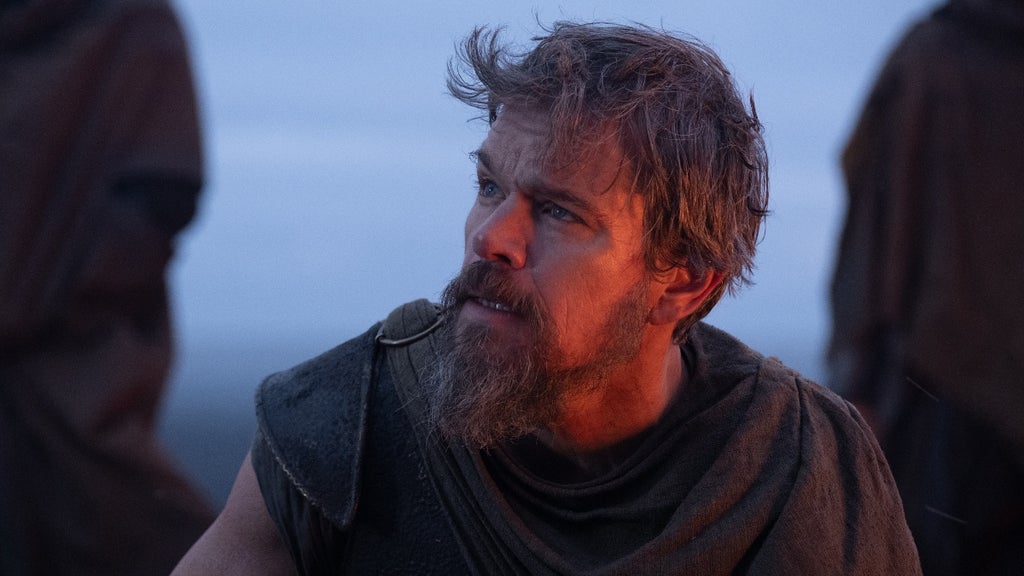
How does “The Odyssey” relate to “Oppenheimer”?
Early audiences have already noted how “The Odyssey” shares thematic ties to “Oppenheimer,” Nolan’s last film, which went on to win Best Picture and Best Director amid a slew of other Academy Awards.
Both films see their respective protagonists grapple in the third act with what they have wrought on civilization. While Cillian Murphy’s J. Robert Oppenheimer fears that the creation of the atomic bomb will lead to worldwide devastation, Odysseus reckons with the dissolve of society after he devised the ultimate betrayal of Zeus’ Law. The “People From the Sea” that everyone is fretting about throughout the film — marauders who pillage villages, disrespecting Zeus’ law — were in fact Odysseus and his men.
While “Oppenheimer” only imagines a world on fire, “The Odyssey” concludes with the knowledge that civilization is about to crumble. The story takes place near the collapse of the Bronze Age around the 12th century BCE, with Odysseus taking responsibility for his hand in that period of destruction. By declaring Odysseus’ men the “people from the sea,” Nolan makes a direct link between stories from Homer’s “Odyssey” and stories of Sea Peoples thought to have brought destruction to various shores at that time.
The film ends on a note both ominous and hopeful, with Odysseus and Penelope both sailing into exile after his attack on the gathered suitors of Ithaca. As they prepare to sail away, Odysseus shares that their stories — and “The Odyssey” — will only be told in song, as no one will be left to write them.
This connects to the loss of Grecian writing during the collapse of the Bronze Age, with the Greek alphabet only being adopted around 800 BCE, hundreds of years after this story took place. It was around that time that Homer’s “Odyssey” was first scribed.
Whether Homer was truly a single person who existed or not is a matter of much scholarly debate. But these final moments of “The Odyssey” acknowledge that stories like those of the Trojan War outlasted a societal collapse that took written language with it, surviving through oral retellings and song. This is also alluded to at the very beginning of the film, when Travis Scott’s Bard recounts a nobler version of the Trojan War and the story of Odysseus to those gathered at Ithaca in a song that’s more rose-colored than the tale Odysseus himself later tells.
In this sense, “The Odyssey’s” ending, while still sobering, has a bit more hope than the conclusion of “Oppenheimer.” Society may be on the verge of destruction, but humanity will survive the collapse — even if mistakes are doomed to be repeated later.
