
Note: This article contains spoilers from “The Odyssey.”
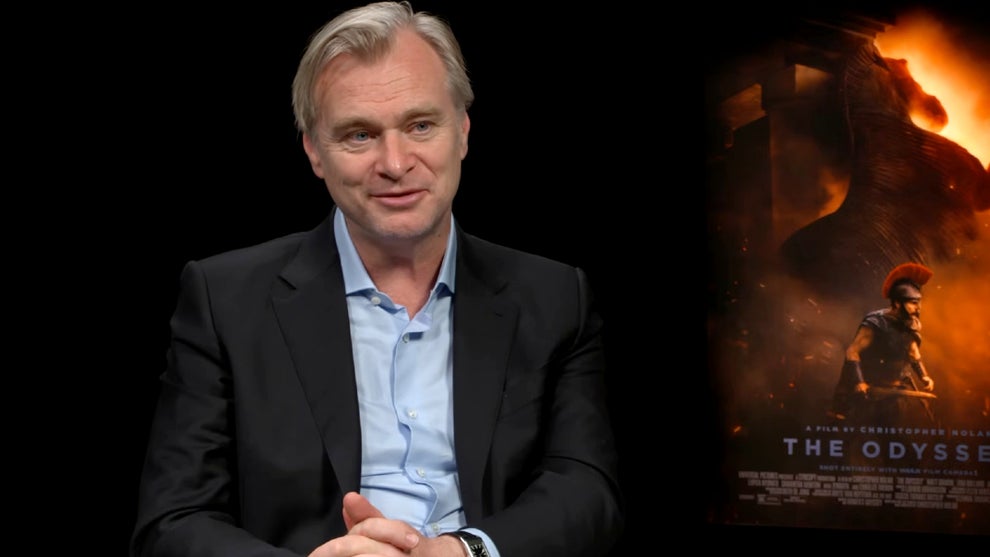
Christopher Nolan realized in the middle of a recent interview that the ending of his latest film, “The Odyssey,” unintentionally mirrors one of the most iconic endings in movie history, joking, “You gotta aim high, I suppose.”
During a wide-ranging interview with “Happy Sad Confused” podcast host Josh Horowitz shared online Thursday, Nolan was asked if there are any films whose endings, in particular, he loves and holds in high regard. In response, Nolan shouted out the haunting conclusion of director Orson Welles’ 1941 classic, “Citizen Kane.”
“Sadly, I think it’s hard to get beyond ‘Citizen Kane,’” Nolan said. “It’s the one that kind of hangs over all of us when we’re writing. To bring it home in the way that Orson Welles and [screenwriter Herman] Mankiewicz did at the end of that. That’s pretty hard to compete with.”

While Horowitz attempted to pivot Nolan’s focus to another question, the Oscar-winning filmmaker ended up cutting the interviewer off moments later with a realization that had not occurred to him before. “I’m suddenly thinking about the ending of ‘Citizen Kane’ and the ending of ‘The Odyssey’ and realizing, realizing how I’m trying to … yeah, anyway,” Nolan said with a laugh.
When Horowitz joked that Nolan was “chasing” Welles’ iconic ending, the “Odyssey” director joked, “Exactly. You’re always chasing that, but you know, you gotta aim high, I suppose.” You can watch the moment in question and Nolan’s full conversation with Horowitz yourself in the video below.
There is a reason why Nolan hinted at a parallel between the ending of “Citizen Kane” and his conclusion to “The Odyssey.” Visually, both films essentially end on images of symbolic wooden objects burning. That image means something very different in Nolan’s take on “The Odyssey,” though, than it does in “Citizen Kane.”
In the latter, the final scene of the film sees the belongings of rich media baron Charles Foster Kane (played by Welles himself) being tossed into a furnace after his death. Among the discarded items is Rosebud, the sled that Kane used to ride when he was a young boy, long before his life was consumed by the greed, ambition and power that defined his adulthood.

“Rosebud” is Kane’s last uttered word before his death, and the final reveal of “Citizen Kane” is that its eponymous character was, in his final moments, grieving the loss of the innocent life he once knew. The image of Rosebud burning is, consequently, the final punctuation mark on that idea. It is the literal destruction of innocence, of uncomplicated joy.
In the final scene of “The Odyssey,” Nolan’s adaptation of the epic Ancient Greek poem by Homer, Odysseus (Matt Damon) is struck amidst the bloody, savage sacking of Troy by the image of the Trojan Horse burning. In voice-over dialogue spoken to his wife Penelope (Anne Hathaway), Odysseus suggests that he found hope in that image, that he realized even vessels for war and betrayal could be destroyed and left behind in favor of something better.
The Trojan Horse burning at the end of Nolan’s film carries, in other words, an inverse meaning to Rosebud burning at the end of “Citizen Kane.” While one represents the destruction of innocence, the other represents the destruction of darkness. It is a thematically rich parallel that cinephiles will no doubt get a kick out of, even if Nolan himself was seemingly unaware of it until recently.
