
If there’s one thing Christopher Nolan loves, it’s telling stories about emotionally unavailable men who lose themselves in their work and don’t have healthy relationships with women. That doesn’t describe all his movies, but it covers the lion’s share. “Interstellar” notwithstanding, Nolan’s films tend to be about detail-oriented professionals who lose track of their souls and may or may not find them again. When they do, it’s not always convincing, whether that’s intentional (“Inception”) or unintentional (“The Dark Knight Rises”).
It’s a big part of why “Oppenheimer” played like Nolan’s most significant film, for better or worse. It’s the movie where Nolan’s emotionally inscrutable protagonist not only let work destroy his relationships, but also arguably the world. In the end, Oppenheimer stands there, staring into infinity, unable to grasp the totality of his actions and wondering what the hell got into him.
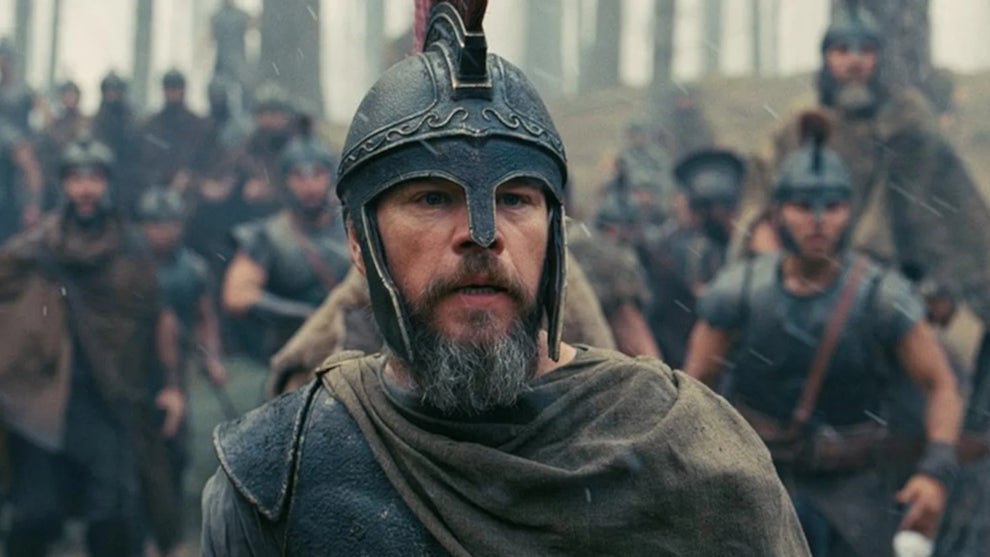
Three years later, we now know “Oppenheimer’s” ending wasn’t a question mark, it was a cliffhanger. Homer’s “The Odyssey” may have been written almost 3,000 years ago, but in Nolan’s hands, it’s the spiritual sequel to the invention of the atomic bomb. Odysseus, played by Matt Damon, doesn’t just fall into a series of misadventures as he returns home after sacking Troy. He endures a series of metaphysical nightmares that reflect his guilt, shame and hubris back at him. It’s not an epic sword-and-sandal action movie, it’s a mournful horror story on a scale Hollywood has never seen before. “Oppenheimer” may be Nolan’s defining movie, but “The Odyssey” is his best.

Odysseus leaves the burning wasteland that used to be Troy and embarks, with his men, into the wine-dark sea. He’s so ready to put the past behind him that he veers off, away from the rest of the fleet, willing to take a scenic route if it means never seeing that a-hole King Agamemnon again. It’s the first of many self-serving decisions that backfire and get Odysseus’ soldiers killed. They can’t even stop for supplies without getting trapped in a cave with a demigod cyclops, a vast unknowable creature that treats human beings like cattle, beneath its interest or scorn.
To the gods of “The Odyssey,” human beings aren’t worth much unless we poke them in the eye. Then we’re worth destroying. Odysseus isn’t content to escape the cyclops, he has to add insult to injury, pissing off the deities his men worship at every turn. Odysseus lost his faith in religion; his men are losing faith in him. Their journeys don’t converge, they repel each other, sending everyone into tragedy and supernatural violence.
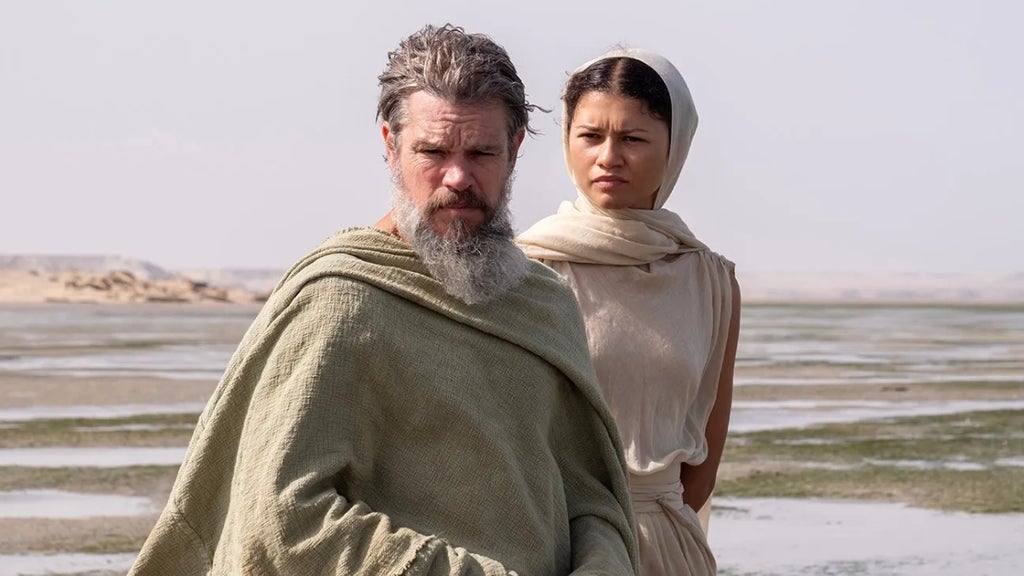
Meanwhile, Odysseus’ wife Penelope (Anne Hathaway) has been waiting at home for 20 years and he’s never met his fully grown son, Telemachus (Tom Holland). His throne is under constant siege, not from warriors, but from scheming creeps who descend on Penelope every night and try to convince her to marry them. She’s running out of excuses for leaving Ithaca without a king and Telemachus is such an innocent dweeb, if she crowned him king, he’d be assassinated. Probably immediately.
“The Odyssey” doesn’t have many women in it, and the ones we do see are typically victims, monsters, underwritten or all three. Unfortunately, Christopher Nolan’s protagonists aren’t the only ones who struggle to relate to women. I guess they learned it from watching him. At least the witch Circe, played by Samantha Morton, throws it back in his face. While she’s disgustingly mangling a face.
Anne Hathaway does her level best to convey Penelope’s depth, but the film too often treats her like an obstacle for villains to overcome and a prize for Odysseus to claim. A third act monologue lets her address the injustices she endures in a sexist culture — since she could simply be a queen, no marriage necessary — but it’s too little, too late, and it reads like a self-aware attempt to stave off inevitable criticism instead of a meaningful aspect of Nolan’s larger story. That’s why it’s worth criticizing anyway. (I said this was Nolan’s best film. I didn’t say there’s no room for improvement.)

It’s tempting to say this is Matt Damon’s movie, but Christopher Nolan is the star. He’s the one who gets to show off. Nolan’s filmmaking isn’t just big, it makes us feel small. Many fantasy films include larger than life creatures, but when Ray Harryhausen creates them there’s a sense of magic and wonder. Nolan’s creations are obscene. His “Odyssey” gives birth to gigantic leviathans and vast, hellish locales that chill like a mausoleum. Matt Damon is brought low by the gods — and in this film, Nolan is Zeus, hurling cinematic awe at us mere mortals like lightning bolts. Christopher Nolan won’t settle for being impressive. Not when terrifying is an option.
But even though Damon is technically second fiddle, casting him was still a stroke of genius. He may, at a glance, look out of place in this historical era, but that’s the point, isn’t it? He never gets to feel at home. He’s completely lost, in the world and in his heart. He can’t logic his way out of his torments, and he can’t even feel his way out until he comes to terms with his conscience. And that’s more difficult than fighting monsters.
For all its grandeur, for all its hideousness, for all its violence, Christopher Nolan’s “The Odyssey” is his most sensitive film. It’s a purely emotional journey, concerned almost entirely with the agonies of the human soul, not problem solving or plot. Watching “The Odyssey” is like watching Nolan try to cleanse himself, and his art, of the miserable questions about human nature and human suffering he raised in “Oppenheimer” but was unable — or unwilling — to discuss. This film wallows in its moral muck and pulls Odysseus and Nolan into it, coating their lungs in the mistakes they’ve made, daring both men to emerge with humility and wisdom.
“The Odyssey” is a personal studio blockbuster about self-loathing and shame. Watching a story this intimate and judgmental unfold on such titanic scale is a rare, almost perverse experience. You can’t say Hollywood doesn’t make them like this anymore. Nobody ever did.

The Best Movies of 2026 So Far