
Everyone loves the scene from David Fincher’s “The Social Network” where a woman tells future Facebook co-founder Mark Zuckerberg he’s an asshole. That’s because, in that moment, Aaron Sorkin’s Oscar-winning screenplay said what we all were thinking.
In the film’s final scene, another woman, who has some objective distance, tells Zuckerberg he’s not actually an asshole, he’s “just trying so hard to be.” Not as many people love that part. It’s probably because almost no one agrees with the conclusion Aaron Sorkin came to about Zuckerberg’s assholery. Academy Award or no Academy Award, the final line of that script sounds more gullible with every passing year.
“The Social Network” is, of course, still a classic. But it’s impossible to claim it tells the whole story of Mark Zuckerberg and the impact of Facebook, because nobody knew how much bigger — and how much worse — it was going to get. Sixteen years later, Sorkin finally returns with “The Social Reckoning,” a quasi-sequel about a corporate whistleblower and a Wall Street Journal reporter who blow the lid off of Zuckerberg’s corrupt decision to alter Facebook’s algorithm, which amplified false information, incentivized rage bait and inflicted serious psychological harm on its users, all for the sake of “engagement.”
Sorkin, who also directs, frames “The Social Reckoning” as an investigative thriller like “All the President’s Men” and “Spotlight.” Except “All the President’s Men” and “Spotlight” were complex, in-depth dramas about the journalistic process, and “The Social Reckoning” is a generic potboiler with highfalutin dialogue. The film technically conveys the information Sorkin needs to tell his story, but his story is an exercise in dry data analysis and heavy-handed banter, leading up to a historical tragedy Sorkin isn’t brave enough to dramatize with any meaningful context. A bad thing happened once, it was Mark Zuckerberg’s fault, and it doesn’t matter who the president was. Apparently.

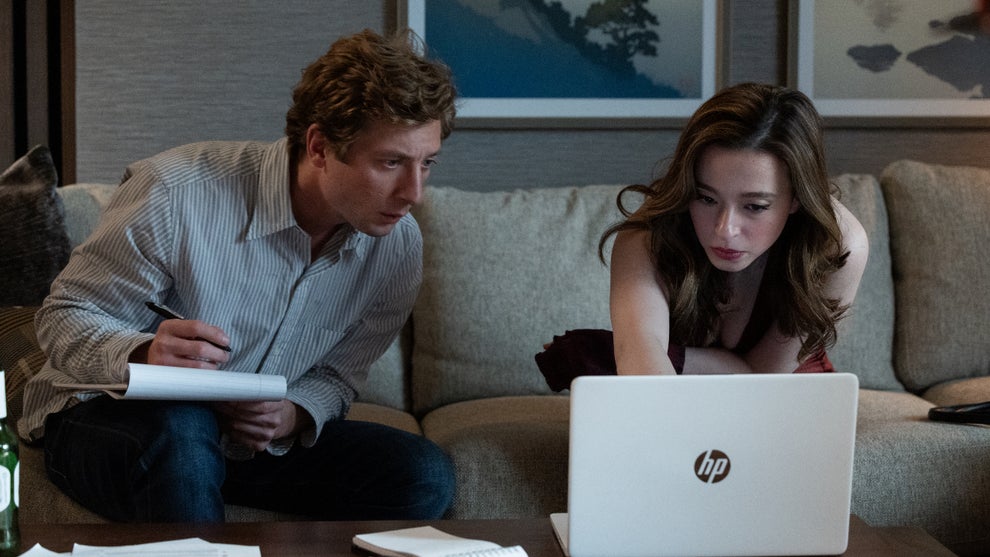
Mikey Madison (“Anora”) stars as Frances Haugen, a Facebook employee who believes social media has the power to unite us. Or, at least, she did. Now, she suspects something is horribly wrong at her company. When she’s approached by Wall Street Journal reporter Josh Horwitz (Jeremy Allen White) — a Luddite who needs everything about the Internet explained to him, because Sorkin isn’t convinced the audience can follow along — Haugen points him in the direction of evidence that will expose the corporation’s shockingly unethical practices.
Unfortunately, Haugen doesn’t actually give him that evidence, so Horwitz has to meet her multiple times and needle it out of her. This gives the two stars time to bicker, but also gives Sorkin an excuse to dress Madison in slinky dresses, because Haugen thinks if she looks like she’s on a hot date it won’t raise suspicions about where she goes every night. Sorkin also, repeatedly, lets the camera linger on her ankle- and wrist-warmers, which weirdly evokes Adrian Lyne’s fetishistic “Flashdance.” Haugen wears these warmers because she has celiac disease and her joints are always cold, but we don’t learn that until long after Sorkin’s many cutaways make everyone a little uncomfortable.
Sorkin struggles to write women convincingly, which is one of the reasons “The Social Network” worked as well as it did; there weren’t many women to write for and the men were mostly sexist pigs already. All he can think to do with Haugen in “The Social Reckoning” is give her repetitive speeches about how great Facebook is, and watch her bristle whenever a man says something that sounds smart. When Haugen accuses Horwitz of mansplaining, he says that’s just something women say when they’re losing an argument, a line Sorkin presents as a sick burn instead of an indictment of Horwitz’s personal character. (Misogyny! Isn’t it hilarious?)
While Haugen and Horwitz develop the story, Sorkin repeatedly flashes forward to January 6, 2021, the day Donald Trump inspired a violent insurrection in the nation’s capital that resulted in multiple deaths. It’s also the day Mark Zuckerberg (Jeremy Strong) was preparing for a senate hearing about Facebook’s role in election misinformation. Apparently, it was also the day he incessantly argued about free speech with a former associate, played by Bill Burr. Their scenes are supposed to be intense, but Sorkin is just spinning his intellectual wheels, debating back and forth with himself while pretending — unconvincingly — the victor wasn’t predetermined by 20/20 hindsight.

Strong’s impersonation of Mark Zuckerberg is hamstrung by Sorkin’s screenplay, which makes the billionaire act and sound like a dweeby Lex Luthor. Zuckerberg represents corporate malfeasance, and serves no other function except to articulate obviously wrong ideas about the responsibility he wields — or, more accurately, refuses to wield — as the owner of what he calls the public square. Strong’s performance is blunt and numbing, but it wears us down until it finally seems acceptable. It’s a war of attrition and the audience loses.
We could talk about “The Social Reckoning’s” comfortable, brisk pacing and its occasionally memorable Sorkin-esque zingers. But the flaws are more fascinating. Consider Jeff Cronenweth’s oddly underwhelming cinematography. He’s the same artist who brought Fincher’s “Social Network” to chilling, complicated life, but even though Sorkin is a very different filmmaker and “The Social Reckoning” a very different story, the new aesthetic can only be described as “above average primetime network television.” It’s clear and efficient, not interesting or beautiful.
By the time “The Social Reckoning” reaches its inevitable conclusion, we’re forced to wonder if Aaron Sorkin knows what the word “reckoning” means. His screenplay name-checks Frank Capra, alluding to “Mr. Smith Goes to Washington” and “It’s a Wonderful Life” — while making an unconvincing case that “Lost Horizon” hasn’t aged badly — but those underdog stories end with the accounts all settled: the good guys win and the villains are foiled. It’s hard to claim Mark Zuckerberg ever got what was coming to him, unless you count the humiliation of changing his company’s name, wasting billions on a VR network nobody wanted and going all-in on a product the world accurately calls “pervert glasses.”
But he’s still a billionaire. The misinformation on his social media platforms still does serious damage. Heck, there’s a really good chance you’re only reading this review because you saw a link on one of Zuckerberg’s sites. That’s not what a reckoning is. Maybe the title is supposed to be ironic, but Sorkin’s film is too hopeful to make that point. “The Social Reckoning” argues that print journalism still matters, the truth has as big an impact as shameless lies and proving Mark Zuckerberg is a hypocrite is the same as taking him down. Sigh. It must be nice in Aaron Sorkin’s world. If only the rest of us lived there.
“The Social Reckoning” opens exclusively in theaters on Oct. 9.
