
When you’re watching a horror movie there’s often a moment where the protagonist, or their horny friend, or their wacky comic relief, does something they don’t know will kill them. It’s at this point when you, or somebody else in the audience, may feel compelled to offer your two cents. “Don’t go in there!” is a good piece of advice but shouting it at the screen rarely, in my experience, affects the on-screen character’s decisions. We know better than they do but in their defense they don’t know they’re in a horror movie. To their way of thinking, walking into the creepy old house with a cannibal in the basement seems like the right thing to do.
Joe Swanberg’s “The Sun Never Sets” isn’t a horror movie. It’s an observant, semi-romantic drama about a love triangle in Anchorage, Alaska. Nobody dies, but their relationship might. Nobody’s wounded except for their feelings. And yet, while watching “The Sun Never Sets,” I experienced the same wincing, protective feelings some folks have while watching the scariest scary movie. If any of these people had talked to me, or anyone else who had already been around the block a few times, a lot of pain and suffering could have been avoided. But they don’t know they’re making bad decisions yet. Nobody gains wisdom until after they needed it.
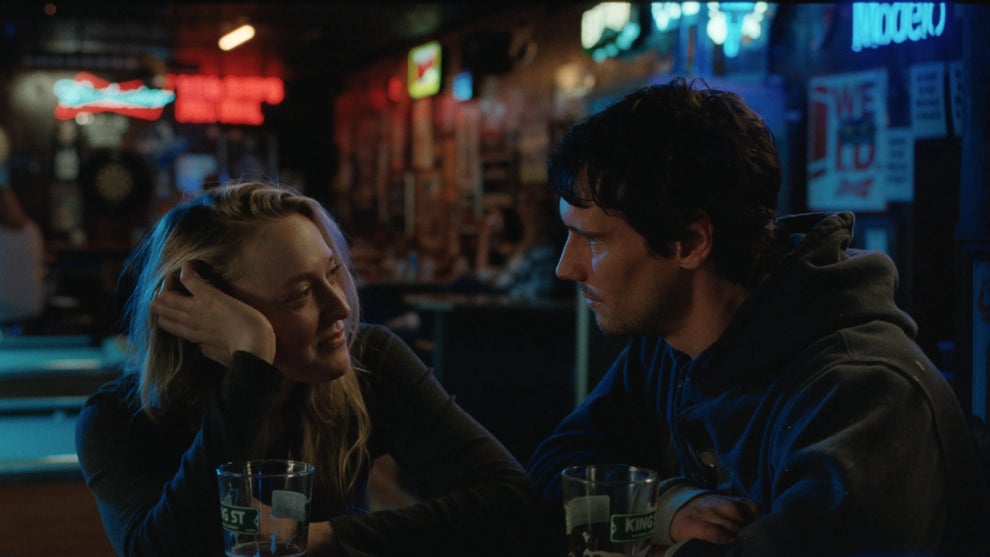
Dakota Fanning stars as Wendy, a construction worker who’s in her thirties and starting to question what she wants from her life and relationships. Her friends are either mothers or pregnant, and while Wendy always wanted kids, she’s in a long-term relationship with an older, divorced father who doesn’t want to have more children. They love each other, but they’re at an impasse. So Jack, played by Jake Johnson, makes a really foolish decision that he thinks is wise.
Jack’s plan is to break up, but only for the summer. Jack promises he won’t date anyone, and he means it, but Wendy can explore any relationship or any life choices she wants. He says this is the best thing for her, so she can decide if she’s comfortable in their relationship or needs something else in her life. He is incredibly insistent. He doesn’t take no for an answer. And that’s a very lousy quality for a romantic partner to have.

We quickly learn Jack’s motives are selfish. He doesn’t want Wendy to stray so he can also sow his own wild oats. He’s not that bad. He just thinks she won’t find anyone better in Anchorage, Alaska. And it looks like he has a point until Wendy runs into her ex-boyfriend Chuck, played by Cory Michael Smith, and immediately starts sleeping with him. She’s free to process her feelings and explore a relationship with an old flame who seems to have changed for the better, while Jack immediately realizes he screwed up and tries to call the whole thing off.
It’s hard to write smart characters who make bad choices. I would say Swanberg, who wrote and directed the film, has it down to a science, but I don’t know. It’s easy to imagine the filmmaker agonizing over his poor characters and their mistakes. That is, after all, what his movie is about. It’s a down-to-earth film about realizing you did something wrong, but you’re not sure exactly how, or whether you did it for the right reasons. Nobody in “The Sun Never Sets” is able to have a romantic relationship without wallowing in their mistakes and repeatedly waffling over how to handle them. Characters confess their love one minute and return to other lovers the next. In simpler, more comforting films we might be able to judge them, but Swanberg makes their foibles too understandable for that.
Fanning and Johnson struggle outwardly, following their compulsions and falling into their own emotional slop over and over. Smith plays a more laconic character, a guy who never puts anything on the line. It’s possible he’s a great guy who simply isn’t comfortable sharing his insecurities with others. It’s also possible that those insecurities undermine his finer qualities and make him kind of an ass, at least after the initial swooning period is over. Maybe he’s not ready for the serious relationship he says he wants. Maybe he is ready, but dating somebody who is technically only on a break from her ex, and who occasionally has huge, emotional reunions with him before they sleep together, is shaking his confidence.
It’s easy to get sucked into the foibles of these flawed individuals, because Fanning is an incredibly soulful performer, Johnson flails like nobody’s business, and Smith can make quiet brooding look loud. “The Sun Also Sets” assembles a practically perfect cast for a narrative which, by design, is deeply flawed. Meanwhile, cinematographer Eon Mora shoots urban Alaska like a crisp, colorful romantic backdrop for messy, struggling relationships. Mora doesn’t make Anchorage so beautiful that it heightens the romance, or that it strikes a jarring contrast between the lovely setting and the personal misery. It’s just a helpful, constant reminder that people are people wherever they are.
“The Sun Never Sets” goes through a lot of familiar relationship movie rhythms but it hits none of the false, contrived notes we often associate with love triangle cinema. It’s written, directed and performed with gentle understanding and impressive patience, an innate understanding that all these screw-ups will get people where they’re going, whether it’s what they originally wanted or not. In the end, we take comfort in films like this, even though, throughout the film, we find ourselves desperately wishing these endearing folks would pick up the phone and call us for advice. Stop dating emotionally unavailable and/or manipulative men, Wendy! You can do better. Yes, even in Anchorage.