
When serial killer Jeffrey Dahmer was in high school he talked his way into a personal tour of the White House for classmates, where he met vice president Walter Mondale. Before cult leader Charles Manson orchestrated nine monstrous murders he was a songwriter who wrote “Cease to Exist,” which was recorded by The Beach Boys under the name “Never Learn Not to Love.”
Yes, it turns out many of history’s greatest monsters had fascinating interactions with other, noteworthy people. I’m sure future generations will have a hard time believing Donald Trump was in “Home Alone 2,” “The Little Rascals” and Woody Allen’s “Celebrity” — then again, current generations already do.
And since everyone loves a biopic, it makes sense that enterprising filmmakers would want to highlight these unusual anecdotes. You can find the Walter Mondale incident in Marc Meyers’ 2017 film “My Friend Dahmer,” the Charles Manson/Beach Boys thing was in a 1990 TV movie called “Summer Dreams,” and I suppose it’s only a matter of time before someone makes a biopic about how every horrible thing Trump ever did somehow connects back to his Razzie Award-winning performance in the supernatural sex comedy “Ghosts Can’t Do It.”
Netflix’s new thriller “Unabomber” tells the story about Ted Kaczynski, who mailed explosives to people all over the country, killing three and injuring nearly two dozen more between 1978 and 1995. He was the target of a nationwide manhunt which only ended after his own brother contacted the FBI with his suspicions. It was a somewhat anticlimactic finale to Kaczynksi’s reign of terror, so the makers of “Unabomber” found a way to pad it out.

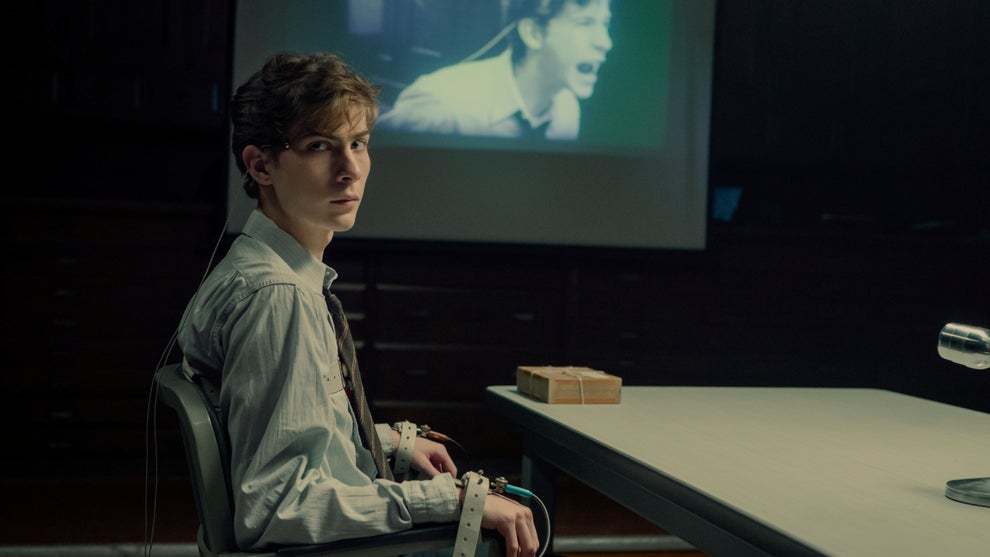
Half of “Unabomber” takes place in the mid-1990s, where FBI Agent Joanne Miller (Shailene Woodley) investigates a lead that practically falls into her help. The other half takes place over 30 years earlier, when a young Ted Kaczynski (Jacob Tremblay) took part in a psychological experiment under Harvard psychology professor Henry Murray (Russell Crowe), who developed a once-noteworthy theory about human personality named, not very cleverly, “Personology.”
Henry Murray is no Beach Boys and he’s no Macaulay Culkin, either. Heck, he isn’t even Walter Mondale. But “Unabomber” makes a big deal out of this trivia, so we watch as Murray psychologically tortures young Kaczynski in the name of science, over and over. “Unabomber” director Janus Metz Pedersen tries to make the case that this domestic terrorist’s murder spree began while sitting across a desk from Henry Murray, but the connection is tenuous. No matter how hard Pedersen pushes in the film’s final moments — and he pushes too hard — half of “Unabomber” always plays like a Wikipedia footnote in dire need of trimming.
Tremblay stands out as Kaczynski, effectively conveying the murderer’s intelligence, insecurity and estrangement. It’s thanks to him that we’re swept up, however briefly, in the idea that Kaczynski’s crimes might have been avoidable. Meanwhile, Crowe treats “Unabomber” like a companion piece to last year’s “Nuremberg,” the film where he played Nazi war criminal Hermann Göring, who was psychoanalyzed while awaiting trial for his crimes against humanity. Crowe seems to enjoy playing smug manipulators and he’s rather good at it.

The other half of “Unabomber” finds Woodley stranded in a screenplay that doesn’t know what to do with her. The film draws obvious parallels between Agent Miller and young Kaczynski, presenting them both as underestimated geniuses who resent their foolish superiors. When Kaczynski shouts at his father, degrading him at the dinner table for acting like he’s smarter than him, it plays a lot like Miller’s many meetings with her supervisors, who can never admit they’re wrong. Eventually both Kaczynski and Miller have to break the rules to achieve their goals.
The film’s biggest problem? These intangible connections don’t mean much. Kaczynski stands up for himself and becomes a terrorist. Miller never does, but she catches the Unabomber so I guess the message is we should suffer fools gladly. That’s a hard sell. Maybe the point is so-called “experts” should listen to precocious youths, although one of those youths did become the Unabomber, so that doesn’t track either. There’s a difference between noticing a parallel and following it, and “Unabomber” never gets around to the second part.
Is “Unabomber” a true crime thriller? A psychological profile? A supervillain origin story? It never decides. What it does best is oversell an anecdote that amounts to almost nothing, while underselling a manhunt that defies narrative convention, which was already hard to make exciting. Two underwhelming halves that don’t add up. Some of the actors work overtime to eke drama out of this material, and composer Marco Beltrami gives 110%, with a memorable and intense score that almost disguises the film’s mediocrities. But in the end there’s no other way to put it: “Unabomber” is a dud.