
“You know my motto: Work hard and never have fun.”
Amy Poehler has built a career on finding the remarkable in ostensibly ordinary people and places. After introducing viewers to the bureaucratic absurdities of Pawnee, Indiana in “Parks and Recreation,” the comedian has reliably demonstrated an ability to make even the most unconventional workplace feel like home. With Peacock’s new comedy “Dig,” Poehler returns to that familiar territory, trading local government for an archaeological excavation in Greece.
The results are predictably charming with a hint of familiarity.

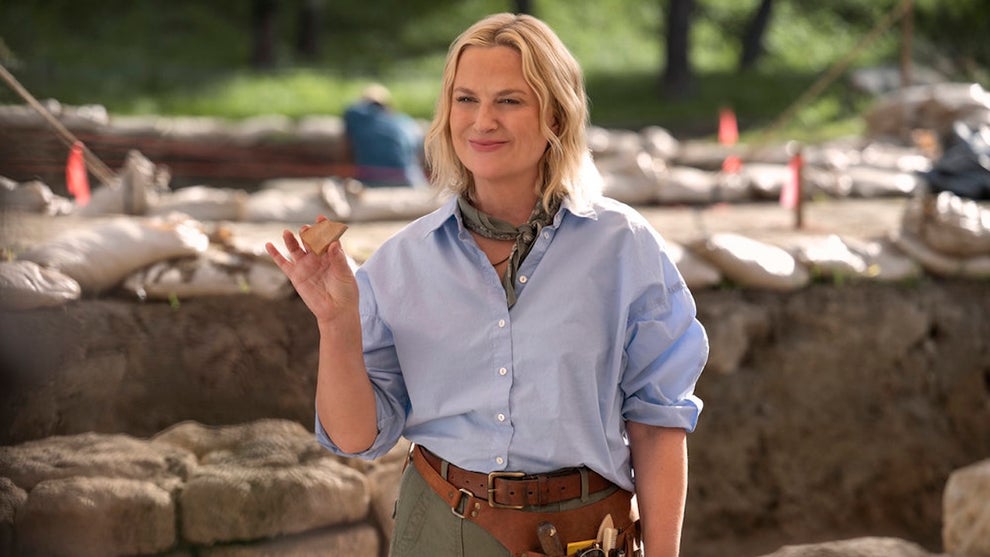
Poehler stars as Elise, an American archaeologist preparing to take over a working excavation site from her mentor, Neville Wycom (Hugh Laurie), an aging professor long overdue for retirement. Neville is reluctant to relinquish his responsibilities, even as his increasingly outdated style of leadership becomes apparent to the younger team members (lovingly referred to as “Ugs”) working beneath him. Elise arrives with an opportunity to establish herself as the next generation of leadership, bringing a new outlook to a profession often more concerned with preserving the past than adopting the future.
The setting is an ancient coastal village in Greece dating back to 12th century BC, where a scrappy group of archaeologists spends their days digging through centuries of history, dodging stray dogs, and hoping to uncover something more exciting than the usual Nazi-era artifacts. Their collective ambition is to make a once-in-a-generation discovery, though their day-to-day work is often far less glamorous. As the series reminds viewers, archaeology isn’t simply about finding old things … It’s about understanding who we are and the stories that connect us.
A shared, complicated history surrounds the many people working at the excavation site, chiefly led by Dylan (Geraldine Viswanathan), an old colleague who disappeared from Elise’s professional life five years earlier. The two were once supposed to begin an excavation together, but Dylan’s abrupt exit left unfinished business between them. Their reunion is further complicated by Dylan’s ex-boyfriend, now engaged to head preservationist Clare (Antonia Thomas), as well as Elise’s affair with the city’s Mayor (an always enjoyable Kayvan Novak).
Naturally, professional boundaries and personal feelings become increasingly difficult to separate.

Based on the novel “Excavations” by Kate Myers, “Dig” finds much of its comedic strength in its ensemble, particularly the wonderfully eccentric personalities populating the excavation site. The professor’s new assistant, Patty (Fina Strazza), is an immediate standout, an affable, wonderfully peculiar character whose allergies to olive trees, olive oil and cheese make her decision to spend a summer working in Greece all the more inexplicable. She’s precisely the sort of character who could become an irritating caricature in a lesser comedy, but the show’s good-natured sensibility makes her an endearing addition.
The mystery at the center of the series begins when Elise and Dylan stumble upon an object unusual in an old trench from a 2014 excavation. What initially seems like an ordinary archaeological find quickly becomes something much more intriguing: a mysterious statue they nickname “Pretty Woman.” The pair agree to keep the discovery secret until they can determine exactly what they’ve uncovered, setting off a chain of increasingly complicated efforts to protect their find from Neville and the rest of the male-dominated excavation team.
Keeping a secret among archaeologists, it turns out, can be considerably harder than digging one up.

Poehler is comfortably in her element, presenting Elise with an appealing mixture of confidence, interest and vulnerability. There’s even something reminiscent of Laura Dern’s adventurous Dr. Ellie Sattler in “Jurassic Park” about her appearance and demeanor, which feels particularly appropriate given the series’ archaeological setting. She has the authority to command a room without losing the amiable, slightly goofy attributes that have made her such an appealing comedic presence.
The series also benefits from a storytelling structure that uses flashbacks to add context for its characters and their mutual histories. Much like fellow co-creator Michael Schur’s “The Good Place,” these glimpses into the past flesh out the ensemble without relying on complicated mythology or exhaustive explanations of the unusual profession. The result is a workplace comedy that makes archaeology accessible without requiring viewers to have an advanced degree in ancient civilizations.
“Dig” is sweet, well-natured, and deliberately low-stakes, rarely letting its central mystery generate the kind of tension that might elevate the material beyond pleasant escapism. Its romantic involvements, professional rivalries and questions of female leadership are all familiar television territory. Even its most intriguing discovery appears less like a world-changing revelation and more like another opportunity for the ensemble to get into amusing trouble.

Something is refreshing about a comedy that doesn’t feel compelled to raise the stakes constantly, as Poehler’s reunion with the creative sensibilities behind “Parks and Recreation” brings back the same affection for oddball communities and unlikely relationships that made that series so enduring. Here, the bureaucratic headaches of local government have been replaced by archaeological red tape, romantic complications, and the intermittent existential question of humanity’s relationship with its past. The dialogue is a little more colorful (thanks to its position on a premium streamer), the setting is considerably more picturesque, and the characters are just as lovable.
For all its talk of major discoveries, “Dig” ultimately understands that the most rewarding finds aren’t necessarily hidden below centuries of sediment.
“Dig” premieres Monday, Nov. 23 on Peacock.