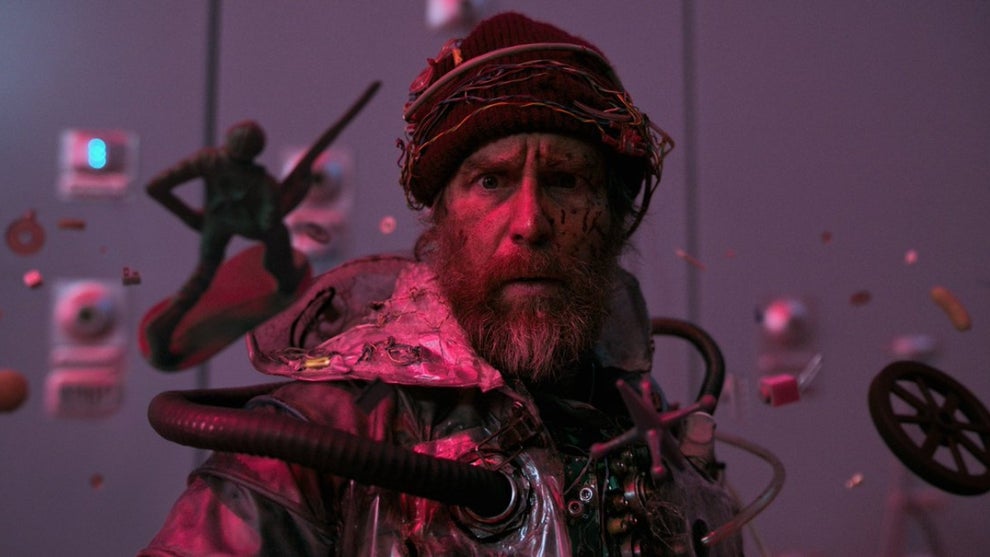
There was a brief window when Gore Verbinski’s success with the first three “Pirates of the Caribbean” movies felt like the inmate had taken control of the asylum. Within the bounds of Disney, perhaps the safest and most staid studio, he cranked out a bonkers adaptation of a theme park ride, replete with ideas and visuals designed to both tickle and bewilder his audience. While it’s been seven years since Verbinski last graced screens with the creepy, unnerving “A Cure for Wellness,” he’s lost none of his bite and sinks his teeth into “Good Luck, Have Fun, Don’t Die.”
Working from a script by Matthew Robinson, the dark comedy, like other Verbinski works, feels like it’s bursting at the seams and threatening to collapse under its big ideas. And yet the threat of combustion, along with a terrific performance from Sam Rockwell, helps provide the film with its off-kilter energy that will keep you hooked until you’re exhausted.
A “Man From the Future” (Rockwell) arrives in a diner and tells the assembled patrons that he needs to assemble a team of seven to save the world. If anyone tries to stop him, he’ll detonate a bomb strapped to his body, and while he may be crazy, he may also be telling the truth given how much he knows about the diner’s patrons. He puts together a team including a couple of high school teachers (Michael Peña and Zazie Beetz), a grieving mother (Juno Temple) and a depressed woman in a princess costume (Haley Lu Richardson) along with a few others to survive the night and stop a 9-year-old boy from creating a world-destroying A.I. in his bedroom.
I can’t understate how essential Rockwell is to the film’s success. You need not only an actor with his charisma, but the lunatic intensity he knows how to bring to a performance. His unnamed future man has to read as unhinged but also winning, and it’s a combination Rockwell has pulled off time and again with his turns in “Confessions of a Dangerous Mind,” “Seven Psychopaths” and “Hitchhiker’s Guide to the Galaxy” just to name a few. No one does alluring brokenness quite like him, and watching Rockwell shimmy between insulting others and relying on them for help is a high-wire act that few actors could walk let alone dance on like he does here.

That burst of energy at the outset helps set the tone for the whole movie because it’s a lot of information — not all of it feels trustworthy, and it throws the viewer off balance. That’s how “Good Luck” proceeds until it lands on its sub-structure, which is to provide backstories for its primary supporting characters, and this is where you can almost feel like the movie becoming too much. While each story is meant to further illustrate the rise of A.I. on pulling the world apart, the concepts are individually so rich — especially in Temple’s story — that it almost feels too big to contain to expository flashback. The film wants to tackle so many of our current ills ranging from obsession with our phones to our callousness towards school shootings that it never feels like it’s fully addressing one idea to its full extent as much as it seeks to reflect the anxiety and burnout of our current moment.
Some of these observations feel worn and banal, like the adults who are freaked out by mean teenagers who are always on their phones. But others feel poignant, like the story of losing a loved one to an online world where they feel more at home and comfortable than they ever did in reality. And the plot involving Temple’s character feels like it could have been its own movie, or at least its own episode of “Black Mirror.” But they exist as these vignettes that both separate us from the main action before we whipsaw back to The Man From the Future leading this group through darkened streets and increasingly unusual and violent obstacles. This means the film vacillates through moments of poignancy and moments of comedy so dark you can understand why larger studios may have stayed away despite Verbinski’s pedigree.
And yet for those like me who enjoy seeing the director continue to take big swings that may not always connect, “Good Luck, Have Fun, Don’t Die” is a welcome return to his aggressively outsized filmmaking where he continues to craft big, memorable images despite working with far smaller budgets than he had on “Pirates.”
Not everything in the movie works, and yet that ramshackle attitude only adds to the film’s appeal. In lesser hands, it would read like just another lamentation of tech leeching away our shared humanity. But through Verbinski and Rockwell, “Good Luck, Have Fun, Don’t Die” remains a frequent blast that will leave you dizzy and with a slight headache.
