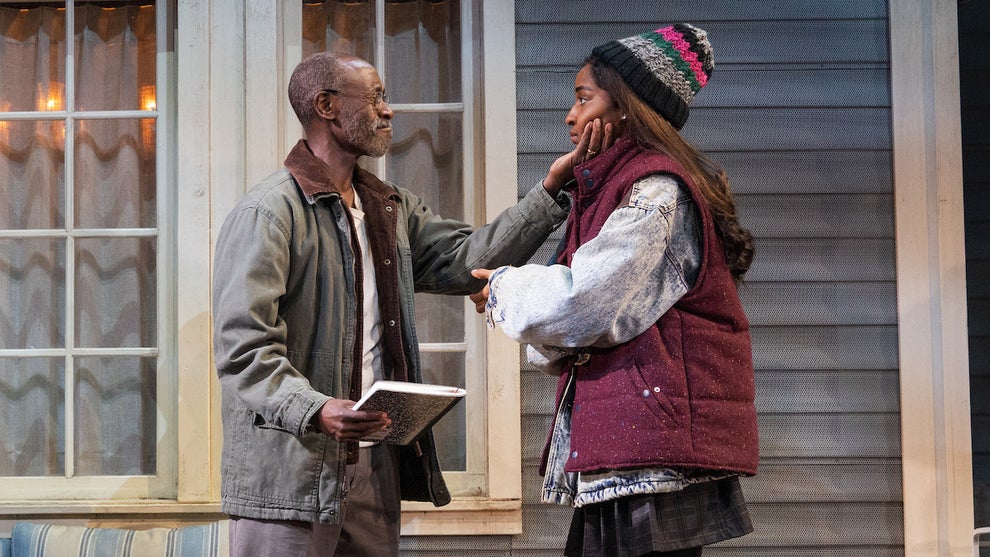
Michelle and Barack Obama are one of the producer teams for the new revival of David Auburn’s 2000 Pulitzer Prize-winning play, “Proof,” which opened Thursday at the Booth Theatre. They make that theater debut through their producing entity, Higher Ground.
Why “Proof” for the Obamas’ first theatrical venture?
“Proof” was initially staged with an all-white cast. In its first Broadway revival, the play now features a cast of color on stage. The show’s director, Thomas Kail, gave the world “Hamilton,” the musical most associated with the Obama administration, almost as much as “Camelot” has come to represent JFK’s.
Beyond the obvious cast difference, Kail hasn’t strayed much from Daniel Sullivan’s original direction. Even the house set now designed by Teresa L. Williams recalls John Lee Beatty’s original scenic design. Unlike Sullivan, Kail does not bring the ghost of a father back at the end of Act 1 to punctuate the play’s shocking revelation. There’s also not much of a jolt when this daughter reveals in Act 2 that her math-genius father has produced nothing of significance in his final years. Rather, his latest proof is absolute gibberish.
Playing that father, who is sometimes alive and sometimes a ghost, Don Cheadle brings a tantalizing edge of competition to each conversation he has with his daughter Catherine (Ayo Edebiri), who is also a gifted mathematician. Cheadle makes an impressive Broadway debut.

Playing that other daughter, Kara Young manages to show yet another facet to an awesome talent that has already brought her two Tonys, as well as much acclaim off Broadway. Her repertoire of both wacky and down-to-earth ingénue characters runs the gamut. In “Proof,” she shows for the first time her Grande Dame chops as the East Side matron Clare, who is out to save her younger sister from poverty, madness and a closet full of clothes from H&M.
Playing Catherine’s new boyfriend, Jin Ha has come a long ways from his 2017 Broadway debut as the transgender character Song Liling in “M. Butterfly.” Ha keeps us guessing what his character is really after: Catherine or Daddy’s lost proofs.
Auburn constructs the first act of “Proof” as a series of two-hander encounters, and in scene after scene, Cheadle or Young or Ha take focus and rivet our attention. Catherine, after all, is the reactive one. She’s depressed after caring for her dementia-suffering father for years. She’s glum, having given up her own studies to be a great mathematician. She’s moody, wallowing in cheap champagne and bad fast food. What Edebiri’s Catherine is not is compelling.
I had not realized the incredible challenge this role presents after having seen Mary-Louise Parker in the original production and then her Broadway replacements, Anne Heche and Jennifer Jason Leigh. Somehow they all turned reactive into engrossing.
Edebiri won an Emmy playing a depressive character on “The Bear,” but there, it’s a supporting character and it’s television. On stage, in her Broadway debut, Edebiri leaves it to the other actors to carry the drama. That’s not a great choice, but it makes for an effective first act, because the other actors are so good.
In the second act, Catherine becomes fully alive. She takes control of her life, and in facing that character’s struggles head-on, Edebiri has to deliver a more vivid performance. Instead, she retreats to mannerisms, delivering facial tics and verbal hesitations. There’s a big hole in the middle of this “Proof.”
