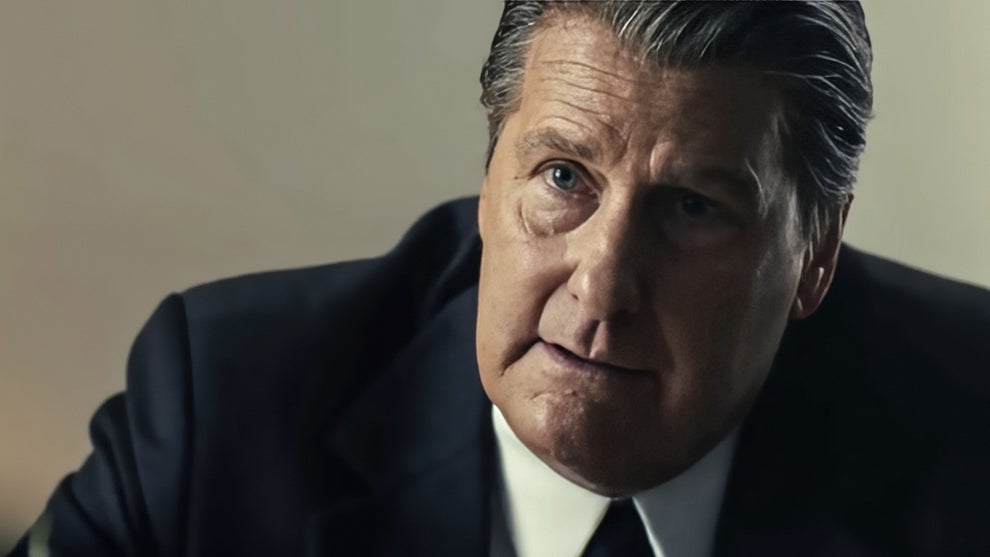
Written and directed by Michael Russell Gunn (“Designated Survivor,” “Billions”), “The Brink of War” tells a story less powerful because of its subject matter than the deeper truths — sociopolitical, but more importantly, humanistic — that it illustrates. Jeff Daniels stars as Ronald Reagan opposite Jared Harris as Mikhail Gorbachev in a dramatization of the Reykjavik Summit of 1986, where the world’s greatest superpowers first began to initiate the end of the Cold War. While the two actors make a meal out of the historic clash between the two leaders, Gunn’s lacking aptitude as a first-time feature director limits the drama that can be wrung out of two men — even these two men — bickering in a room with one another over the fate of humanity.
The film opens as Reagan frets to Secretary of State George Shultz (J.K. Simmons) that he has “failed,” after being unable to come to an accord with Gorbachev over the de-escalation of the Cold War. Seventy-two hours earlier, the world leaders had met at Gorbachev’s request and discussed winding down the nuclear arms race between the United States and the Soviet Union that, at that point, had resulted in a reported 70,000 missiles pointed at each other and world populations poised with dread. Reagan’s plan is to provoke Soviet leadership by preempting the main topic of conversation, instead leading with a request that Gorbachev allow the sister of famed classical musician and conductor Mstislav Rostropovich, who defected from Russia in the 1970s, to visit the U.S. for his own birthday. Reagan’s power play gets quickly undercut after Gorbachev proposes a shocking and unexpected reduction in arms — to 50 percent of the current numbers.
Quoting a Russian proverb doveryai, no proveryai — “trust, but verify” — Reagan embraces the proposal, and encourages both countries go even further with a “double-zero” plan, which would result in total nuclear disarmament over a ten-year period. But when Gorbachev questions the need for the U.S.’s in-development space militarization Strategic Defense Initiative, tempers flare and talks stall. In the meantime, Gorbachev’s wife Raisa (Branka Katić) uses the summit to generate good PR, staging a series of frivolous photo opportunities in Reykjavik for a group of international reporters (Aya Cash, Guy Burnet). Meanwhile, the First Lady (Hope Davis) remains back in the U.S., trying to quell mounting criticism for not joining her husband abroad.
In the context of moviegoing, 40 years doesn’t seem like that much time; but in the firehose of history, it’s practically an eternity. There have been multiple generations of audiences who now barely know what the Cold War was, much less felt its oppressive effects. As with Anthony Maras’ D-Day drama “Pressure,” released earlier this summer, our collective cultural amnesia over the events in “The Brink of War” practically makes the film an historical document. Also like “Pressure,” it chronicles granular or, less generously, not always especially thrilling machinations, pivotal though they may have been.
The film is skillfully cast. Even though neither Daniels nor Harris look much like the real-life people they’re playing, both possess plenty of actorly gravitas to convince audiences. But Gunn’s script treats the motivations behind Gorbachev, and especially Reagan, like mysteries to be solved, leaving it to his stars to elevate that structural sleight of hand into a meaty tete-a-tete on-screen.
The film is distributed by Angel Studios, the Utah-based distributor which emerged as a significant theatrical player with its blockbuster release of the dubiously factual sex trafficking drama “Sound of Freedom” (its success attributed, in part, to a “pay it forward” ticket-buying system that encouraged viewers to participate via QR code during the closing credits, replicated here with a post-credits message from Daniels). Consequently, it may not come as a surprise to learn that Reagan’s frequent, ego-driven monologues about American values in “The Brink of War” are invariably presented in hushed, sober tones of indisputable truth, as opposed to dramaturgical counterpoint to Gorbachev’s.
Gunn is no readier to factor even potential fallibility into his portrait of Reagan compared to the legions of modern conservatives who treat the president like their patron saint. Those politics dilute what could be a much more compelling discussion on screen about Western values, then and now, by effectively positioning the Americans not just as good guys, but “right” long before either leader sits down in Iceland. As opposed to a more shaded evaluation of Reagan, the film instead aims for sitcom vulnerability by emphasizing the president’s PTSD from his 1981 assassination attempt. For better or worse, the device gives his clenched fist a dual meaning, as the leader’s lingering anxiety calcifies into tenacious resolve.
The film’s other portraits of U.S.-Soviet conflict are even less sophisticated, from the public relations battle between Raisa Gorbacheva and Nancy Reagan to the literal line of white tape that separates the CIA and the KGB in the basement of Iceland’s Höfði house. Katić and Davis deliver sturdy performances that emphasize their characters’ stature as stateswomen who are as crafty as their husbands. (In the spirit of the FCC’s equal-time rule, Davis should portray Hillary Clinton in a different film or TV series; she looks exactly like her here, not Reagan.) In the roles of journalists whose reporting facilitates the First Lady face-off, Cash and Burnet offer an altogether contemporary read of political gamesmanship (especially its silliness), but add little dimension to the central conflict that unfolds away from the eyes of the public.
Simmons’ performance as Shultz, the political altruist frantically trying to broker an agreement between the two headstrong leaders, injects much-needed humanity into this showdown between two 800-pound geopolitical gorillas. But for a movie whose seeming purpose (much less marketing campaign) is to “keep the conversation going” as rejoinder to the tribalism that’s keeping our current political system gridlocked, Gunn ultimately proves too conciliatory to America’s perspective by the time Reagan and Gorbachev part ways. It should be noted that the depicted negotiations did not materially accomplish anything in real life.
“The Brink of War” is not without its virtues, but Gunn’s debut would likely be better served by premiering on a streaming service a la Daniels’ miniseries “The Comey Rule,” not least of which because its chief visual asset is some stunning Iceland photography. Certainly we’re in an era where anything that encourages deeper political conversation is a good, perhaps even necessary thing. But if you’re advocating that as a filmmaker, your material should be a little less certain from the outset which side of the debate is correct.