If you’re a queer person who remembers what the world was like for the LGBTQ community in the 1990s, you know that it wasn’t an easy time. The HIV/AIDS epidemic was still in full swing and stigma was everywhere. Marriage equality and adoption for same-sex couples were both still a pipe dream. It was the era of “Don’t Ask Don’t Tell” in the military. There were no conversations around pronouns, much less gender-affirming care. But it was also a time when rainbow flags were beginning to fly higher, and when many were especially committed to fighting the good fight. And by the turn of the century, things were starting to feel just a little more hopeful.
Russell T. Davies surely remembers what it was like to feel this hope. He also sees the writing on the wall today. Despite making strides just some 10 and 15 years ago, it’s clear that society is taking massive leaps backwards in time. “Tip Toe,” a new show written and created by Davies (“Queer As Folk,” “It’s A Sin”), tackles exactly this, using a queer and trans lens for a conversation that extends far beyond our own community. It’s a show that brilliantly, humorously and heartbreakingly acknowledges just how much harm queer people are experiencing in the age of disinformation.
Right from the start, the show promises there will be no happy ending. The opening scene clearly depicts our main protagonist, an HIV-positive, gay, aging bar owner named Leo Struthers (the incomparable Alan Cumming), dangling dead from a light post, a cord wrapped around his neck. You brace yourself for what you imagine will be a tragedy and a mystery, except it isn’t, really. Instead, you get to meet Leo as he was just 10 days earlier — vibrant, hilarious, a good storyteller, a kind-hearted boss and very, very much alive.
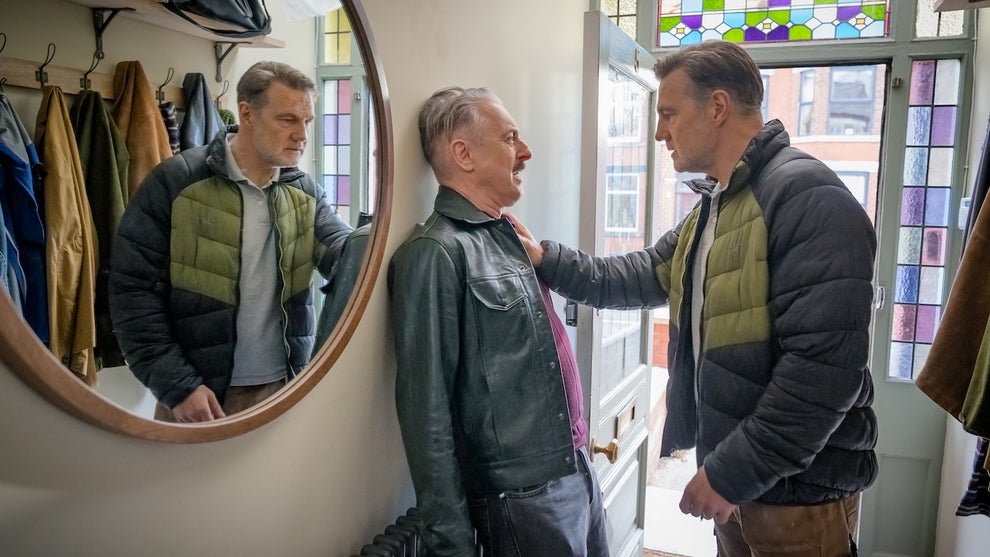
The story really begins when a one-night stand runs off with Leo’s laptop. Leo, in nothing but a pair of nude boxer briefs and a tank top, runs after him, and ends up locking himself out of his house. He goes over to his neighbor Clive Goss’s house, asking to use his phone to call his friend for the spare key. Goss (David Morrissey) reluctantly agrees to help. His discomfort around his gay neighbor is evident early on, particularly his discomfort with Leo being near his sons, 22-year-old Saul (Joseph Evans, walking around in a towel) and 16-year-old mild-mannered George (Jackson Connor). It’s here you begin to recognize that for the Clives of the world, homosexuality is erroneously viewed as being one step away from pedophilia. And it’s here you begin to understand the amount of disinformation that is clouding the minds of men like Clive.
Once Leo gets back into his house, Clive suggests Leo give him the spare key. It would be an innocent enough gesture from someone who could trust his neighbor. But as anyone from a marginalized background can tell you, it’s just not that easy to trust a conservative, straight, white man with unfettered access to your home. But Leo is an optimist. Despite his better judgement, he offers Leo his key, along with his security code, and in doing so, sets off a truly unfortunate chain of events.
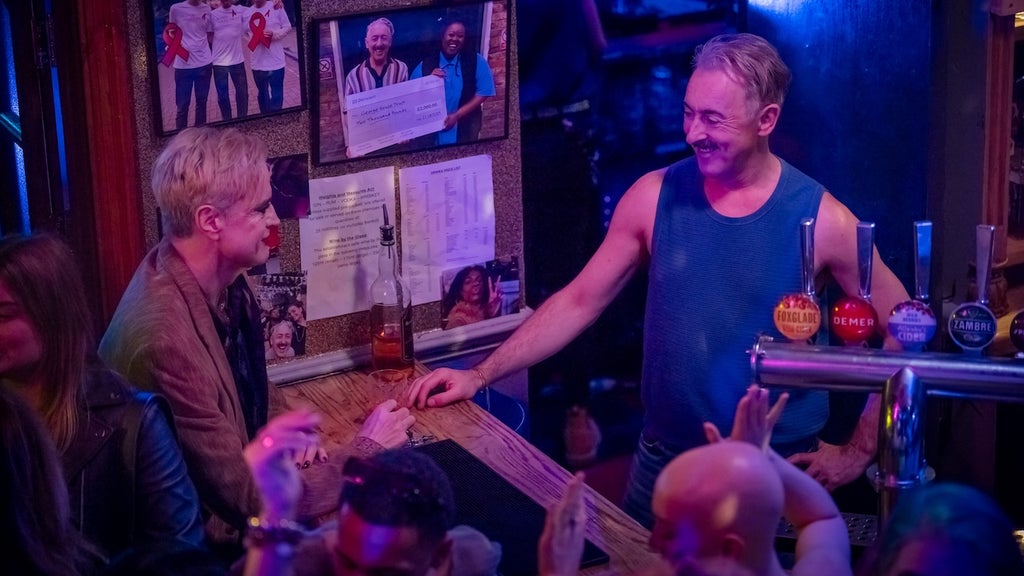
That sense of unease fades into the background, however, once we get to see Leo in his element, chatting up his employees at the Spit & Polish Bar in Manchester’s Gay Village. The Leo we get to know here is confident, charming, witty, if not a bit over the top in his storytelling. He’s an almost parental figure to his young staff, which is composed primarily of trans women and a few young gay men.
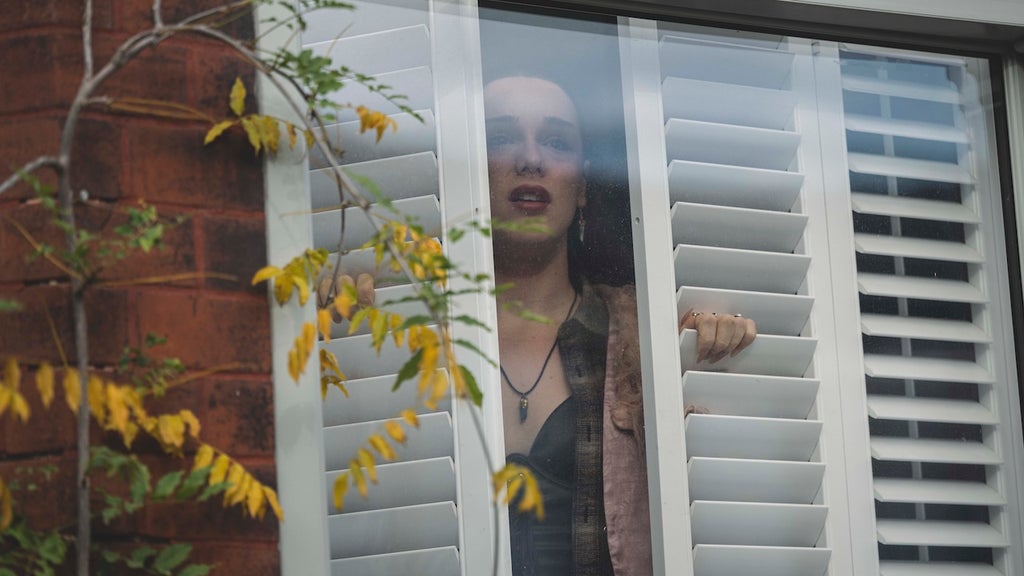
When one of his workers, Zee (Iz Hesketh), mentions she needs help sneaking into her old place to pick up her things before her transphobic housemates see her, Leo and Judy (Luyanda Unati Lewis-Nyawo) agree to come and help her out. Safety in numbers, after all. It’s here that you’re reminded, once again, that for queer and especially for trans folks, threats of violence are perennial..
Throughout this five-episode miniseries,, viewers are constantly in a tug-of-war between getting to experience the joys of being out among other queer and trans folks, of wanting to put on a little makeup and have a good time, of just wanting to simply exist and be left alone; and the dangers that lurk all around the LGBTQ community thanks to the rise in not only conservatism, but disinformation and hateful rhetoric. More to the point, the tug-of-war is also between Leo, who clearly has a big heart and wants to see the good in people and be of help to queer youth, and Clive, who spends his free time watching racist, homophobic and transphobic videos with his headphones on, while he continues to grow further away from his family. Even if Leo makes the occasional misstep (and he does, bless his heart), he remains the voice of reason, especially around Clive, who seems to believe that COVID and HIV/AIDS are both hoaxes.
Each episode uncovers just a little bit more of how Leo ends up losing his life, and in a way, it’s made clear that it’s not just any one person’s doing. Leo is frequently apologizing for simply daring to exist as a gay man. He’s listening to microagression after microagression, not only from his bigoted neighbors — at one point, Clive’s wife Marie (Pooky Quesnel) goes on a rant about how gay men are taking her job), but also from friends and allies. Even his best friend Stephanie (Elizabeth Berrington), who frequently comes to his rescue, also shares some of her misguided beliefs, including that gay men somehow view all women with disdain.
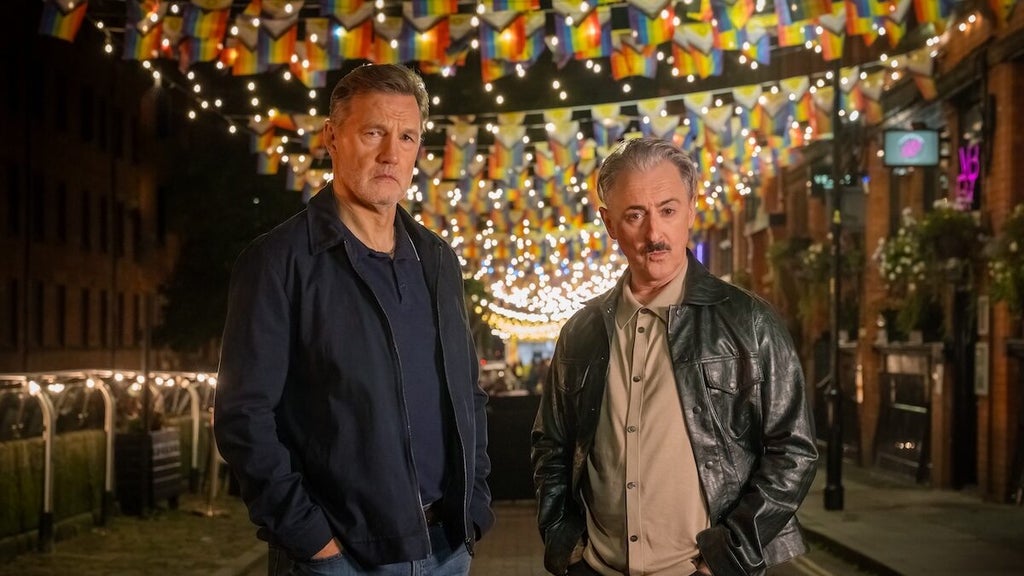
In one scene, Leo and his long-time friend Melba (Paul Rhys) have a conversation about whether things are getting worse. Melba makes it clear he feels that the community has more or less been tricked into coming out so they can become easier targets, and how he no longer walks into a room with bravado, but prefers to “tip toe” for his own safety. Melba goes on to stress to Leo that it’s not just that it feels like we’ve gone back in time, it’s that we are in the depths of a tsunami of rising bigotry.
There are even more factors at play, such as the way toxic masculinity further drives men towards bigotry and loneliness. In one scene, some of Saul’s friends are gathered around watching soccer and talking about how some of them have never even had a girlfriend, while also blaming women for having unrealistic standards. But Clive is really the most fascinating example. He shares how he’s lied to his wife in a misguided attempt to appear more appealing to her (unsurprisingly, it backfires). And every time he appears to finally be coming around to seeing eye to eye with Leo, or showing any ounce of lightheartedness, he immediately has to shut himself down. Morrissey’s work throughout all this is an absolute master class.
“Tip Toe” serves as a warning call to everyone that things really are getting worse for queer and trans folks right now. It’s not just our imaginations or our algorithms. Through Melba’s character, it also reminds us that we can’t just keep typing into our devices in order to get ourselves out of this mess. “Heaven forfend you should get off your ass and do something,” he says at one point to Zee when an online post goes awry. Perhaps we all really are too stuck on our screens, either believing and absorbing all the misinformation and disinformation out there, or else ignoring the very real issues that are happening all around us that we won’t be able to stop with a simple hashtag or reel.
Either way, it’s shows like this that remind us we are always worth fighting for.
“Tip Toe” premieres Thursday on Starz.