
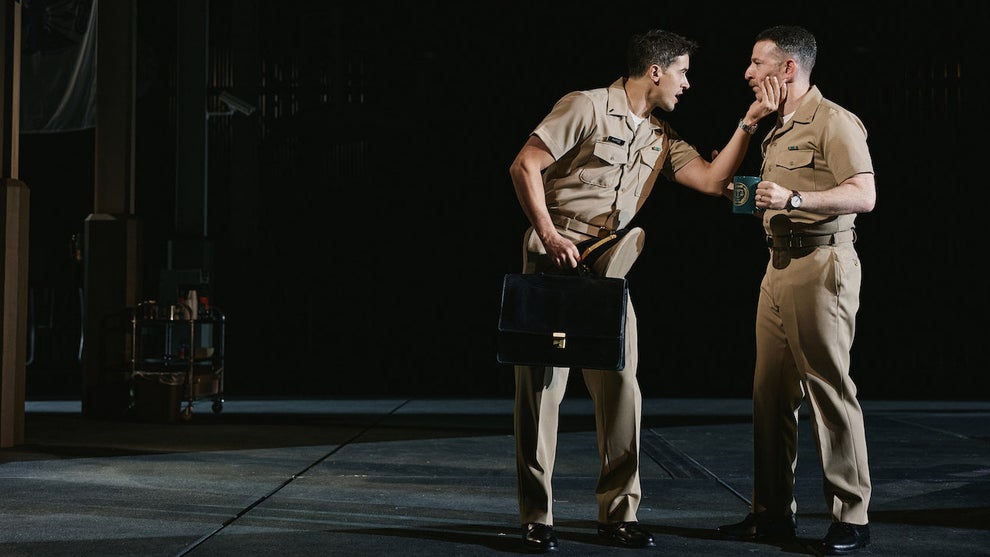
The new regime at Lincoln Center Theater has a novel pitch to theatergoers: Since you’ve already seen the movie, why not see the stage version?
It started last season with “Ragtime,” and continues now with “A Few Good Men,” which opened Thursday at the Vivian Beaumont Theater. Coming soon at that revered venue is “The Sound of Music.”
Before there was the 1992 movie starring Tom Cruise, Demi Moore and Jack Nicholson, Aaron Sorkin wrote the play “A Few Good Men,” which opened on Broadway in 1989. It didn’t exactly impress the people at the Tony Awards, since it received only one nomination, for lead actor Tom Hulce. It was quite a snub. When it came to Best Play nominations, Sorkin’s big message drama about corruption in the army lost out to the boulevard comedy “Lettice & Lovage,” a piece of fluff designed to showcase the star power of Maggie Smith.
LTC’s revival of Sorkin’s court-martial drama makes it clear that the Tony Awards got it right. “A Few Good Men” is a creaky old play. Two Marines (Lavel Schley and Collin Kelly-Sordelet) are accused of murdering PFC William T. Santiago (Daniel Velez), at Guantanamo Bay, Cuba. Were the two men acting alone, or had they been ordered by their superior LtCol Nathan R. Jessep (Bradley Whitford) to bind, shave and gag Santiago?
Despite its military milieu, “A Few Good Men” begins much like a rom-com with an overly contrived fight between a man and woman who could not be more different. In the Demi Moore role of LCDR Joanne Galloway, Krysta Rodriguez is the epitome of earnest dedication to the rule of law. In the Tom Cruise role of LTJG Daniel Kaffee, Tom Blyth is the epitome of nonchalant white male privilege. They don’t fall in love, but faster than you can call Whitford’s villain a God-fearing fascist, Joanne and Daniel end up as not-so-strange bedfellows to defend the soldiers accused of murder.
These two defense lawyers don’t make their case; it is handed to them when a subordinate (Thom Sesma) snitches on Jessep, then conveniently commits suicide. Agatha Christie would have solved this problem sometime between her first and second drafts.
Equally easy-peasy is how Sorkin gets hard-ass Jessep, the Nicholson role, to break down on the witness stand and spill his authoritarian guts. In the film, Cruise strains credulity, since he’s no match for the mighty Nicholson. And that goes double for Blyth’s weak takedown of Whitford.
Michael Arden directs Sorkin’s play, which unspools on the vast Vivian Beaumont stage as if it were really a screenplay. Arden knows how to keep the snippets of scenes flowing without pause, but the mammoth set, by Dane Laffrey, only highlights the play’s weaknesses.
Arden usually directs musicals, winning Tony Awards for “Parade” and “Maybe Happy Ending.” Here, he has substituted singing with lots of yelling from his actors.
