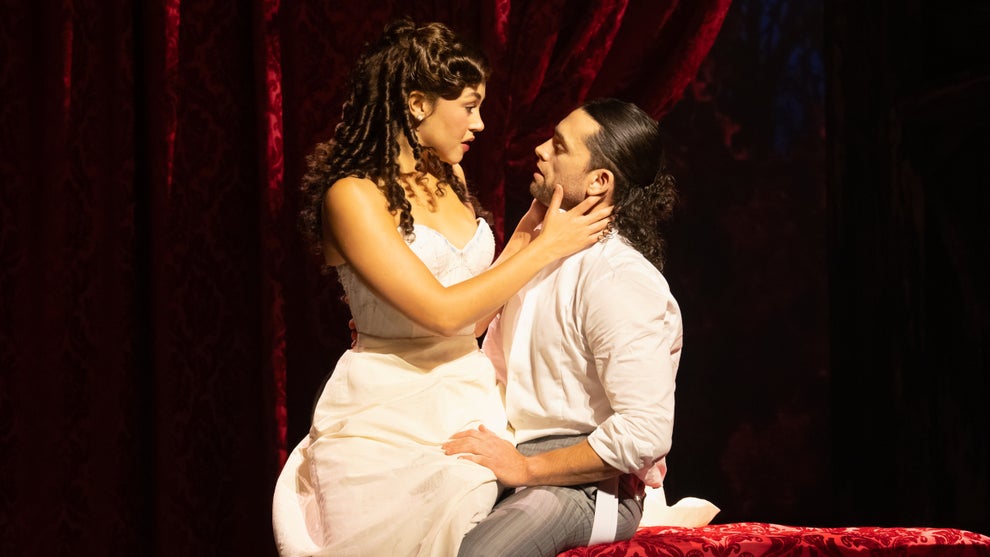
There’s a great running gag that never fails to perk up Broadway’s newest musical. “Wanted,” which opened Sunday at the James Earl Jones Theatre, tells the true story of twin sisters in late 19th Century Texas who became bandits to settle their mother’s sharecropper debt. Mary and Martha Clarke are successful in their many hold-ups and train robberies because they can pass for white despite being Black. Only the musical’s dense white characters fall for this ruse. The other Black characters know at first glance that Mary and Martha are one of them regardless of all the face powder.
Especially delightful are two maids (Aurelia Williams and Awa Sal Secka) who serve Mary (Solea Pfeiffer) and Martha (Liisi LaFontaine) when they take up residence in a posh hotel. Songwriters Angelica Cheri and Ross Baum give the maids a terrific comic number, “Dangerous,” which has little to do with the two bandits many crimes. In the opinion of these two domestics, what’s far more dangerous is Mary and Martha’s trying to pass for white. Williams and Sal Secka are a truly great comic duo, although it would be difficult to say which one is Laurel and which one is Hardy. Angelica Cheri’s book for “Wanted” cleverly and continuously switches back and forth regarding who’s the alpha comic and who’s the beta here; equally wonderful, Williams and Sal Secka manage these transitions without breaking a sweat.

Stevie Walker-Webb’s direction of these two comics is nothing short of brilliant.
There’s only problem with the two maids and their “Dangerous” song: It arrives half-way through the first act of this two-and-a-half-hour musical. What precedes it might be the dullest crime spree ever staged, with Walker-Webb’s direction unable to find any real focus. As played by Pfeiffer and LaFontaine, Mary and Martha aren’t very colorful criminal, and the pale face powder (makeup by J. Jared Janas and Tony Lardo) is the least of the problems.
A chorus of six singers, credited as the Kinfolk, tells us the story of “Wanted.” They’re a gospel choir decked out in white spectral gowns (costumes by Emilio Sosa) and would be better labeled as Mary and Martha’s Conscience. Whenever they sing, which is a lot, this musical stops dead in its railroad tracks.
The Kinfolk do step aside for a moment to let Williams and Sal Secka delight us. And the Kinfolk are also offstage when the primary love story in “Wanted” slowly develops heat. Mary Clarke catches the eye of Jesse (the charismatic Bradley Jaden), a former slave owner who owns the hotel where Mary and Martha are holed up. Faster than Mary can sing “Real Woman,” Jesse asks her to marry him. As songs go, “Real Woman” is this century’s “Material Girl,” and just as Madonna never apologized for wanting to be rich, Pfeiffer makes unabashed materialism her credo. What Mary lacked in excitement robbing people at gunpoint, she finds her a truly vibrant voice here.
Beyond the show’s two maids, the most riveting aspect of “Wanted” is the sly way in which Pfeiffer’s Mary goes from real gold digger to committed lover with her follow-up song, “The Way I Am.” With these two back-to-back hits, Ross Baum delivers beguiling melodies that are a kind of elevated recitative. Elsewhere, this Broadway-debutant composer comes down with a bad case of anthem-itis. Several songs begin small and promisingly, but after a stanza or two, the tunes inevitably go big and quickly crescendo into deafening. It’s difficult to tell if the audience is applauding the performer or the sound design by Gareth Owens.
As with any classic Rodgers & Hammerstein musical, there is a second love story, and that comes when sister Martha falls in love with Elijah (Luke James), one of Jesse’s Black employees, many of whom were his former slaves. James brings a quirky charm to his seduction of Martha, but their affair gets buried in the characters’ mutual self-righteousness. The bad couple, Mary and Jesse, are a lot more fun to watch.
Angelica Cheri has based her book for “Wanted” on the lives of Mary and Martha Clarke, her great-great aunts. In interviews, Cheri has said that this family legend has changed over the years. It’s unfortunate that Cheri’s retelling often doesn’t make sense.
Martha shoots Jesse when he marries Mary, but doesn’t want to kill him. She only wants to graze him. Why? So Mary can feel sorry for him?
Biggest whopper is Mary’s late-in-the-show realization that Jesse’s really a bad guy. The show is set in 1893, not 1993. Didn’t she know that owners of plantations also owned slaves? Mary enchants with her wickedness at the end of act one. When she’s redeemed in the second act, she turns back into being a bore.
