
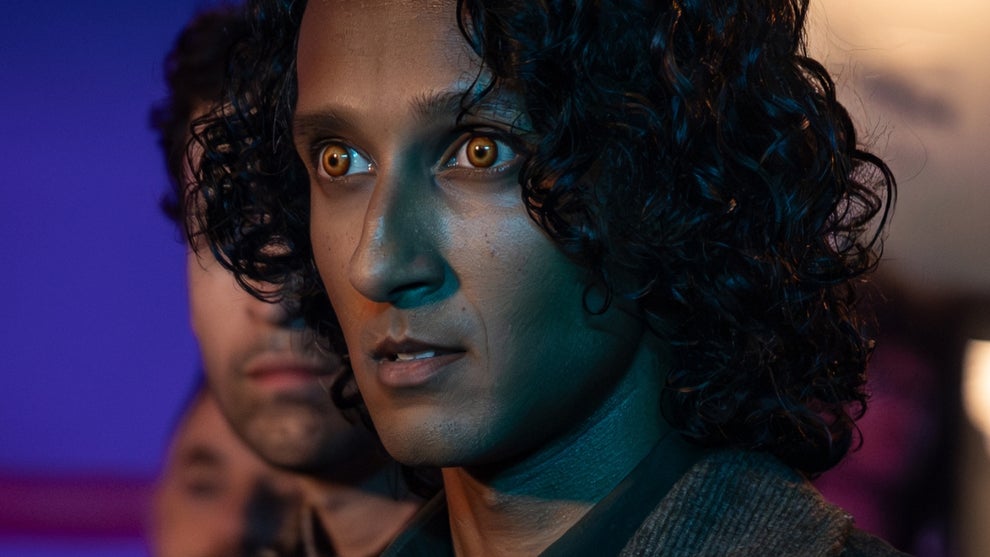
Is there a trickier character on TV right now than The Vampire Armand? From Arun to Amadeo, from “Rashid” to “Maitre,” from Lestat to Louis to the still mysterious transformation of Daniel Molloy, Armand’s true identity and motivations are always lurking somewhere beneath the surface, just out of sight. And actor Assad Zaman is ever doing elegant work, both on screen and in interviews, to dig into those motives without giving it all away.
Certainly, it’s no surprise that the ancient trickster is up to something again in “The Vampire Lestat.” Viewers got their first taste when the character returned at the tail-end of Episode 3, introducing himself as Arun at an AA meeting – specifically, an AA meeting attended by Lestat’s former bandmate Alex, fresh off of his dramatic exit from the tour.
And in Episode 4, Armand is back in full, doing step nine of the 12 Steps, no less. “We meet him two years after his entire world has been shattered,” Zaman told TheWrap, “and his 77 years of building this foundation of life has been taken away from him.” And according to Armand, there’s sincerity in those amends, even if his approach to Daniel is different than his approach to Lestat.
“Armand’s confession to [Lestat] is very different to Armand’s confession to Malloy. There’s a different objective there. I think Armand comes to Malloy to offer Malloy something for Malloy,” Zaman explained. But with Lestat? “I think it’s more for Armand himself.”
The catch is that Lestat clearly knows it, and in return, he has a grand time playing games with his favorite gremlin.
“I think it’s great fun for Letsat to play with Armand in that way,” series star Sam Reid said about their Episode 4 encounter. “I mean, that’s their dynamic. I think they both get a kick out of it. I think they do complete a part of each other that is necessary for one another.”
Rile Armand up he does, with a sultry blood shower and a cutting answer to Armand’s apology (and that’s before he drops his diss track, “Big Boss”). Lestat tells him simply that he is a “F– cloud,” before really laying in: “Be who you are, but be it on the other side of the moon … or kill yourself,” Lestat goads him.

According to Zaman, that reaction comes as no surprise to Armand: “It’s sort of to be expected. He also has a greater plan.” As for that last part, sorry Lestat; not in the cards for Armand. “He is a survivor at the end,” Zaman said. “He can’t really end it.”
That means Armand has to continue to evolve. “Reading the books, reading about Armand, he goes through these eras,” Zaman explained. “He goes through quite a few of these tragedies, moments where his entire worldview or his entire sort of existence is broken and shattered, and then he has to rebuild.”
Below, Zaman helps us untangle the many mystifying layers of Armand’s new era, from his thoughts on the Armand Told the Truthers to why he couldn’t help but enjoy “Big Boss.”
I’m curious about the fact that the sentiment “Armand Told the Truth” exists in the public and how that’s hitting for Armand. For someone who’s such a proponent of these great laws, but also seeks so much validation, is there a part of him that feels vindicated by that, or is he just horrified by the concept of being a public figure?
I’m not sure whether that’s really in his register, in the journey that he’s on in this. He’s very clearly recruiting and very clearly trying to bring vampires into his way of thinking, and going back into the dark, and taking away this broadcast that Lestat, and Louis to an extent and even Malloy, are sort of doing. I think his mission is singular to the point where him being vindicated, or being right, or being seen as the sort of the right one, isn’t really of interest to him. I think he’s got bigger, or he’s got more personal things that he wants to sort of achieve.
So yeah, I’m not sure how aware – well, he’s aware, but I’m not sure how bothered he is by the Armand Told the Truthers. They’re a means to an end, the followers.
Digging into this episode, and the return of Armand at the end of Episode 3. I’m curious if you could just tell me a little bit about the concept of Armand as an addict, and what that means to you.
Armand is addicted to everything, like addicted to the concept of surviving life. We meet him two years after his entire world has been shattered, and his 77 years of building this foundation of life has been taken away from him. And that has caused him to, I guess, reevaluate things, and how he’s sort of approached things.
Reading the books, reading about Armand, he goes through these eras. He goes through quite a few of these tragedies, moments where his entire worldview or his entire sort of existence is broken and shattered, and then he has to rebuild.
He goes through a period of cocooning, he goes through a period of sort of rediscovery, and this one is a very specific one, where he has to come to terms with the lies that he’s told, come to terms with what he’s done to certain people, the hurt that he’s caused. And he is a survivor at the end. He can’t really end it. He hasn’t got the courage to end it himself, so he has to survive some way, and I think that comes with acknowledging the systemic behavior that he’s sort of undertaken for the last 70-odd years, and that has been his sort of addiction.
So he’s going forward with that in mind. He’s got a mission, but he’s also, I think, he’s sincere in the acknowledgment of his addictions and wanting to lay them bare.

That speaks to the underlying question about this character, which is you never really know where he’s coming from. My read on him is that I think he typically does come from a sincere place, and does things that are abhorrent because of that. Do you feel that way about him, or do you feel like he’s running games and strategies all the time?
No, absolutely. No, absolutely, you’re right. I think he is. It’s funny, I also think most of us are coming from sincere places. I think he does. He tangles himself into webs of deceit and lies and manipulation because he thinks that’s the only way to hold on to safety. That the safety that he gets from the people that he values as his protectors, as his source of love, he thinks that’s the only way to hold on to them. But it’s sincere.
I don’t think he goes – oh, well, it’s difficult. It’s such a good question, because I’m also still figuring it out as well. There’s so many contradictions with Armand, and I love that. And I love that there’s such … another reason why I’m sort of hesitating with this, because I love that there is such a divided audience with Armand. How people are so adamant that he’s one thing, and so adamant that he’s the opposite. I actually think that that’s really useful, because if I prescribe Armand too much myself, I think it makes him harder to access maybe, because I’ve already given it. I’ve given my version, or I’ve given what I’m trying to do.
He’s sincere, but maybe sometimes he isn’t. Maybe sometimes something comes out rooted in evil, or something comes out rooted in a f–ed up fantasy, because he doesn’t really understand, he was never given the chance to really understand who he is, as a good person or a bad person. He was told what he was. He was used and abused the way he was.
The king of “two things can be true.”
Yeah.
I feel like that is certainly the case in the dynamic between him and Lestat. It’s so playful, yet hateful, and so complex. Can you tell me about getting to dig into that dynamic in that bus scene with Sam? And then sort of as a follow-up to that, tell me a little bit about Armand’s mindset when he’s immediately greeted with a diss track?
Yeah, it’s so on-point for Lestat as a character, and I think Armand. It was so fun. I love the scenes with Armand and Lestat. I love playing with Sam. The dynamic between them two, there’s so much to dig into in that. There’s so much to find. They have this brilliantly complex history. Lestat obviously loves teasing him and taunting him, and I think, in a way, Armand kind of enjoys it himself. There’s a little bit of that. There’s a cattiness there.

Armand’s confession to him is very different to Armand’s confession to Malloy. There’s a different objective there. I think Armand comes to Malloy to offer Malloy something for Malloy. But I think Armand comes to Lestat to declare that he has understood what their relationship – Armand himself has come to terms with the destructiveness of this obsession with Lestat. And it’s not necessarily for Lestat. And I think it’s more for Armand himself. So I don’t think he’s surprised that Lestat teases and taunts him, and belittles him and humiliates him in that moment. It’s sort of to be expected. He also has a greater plan.
And then, you know, he also enjoys “Big Boss,” even though he shouldn’t. It’s how he fell in love with Lestat in the first place, watching him perform, and seeing his freedom, and seeing how he’s able to embrace who he is in its entirety – Something that Armand has always struggled to do and come to terms with.
He loves it, and he hates it, and watching him perform is like self-flagellation again. It’s like, “I shouldn’t love this, but I am loving this. I can’t show him that I love it. I do love it.” For me as an actor, that day was also the same thing. I was also really enjoying it, and trying to sort of ride past it and keep a straight face through it. I hope we do get more with Lestat and Armand. There’s a lot there.
There’s so much. There’s a part of me that’s like, he must have been a little bit elated that Lestat thought about him enough to write a song.
Oh yeah, right? Lestat wrote a song? I don’t think Armand really took in the contents of the song. I think he just was like, “He wrote a song about me?” [Laughs]
I am about out of time with you, so I will just sneak in one more super-short question: Is getting a dressing down from Eric Bogosian as invigorating as it seems like it would be?
Yes, it is very invigorating. I love watching him in his element with those speeches as well. They’re similar to some of the amazing bits of dialog that he has in Season 2, where Malloy is able to distill the grandiosity of vampiric life and existence, and all of that stuff, and dilute it, distill it into its simplest form. This is an absent father doing the steps. And he goes, “I’ll do it better,” and he does it better. [Laughs] He does it perfectly. That was really a joy to watch Eric performing that.
