
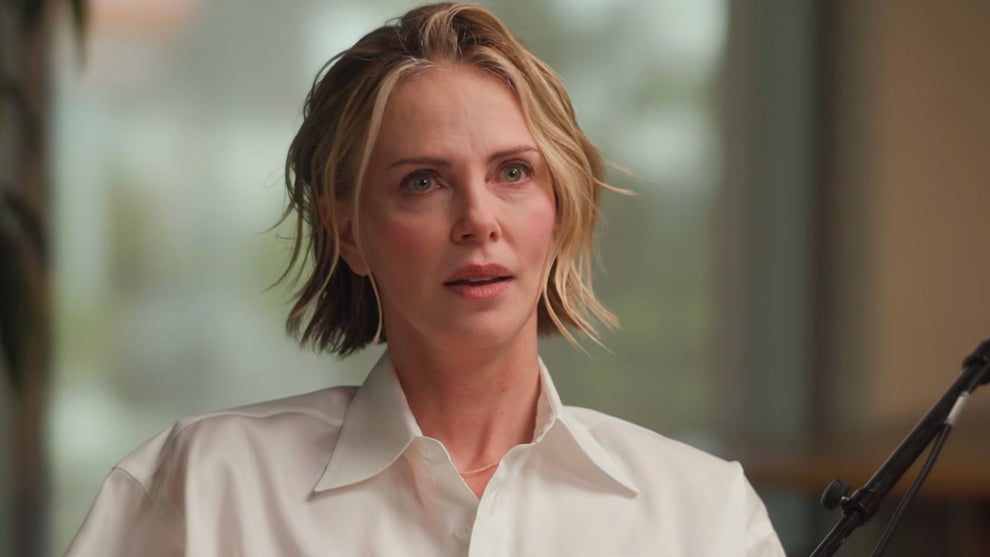
Charlize Theron’s hour-long sit-down on The New York Times’ “The Interview” podcast took a surprisingly revealing turn Saturday while discussing how her childhood trauma shapes her today.
“Life is so valuable. I think, like, life is so beautiful,” Theron said before catching herself welling up, and looking straight into the camera. “Stop it! No, this is not in the interview. You are not putting this in the interview. It’s so sappy and stupid.”
“It’s not,” interviewer Lulu Garcia-Navarro assured.
“It’s so stupid, it’s really stupid,” Theron said, wiping her eyes, apparently embarrassed.
“I feel like I’m getting the real you, which is the person that still doesn’t wanna like, be in touch with their emotions,” Garcia-Navarro observed.
In what began as a rather innocuous recounting of why the actress kept making action movies after a severe neck injury while filming 2005’s “Æon Flux,” Garcia-Navarro was stunned by the actress’ openness — and teariness. She pivoted off of talking about her new Netflix film “Apex” and pressed in on why Theron was “getting teary.”

“I think I wasn’t going to let anything take away from my life,” the 50-year-old said of her drive to keep doing stunt-heavy action films after the injury risked paralyzing her. “There’s a spirit about me, and I think some of it maybe has to do with the fact that I experienced so much death early on. I’m very aware that time runs out really quickly, and that time can run out as soon as I walk out of this building. I can cross the street and it’s done. I’m so hyper aware of that.”
She continued: “I live my life every single day like that. If I lay in bed one day, I’m like, ‘I am missing a day in my life.’ But I was never going to be, I didn’t want to live, like, a safe life because of that. I mean, I do live a very safe life, I’m not a reckless person … If I get to be on my deathbed one day, I want to say, ‘I did everything that I really wanted to do.’”
“I can see you getting teary,” Garcia-Navarro responded. Theron jokingly denied the tears, but eventually relented, diving deeper.

“It’s so funny because people are always like, they think I’m a tough bitch. I think a lot of people think I’m, like, very cold … I can take care of myself,” she noted. “And I’m also sometimes a little brash, and I think people take that as, ‘She’s so tough. She’s so cold.’ And it’s the complete opposite.”
“My kids are so embarrassed by me because I will cry at the drop of a hat,” she continued, nodding to her teen daughters. “My kids are always like, ‘Stop crying.’ So I have access. I think it’s why I’m OK at acting. I can go to those places very easily. As you can tell. I have an ability to really feel deeply. Sometimes it’s not nice, but it works for my job, and it works in my life. I really do appreciate things. And I’m not perfect at that every day, but I aim for that, definitely.”
Theron has been open about her childhood growing up on a farm in South Africa, specifically living with a violent, alcoholic father. Her mother shot and killed her father in self-defense when Theron was just 15.
“It really did change our relationship — we were always very close, we felt like a team,” she recalled. “But that night changed it because in retrospect, like, once I got out of the shock of it, I realized that she saved my life. Which is a big thing.”
“Apex,” from director Baltasar Kormákur, co-stars Taron Egerton and premieres globally April 24 on Netflix.
