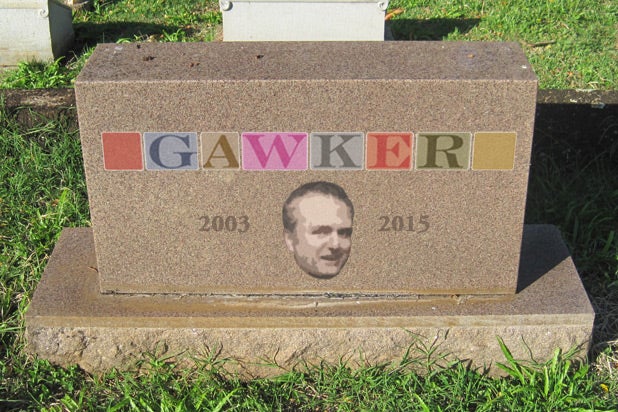
When Gawker CEO Nick Denton led damage control in July after widespread blowback from a story about a Conde Nast executive’s would-be weekend romp with a gay porn star, he set his site’s funeral in motion.
Denton began to speak softer about Gawker, previewing a site that could no longer serve as the premier middle finger to other media — and advertisers — because that tone no longer made business sense.
“The fact of the matter is that it is really hard to sell Gawker, Gawker.com in particular, because Gawker.com likes to pick fights with pretty much everybody,” he told staff in a two-hour meeting after the Conde Nast fiasco.
Denton concluded by promising Gawker would still be a business that supports editorial freedom. But it was also a business and “needs to survive in order for it to support that.”
This was the deathbed confessional for the Gawker we all knew and loved (and loved to hate).
“The company walked a tightrope, trying to keep its roots as outrageous but not be so freewheeling that advertisers are scared off,” Rick Edmonds, Poynter media business analyst, told TheWrap in response to the news on Tuesday that Gawker is morphing into a politics site and laying off staffers in the process.
That tightrope snapped in July when the site went too far with the Conde Nast story. Discover was the lone advertiser to walk away, but Denton acknowledged that his decision to take down the story was prompted in part by his fear of losing additional advertising.
“If the post had remained up, we probably would have triggered advertising losses this week into seven figures,” he said. “Fortunately, though, I was only aware of one advertiser pausing at the time the decision to pull the post was made.”
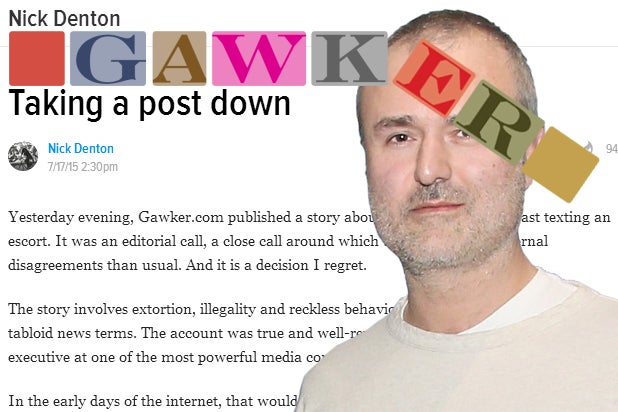
Executive editor Tommy Craggs and editor-in-chief Max Read resigned over Denton’s decision to pull the story. On their way out, both criticized Gawker for giving in to advertiser pressure.
Craggs said the story had become “radioactive” and Discover and BFGoodrich’s threats to walk away unduly influenced Denton.
Read ripped Denton for allowing noneditorial business executives to participate in the decision to take down the story, calling it an “unacceptable and unprecedented breach of the editorial firewall” that made a “joke” of Gawker’s claim to be the world’s largest independent media company.
The Conde Nast debacle came less than a year after the “GamerGate” scandal. That was sparked by a Gawker Media writer, who tweeted, “Nerds should be constantly shamed and degraded into submission.”
Adding to the pressure on Gawker Media is wrestling icon Hulk Hogan’s $100 million lawsuit over the sex tape the site published featuring the former wrestler. That case goes to court in early 2016.
Gawker bowed to the increasingly clear reality that it couldn’t continue to disregard practical advertising concerns, said Jennifer Kavanagh, who ran digital operations at NBC and Oxygen.
Kavanagh, now a media strategist at Brave Ventures, said now is a perfect pivot point for Gawker.
“My sense is that it’s a recognition of a major revenue opportunity. If one is to consider a pivot of this nature, it is well-timed as we move into an election year,” she said.
Whether Gawker 2.0 succeeds is anybody’s guess. But the cause of the original’s death is clear: a massive stroke induced by advertisers that at one point in time Gawker shrugged off.
21 Biggest Media Missteps of All Time (Photos)
The Washington Post's Fabricated Heroin Child Addict
Janet Cooke, who falsely claimed a master's degree from the University of Toledo, wrote a profile in 1980 for the Washington Post on an 8-year-old heroin addict. The story went viral and won the Pulitzer Prize in 1981. Two days after winning, the Post admitted the story had been fabricated and she resigned.
TheWrap
"The Daily Show's" "Blow Me" Blow Up
In 1997, then-host Craig Kilborn told Esquire in an interview that co-creator Lizz Winstead found him attractive, asserting: "If I wanted her to blow me, she would." He was suspended and she quit some time later.
Stephen Glass, formerly a journalist for The New Republic, was discovered to have fabricated almost half of his articles. In 1998, it was revealed that he had invented events, quotes and sources for a number of publications.
NY Times' Faulty Coverage of Iraq's Weapons Program
Judith Miller of the New York Times was discovered to have reported on Iraq's weapons of mass destruction in 2002 using inaccurate information from unreliable sources. At the time, her articles were used to push the U.S. case for war with Iraq.
Jayson Blair worked as a journalist for the New York Times before resigning in May 2003 when his editor questioned him about similarities between his work and that of other journalists. Blair later told "Talk of the Nation" that his bad habit started when he grabbed a quote from a press conference that he had not attended.
Dan Rather, then a correspondent on "60 Minutes," produced a flawed CBS News story in September 2004 that challenged President George W. Bush's National Guard service. Rather used fake documents to show Bush had received special treatment. Once the scandal made news, several CBS producers were fired.
CBS fired Don Imus in April 2007 for using racial slurs on his radio program, during which he referred to the Rutgers women's basketball team as "nappy-headed hoes." Opponents protested the show, sponsors pulled advertising and the show was canceled a week later.
Getty Images
Sue Simmons F-Bomb Outburst
WNBC New York news anchor Sue Simmons dropped a serious gaffe in a teaser for the 11 p.m. news in July 2008, yelling "What the f-ck are you doing?" on-air. Simmons was subsequently fired, but loyal fans fueled a #SaveSueSimmons hashtag and encouraged WNBC to bring her back.
MSNBC host Ed Schultz called rival pundit Laura Ingraham a "right wing slut" in May 2011, resulting in his suspension and later replacement. The slur was in response to Ingraham’s criticism of President Obama’s Ireland trip while tornadoes were devastating the United States.
Rupert Murdoch's News Corporation was busted for hacking the phones of celebrities, government officials and members of the British Royal Family on several occasions. The issue became a huge topic after the Guardian reported in July 2011 that the voicemail of murdered schoolgirl Milly Dowler had been hacked by News Corp., leading to the arrests of a number of top company editors.
Salaheddin Barhoum and Yassine Zaimi were misidentified as the Boston Marathon bombers by the New York Post in April 2013. The publication printed a photo of the men on its front page with the damning headline "Bag Men." They later sued for libel, invasion of privacy and emotional distress.
Washington Post
CBS' Discredited "60 Minutes" on Benghazi
"60 Minutes" correspondent Lara Logan and her producer were asked to take a leave of absence after it was revealed her October 2013 report on Benghazi was flawed. Her eyewitness volunteered information to "60 Minutes" about an attack that differed from the version he told the FBI. She returned six months later.
Reporter Randi Kaye looked a bit under the influence while on air with Anderson Cooper in January 2014. In the "Gone to Pot" segment, Kaye is seen swaying back and forth and giggling while covering the legalization of recreational marijuana in Colorado.
In July 2014, Twitter users began noticing familiar phrases between BuzzFeed writer Benny Johnson's articles and those of other websites. BuzzFeed found 41 times when he had plagiarized someone else's work or improperly attributed. He was fired and BuzzFeed issued a statement.
Bill Simmons was suspended by ESPN for three weeks in September 2014 for his criticism of NFL commissioner Roger Goodell's handling of the Ray Rice scandal. He dared ESPN to fire him for speaking out, stating he'd go public about Goodell if anyone punished him. In 2015 Simmons' contract was not renewed.
Rolling Stone's Erroneous "A Rape on Campus" Story
Sabrina Rubin Erdely published a story in the Dec. 2014 issue of Rolling Stone that claimed several fraternity members at the University of Virginia raped a woman named "Jackie" during a chapter house party. The story was discredited after other journalists noticed discrepancies in Jackie's story, and Rolling Stone retracted it in Apr. 2015.
Rolling Stone
New Republic's Unwarranted Facelift
Known as the man who bought and subsequently ruined the New Republic, Chris Hughes was blasted in Dec. 2014 by the journalism community for drastically changing the publication. Approximately 50 of the magazine's staffers resigned in protest.
ESPN's Very Own Goes to War Over Penn State's THON
Keith Olbermann's sharp tongue has gotten him into trouble a few times, including his Twitter war with Penn State students in Feb. 2015 over their annual THON fundraiser. Olbermann mocked the university, which two years earlier had been penalized by the NCAA over the Jerry Sandusky child sex abuse scandal. ESPN suspended him.
"NBC Nightly News" anchor Brian Williams Tells Matt Lauer Suspension Was ‘Torture,’ But ‘Absolutely Necessary’ (Video)" href="https://www.thewrap.com/brian-williams-tells-matt-lauer-suspension-was-torture-video/">Brian Williams admitted in Feb. 2015 that he exaggerated his experience aboard a helicopter that was struck by RPG fire during the invasion of Iraq in 2003. Williams was suspended by the network and will return as Brian Williams Demoted to MSNBC Breaking News Anchor" href="https://www.thewrap.com/brian-williams-demoted-to-msnbc-breaking-news-anchor/">a breaking news anchor for MSNBC in August.
ESPN reporter Britt McHenry was suspended for a week in Apr. 2015 after a video in which she berates a towing company employee went viral and received heavy public backlash.
Gawker’s Condé Nast controversy joins a growing list of spectacular media fails
The Washington Post's Fabricated Heroin Child Addict
Janet Cooke, who falsely claimed a master's degree from the University of Toledo, wrote a profile in 1980 for the Washington Post on an 8-year-old heroin addict. The story went viral and won the Pulitzer Prize in 1981. Two days after winning, the Post admitted the story had been fabricated and she resigned.