How ‘Underground’ Pushed WGN America Ratings Up 1000 Percent
Historical Underground Railroad drama gooses network’s total viewers numbers up over 500 percent as well
Joe Otterson | April 27, 2016 @ 3:25 PM
Last Updated: April 27, 2016 @ 3:28 PM
WGN America
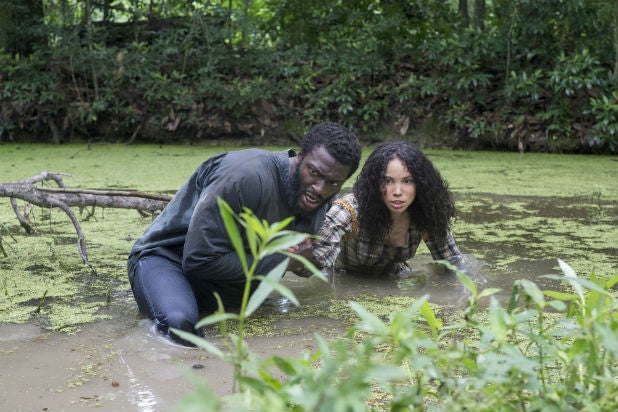
2016 is shaping up to be a banner year for WGN America, thanks in large part to its new drama “Underground.”
The series, which focuses on a group of slaves in the pre-Civil War South who decide to make the perilous journey North, is outpacing WGN America’s 2015-2016 primetime average by 508 percent in total viewers and 1,005 percent among adults 18-49 in live-plus-seven viewing.
In live-plus-same day, the show is no slouch either. After seven episodes, it is averaging just over 1 million viewers per episode and a 0.31 rating in the key demo, with the premiere drawing 1.4 million viewers and a 0.39 rating. And “Underground” is not alone on the network.
Fellow freshman series “Outsiders” also performed well in the ratings. That show managed to draw an average of 822,000 viewers and a 0.29 rating over 13 episodes in live-plus-same day with the finale airing April 19. While not off the charts, compare that to other new shows on well established cable networks.
HBO’s 70’s music drama “Vinyl” closed out its freshman season averaging just 645,000 viewers and a 0.22 rating. Showtime’s “Billions,” set in the world of high finance, averaged 1.1 million viewers and a 0.33 rating for its first season.
So, barring a sudden drop off in the ratings,”Underground” is in pretty good shape, especially considering the show is just the fourth original show to debut on WGN America. So what is that is drawing fans to series?
For starters, other than “Roots,” which was a miniseries, no other scripted U.S. television show has focused on slavery, let alone the Underground Railroad.
“I’m not aware of any other show with that central storyline,” Dr. Darnell Hunt, Director of UCLA’s Ralph J. Bunche Center for African American Studies, told TheWrap in March. “I’m aware of shows where that theme may have occupied an episode or two … So this I think, with the exception of ‘Roots’ — which explored a different aspect of slavery — is rather unique.”
The show also comes along at a pivotal time, as questions of diversity and inclusion on television continue to pop up.
“Currently, the American public is about 40 percent minority and that’s increasing by about half a percent every year,” Hunt said. “So the simple fact is the audience is very diverse and people want to see their own stories and experiences reflected on screen. So it stands to reason that a diverse audience wants to see diverse content.”
“Underground” airs on Wednesdays at 10 p.m./9c on WGN America.
21 Times Hollywood Tackled Race Issues (Photos)
Selma (2014) - David Oyelowo plays civil rights leader Martin Luther King Jr. in a biopic that explores the civil rights leader's role in the 1965 Selma protests.
Harpo Films/ Plan B Entertainment
Dear White People (2014) - This biting satire follows four black college students making their way in "post-racial" America.
Homegrown Pictures
12 Years a Slave (2013) - Chiwetel Ejiofor led the 2014 Best Picture winner, which is a true story about a freeborn black man who spent over a decade in slavery in the pre-Civil War South.
Fox
Django Unchained (2012) - Quentin Tarantino's controversial Oscar winner follows a freed slave who fights to liberate his wife from a brutal plantation owner.
The Weinstein Co.
Gran Torino (2008) - Clint Eastwood plays a grizzled Korean War veteran who reluctantly takes his young Hmong neighbor under his wing.
Warner Bros.
Crash (2004) - 2006's Best Picture Winner traces the intersecting lives of people of different races in present day Los Angeles.
Bob Yari Productions
American History X (1998) - Edward Norton plays the leader of a violent neo-Nazi gang who reevaluates his life when he sees his little brother going down the same path.
New Line
A Time to Kill (1996) - Based on the best-selling John Grisham novel, Samuel L. Jackson plays a man on trial for murdering the two white supremacists who raped his daughter who turns to an untested lawyer played by Matthew McConaughey.
Warner Bros.
Schindler's List (1993) - Steven Spielberg's unflinching look at the Holocaust through the eyes of a man who saved thousands of Polish Jews.
Universal
Malcolm X (1992) - Spike Lee and Denzel Washington teamed up for the true story of the inflammatory Nation of Islam leader.
Warner Bros.
School Ties (1992) - Brendan Fraser led this all-star cast (which included Ben Affleck and Matt Damon) in which he played tbe only Jewish student at an exclusive 1950's prep school.
Paramount
Boyz n the Hood (1991) - John Singleton's hard-hitting look at life in South Central Los Angeles saw Cuba Gooding Jr. trying to avoid the pitfalls of life in the ghetto.
Columbia Pictures
Dances with Wolves (1990) - Kevin Costner won multiple Oscars for this tale of a Civil War soldier who comes to identify with an oppressed native tribe in the American West.
Orion Pictures
Do the Right Thing (1989) - Spike Lee's searing portrait of a day in the life of a mostly black Brooklyn neighborhood during an intense heat wave.
Universal
Mississippi Burning (1988) - The true story of the disappearance of three civil rights protesters in 1960's Mississippi and the FBI agents who investigated.
Orion Pictures
The Color Purple (1985) - Whoopi Goldberg was nominated for Best Actress in this story of a black woman at the turn of the century fighting for her place in society.
Amblin
Blazing Saddles (1974) - Mel Brooks and Richard Pryor collaborated on this hysterical look at a black sheriff taking charge of a frontier town.
Warner Bros.
Guess Who's Coming to Dinner (1967) - Sidney Poitier stars in this groundbreaking film about a white woman who brings her black fiancee home to meet her parents.
Columbia Pictures
In the Heat of the Night (1967) - Sidney Poitier again challenged conventions when he portrayed a black detective investigating a murder in a rural Southern town.
United Artists
To Kill a Mockingbird (1962) - Gregory Peck cemented his place in film history as Atticus Finch, a white lawyer defending a black man accused of rape, in the adaptation of Harper Lee's masterpiece.
Universal
Birth of a Nation (1915) - Considered the first true narrative film, it attracted widespread criticism for its portrayal of African Americans and its glorification of the KKK.
D.W. Griffith
1 of 21
The film industry has never shied away from the controversial topic
Selma (2014) - David Oyelowo plays civil rights leader Martin Luther King Jr. in a biopic that explores the civil rights leader's role in the 1965 Selma protests.