
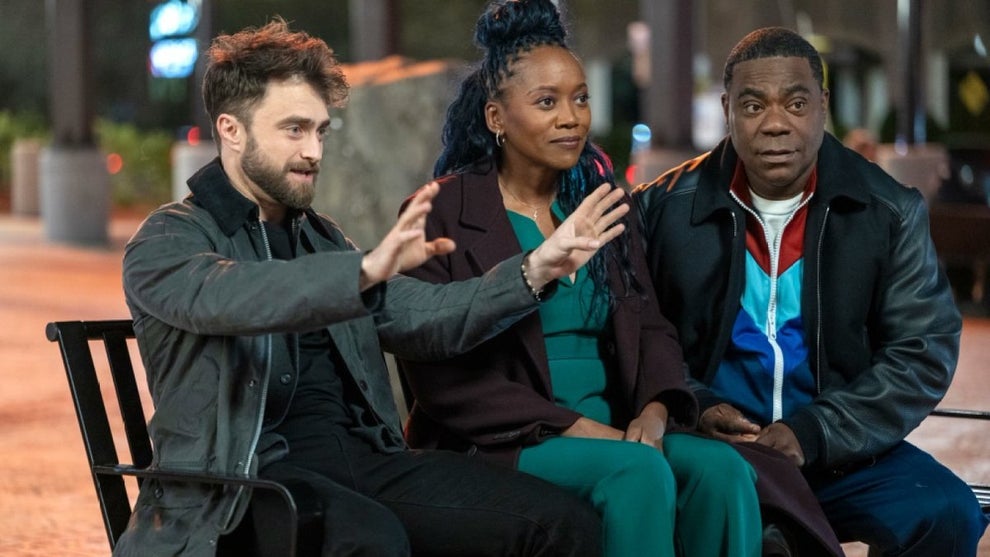
“The Fall and Rise of Reggie Dinkins” feels of a pair with other Robert Carlock projects. The show carries a comic tone aligned with series like “30 Rock” and “The Unbreakable Kimmy Schmidt,” featuring rapid gags, quick cutaways and an all-around dense joke structure.
But “Reggie Dinkins,” created by Carlock and longtime collaborator Sam Means, has one major difference: it’s shot and edited in a documentary style.

“A lot of times, we’re like, OK, when we are going to shoot this scripted scene, where would we do this naturally in a verité format?” said director of photography Charlie Gruet. “You’re over here shooting and then someone starts to talk and you whip over and you miss that first word. Instinctively, that’s a no-no in scripted formats, but we kept telling ourselves, After the fifth take, you know that Bobby’s going to come in over here, but don’t anticipate. The camera can never really anticipate. Then Kyle had to fix all of our mistakes.”
“That was something we talked about a lot,” editor Kyle Gilman added. “We’ve got these great professional camera operators that were going to anticipate, and you really don’t want them to.”
Both Gruet and Gilman have been in this orbit before. The cinematographer worked with “Reggie Dinkins” pilot director Rhys Thomas on “Saturday Night Live,” while the editor has been a part of the Carlock crew since working on “Kimmy Schmidt.”
But the verité style of “Reggie Dinkins” brought the craftspeople some distinct challenges. To start, both the camera operators and the editors essentially had to be “in-character” (often as Daniel Radcliffe’s Arthur Tobin), as “The Fall and Rise of Reggie Dinkins” itself is meant to be some sort of documentary assembled in-universe.
“There were definitely many times on set when we’d be shooting something and I’d ask Robert and Sam or whoever’s directing the episode just to remind me, even though I knew the answer, ‘Who’s editing this sequence?’ They’re like, ‘Arthur,’ and I’m like, ‘Wouldn’t Arthur get a shot of this thing?’” Gruet remarked. “Every day, literally every day, there was a logic check between creators and writers and directors and me and everybody just to kind of be like, This is what would happen logically.”
“That’s one of those things you really can’t let anyone think about for very long. There’s too many steps from this movie that they claim to be making to a sitcom that’s airing on NBC,” Gilman said. “I never think of it as his decision-making as an editor. It’s always, What’s the best way of telling the story? Which I assume would be Arthur’s decision too.”

A big consideration for Gruet was the in-universe lore of his two real-world camera operators. A-Camera operator Zack Schamberg is referred to throughout the show as Marty (“On day one, Dan Radcliffe was like, ‘OK, which one’s Marty?’” Gruet said), while the B-Camera operator was nicknamed Clive (despite that name never being said in the show).
“The big thing was, if we see an operator on camera, the footage that that operator’s shooting is usable footage, so it has to be an operator,” Gruet said. “There was discussion of, ‘Oh, do we cast somebody, and do we outfit them with a camera?’ But we emphatically were like, no, if we see that camera, that camera needs to be capturing usable footage that makes it into the show. There was a wonderful coordinated dance between the operators and the actors.”
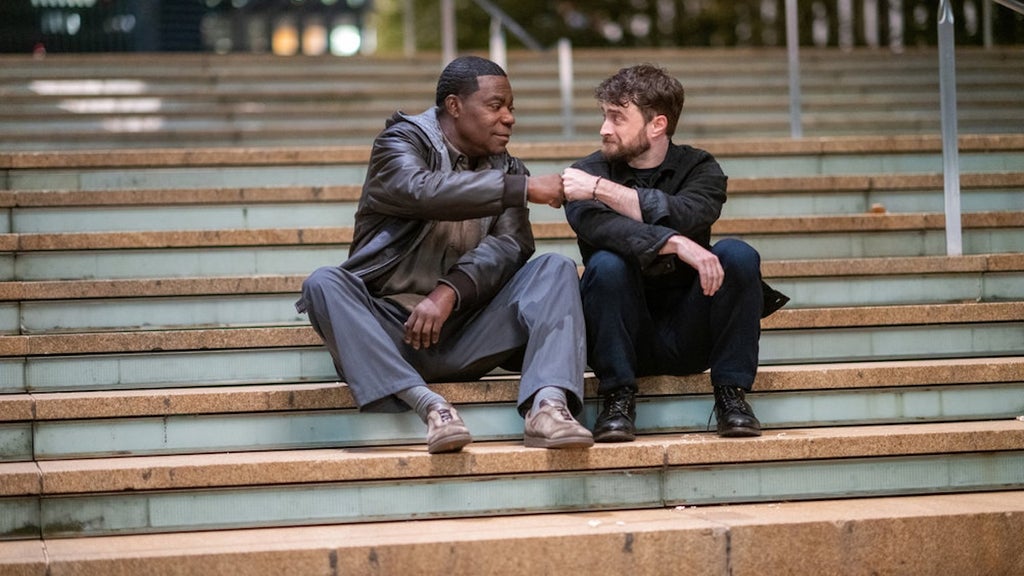
Gruet said the stars (including Radcliffe, Tracy Morgan, Erika Alexander, Precious Way, Jalyn Hall and Bobby Moynihan) appreciated this real-time shooting style, as it allowed them to perform to each other rather than trying to hit their angles. It also gave Gilman plenty of footage to work with — though not nearly as much as a true documentary.
“You’re not getting the same amount of camera angles and coverage where you’re just letting it run for an hour because it’s very carefully shot, but it’s probably the most difficult show that I’ve edited because of those constraints,” Gilman said. “With that said, it’s because I’ve never edited any unscripted shows, which I think are extremely difficult.”
The documentary format opened the crew up to challenges and opportunities. Committing to realism, Gruet wanted lighting in the show to be motivated by the massive windows throughout Reggie’s house. He designed various lighting schematics so different intensities of light would shine through the south-facing windows depending on the time of day.
“I think it really added an element of authenticity to the documentary vibe,” he said.
Gilman, meanwhile, found that the documentary format opened him up to comic beats in the edit that couldn’t be achieved in a regular sitcom.
“We did a For Your Consideration event and watched the first and fifth episodes with an audience, which is so amazing to see. You never see a TV show with an audience,” he said. “I noticed the first big laugh is an editing joke in the pilot, when he says, ‘Let me put on my producer hat’ and we cut to him wearing a hat. You’re just able to do those kinds of things in a documentary format that you couldn’t do. A jump cut wouldn’t make any sense in a regular scripted scene.”
Of course, cutaways have long been a part of the Carlock house style, with shows like “30 Rock” constantly whip panning into and out of various gags. Gilman noted that “Reggie Dinkins” doesn’t use these whip pans for its cutaways, allowing them to drop more cleanly and efficiently into these jokes.
“You do it as tight as possible, which is kind of the rule of almost everything they do,” Gilman said. “When in doubt, just take out a couple frames between the lines. Especially when you’re on NBC, you just want to fit as many words into the shows as you can because you’ve only got 21 minutes and 18 seconds. It’s dense.”
