
Political podcasts increasingly look and function like television. Distributed through YouTube and available on connected TVs, they compete with cable and broadcast news for political attention — raising a consequential question for the television business: Are advertising dollars leaving for the newer, sexier medium?
TheWrap’s findings suggest that, at least for now, the growth of political podcasts is expanding the advertising market rather than simply siphoning dollars from TV news. That distinction matters as the midterm elections approach, with a record $11.6 billion in political-ad spending projected for the 2026 cycle — including $5.6 billion for broadcast television, according to AdImpact.
On the podcast side, advertisers have sharply increased their spending over the past two years. But because agencies can finance those buys through audio, digital video, creator, performance-marketing and integrated-media budgets, it is difficult to determine precisely where that growth is coming from.
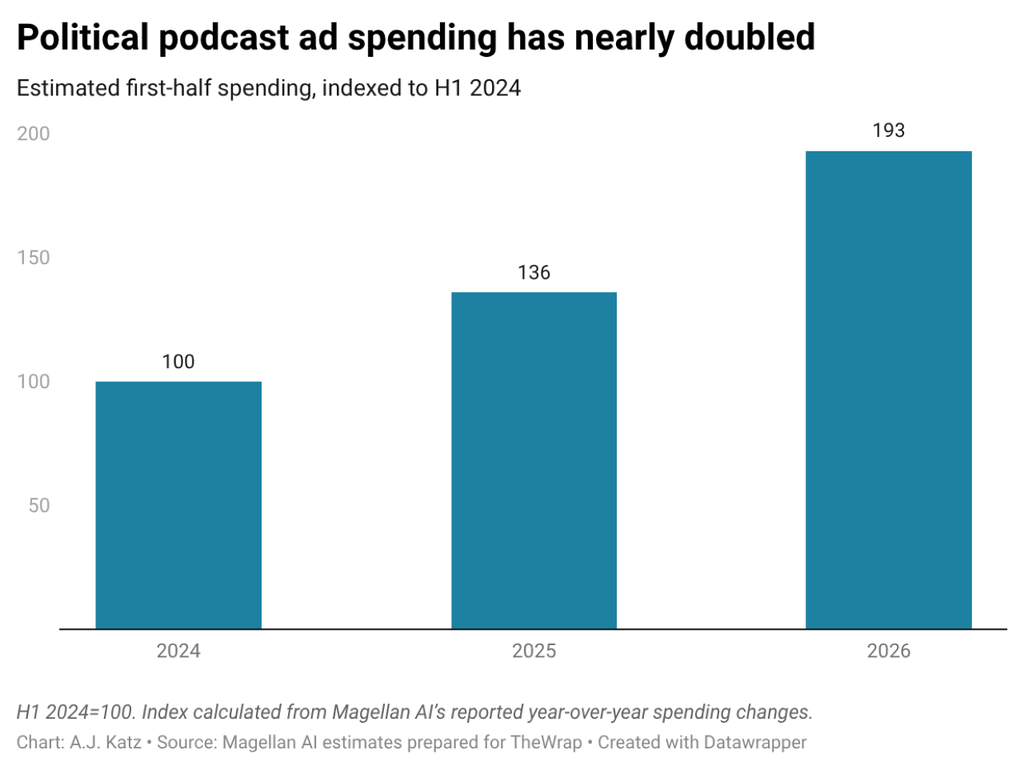
Ad spending on political podcasts jumped 42% in the first half of 2026 after rising 36% during the same period last year, according to Magellan AI estimates provided to TheWrap. Taken together, spending increased approximately 93% over two years.
For context, the broader U.S. podcast-advertising market grew 17.6% in 2025, while overall digital advertising increased 13.9%, according to IAB and PwC. Those figures cover the full year rather than the same reporting period.
The scale and composition of that growth suggest political podcasts are becoming a broader commercial advertising category rather than merely a destination for political campaigns and advocacy groups.
Interviews and industry data offered little evidence that the rapidly growing podcast dollars are coming directly from CNN, Fox News, MS NOW or the broadcast networks.
“Most of our clients avoid advertising on political podcasts across both audio and video formats,” Maria Tullin, senior vice president and managing director of performance audio at Horizon Media, told TheWrap. “The leading shows in this category tend to be highly opinionated, partisan or controversial, which generally conflicts with our brand-safety standards.”
Growth without a clear source
Where is the money coming from? It’s not confined to political campaigns or advocacy groups. Financial services ranked as the largest advertiser category for podcasts in Magellan’s Politics genre during the first half of 2026, followed by consumer services and software, nutritional supplements, business services and software, and food. The top 10 also included health services, nonprofits and religious organizations, insurance, telecommunications and auto.
Magellan categorizes shows using Apple Podcasts’ genres. Its sample includes roughly 240 ad-supported shows in the Politics category during each period, drawn from Apple Podcasts’ top 3,000 and additional programs that sell advertising. The firm said its estimates include podcast revenue across both audio and video.
The figures show substantial growth and participation from mainstream advertising categories. They do not reveal which budgets funded that growth or establish that the money was transferred from television news.
Bryan Barletta, a partner at the podcast-industry trade organization Sounds Profitable and president of Podcast Movement, described the market as fragmented rather than a clean, dollar-for-dollar shift from television.
“There isn’t one bucket,” Barletta said. “Depending on the advertiser, the money can come from podcast/audio, digital video, YouTube, creator/influencer, performance or integrated media budgets.”
At Horizon, Tullin said the source can depend on whether an advertiser is sponsoring an individual personality or buying from a network that can extend a campaign across several platforms.
That accounting makes substitution difficult to prove. Consumers may treat a cable-news segment, YouTube show and video podcast as interchangeable viewing options, while advertisers classify them as different products financed by separate teams.
“We should be careful about claiming a direct shift specifically from TV news to political podcasts,” Barletta said. “The data doesn’t prove that yet.”

SXSW to Launch Podcast Festival in 2027
When a podcast becomes television
YouTube is the biggest reason those distinctions are breaking down.
Forty percent of podcast listeners identified YouTube as their most-used podcast platform, more than twice the share for Spotify, according to research released in June by Sounds Profitable and JAR Podcast Solutions. YouTube was also a leading source of podcast discovery.
For advertisers, video changes the product. A show distributed on YouTube can pair a host-read integration with television’s sight, sound and motion, digital targeting and platform measurement. The same episode can be watched on a phone, computer or connected television.
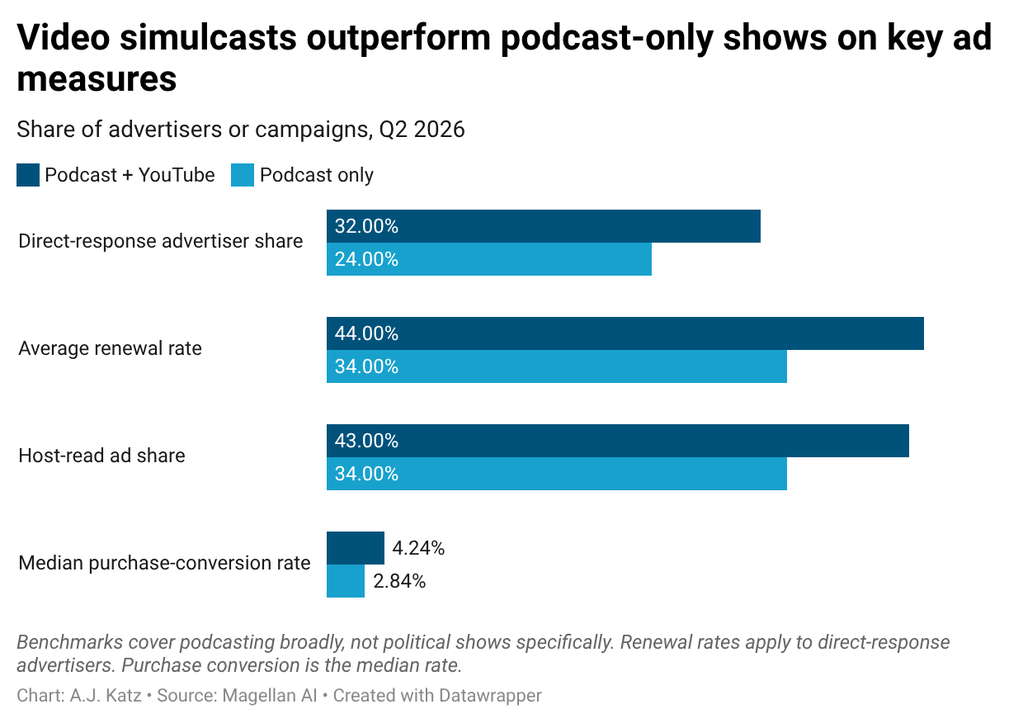
Magellan’s second-quarter advertising benchmarks show several differences between programs distributed as both podcasts and YouTube videos and those available only as podcasts. Direct-response brands represented a larger share of advertisers on simulcast shows. Magellan reported an average renewal rate of 44% for direct-response advertisers on simulcasts, versus 34% on podcast-only programs.
The median purchase-conversion rate for simulcasts reached 4.2%, compared with 2.8% for podcast-only shows, according to Magellan AI. Simulcasts also tended to carry more host-read advertising. The benchmarks cover podcasting broadly rather than political programming specifically, but they help explain why adding YouTube can make a show more attractive to advertisers.
“If someone watches a 90-minute political podcast through YouTube on their television, is that podcasting, digital video, YouTube or TV?” Barletta said. “To the consumer, it’s just a show.”
Tullin said YouTube captures a substantial share of video-podcast consumption, although increased video investment by Spotify and Apple could diversify distribution. Video assets are likely to matter most to advertisers already active in broadcast news, she said, while audio-first podcasts can still provide reach for brands deliberately seeking politically engaged audiences.

Lower costs, greater brand risk
Podcasts have grown more popular with advertisers because they offer relatively low costs, long stretches of audience attention and a close relationship between hosts and listeners. But political personalities can also present greater brand-suitability concerns than professionally produced television news.
Tullin said podcast inventory is less expensive than television, but brand safety is “significantly more complicated” because fewer guardrails constrain what hosts can say. Horizon uses third-party tools such as Barometer to evaluate shows against each client’s suitability standards.
That helps explain why competition for attention does not automatically produce competition for the same advertising dollars. A company willing to advertise during professionally produced coverage of politics may refuse to appear alongside a partisan personality discussing the same subject.
Barletta said episode-level contextual analysis has made those decisions more precise, allowing advertisers to assess particular content rather than reject an entire show or category. Better screening, however, cannot eliminate the reputational risk or persuade a brand that does not want to appear around polarizing political material.
The potential reward is an attentive audience. Sounds Profitable found that 86% of daily podcast users recalled hearing a podcast advertisement during the previous week — the highest rate among the ad-supported media it tested. Eighty percent said they trusted podcast advertising. The findings came from a Signal Hill Insights survey of more than 5,000 U.S. adults.
Those results explain advertisers’ interest in podcasting broadly. They do not demonstrate that mainstream brands are abandoning TV news to fund political shows.
For now, the growth in spending is clearer than its source. Political video podcasts are attracting more advertising and blurring the line between podcasting and television, but the available evidence does not show that they are taking TV-news dollars at scale.
