
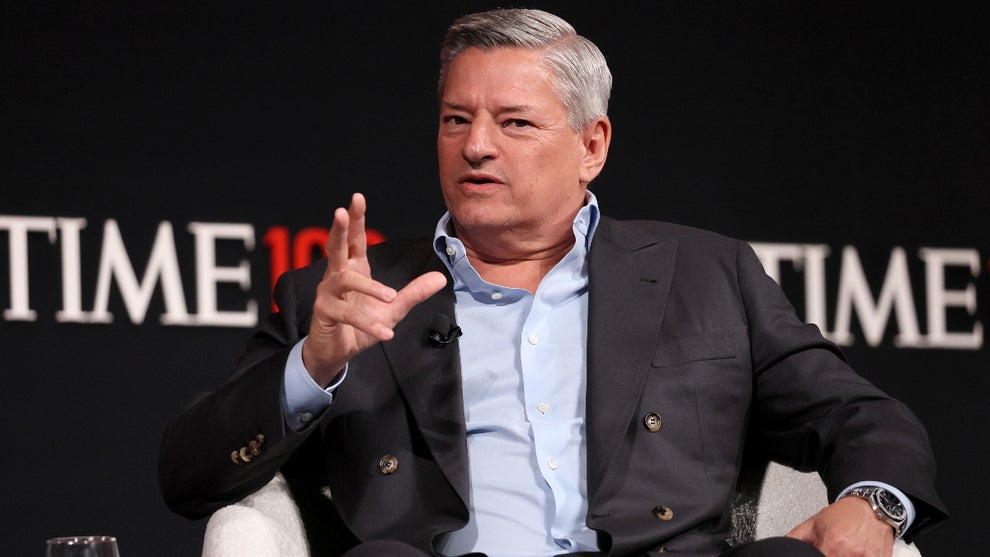
Netflix co-CEO Ted Sarandos is brushing off a threat from President Donald Trump to fire the streamer’s board member Susan Rice or “pay the consequences.”
In a Truth Social post over the weekend, Trump called Rice “racist” and “deranged” and said the former U.S. ambassador and national security adviser has “no talent or skills” should be fired immediately after she warned that corporations who “bent the knee” to Trump could face consequences if Democrats return to power.
“HER POWER IS GONE, AND WILL NEVER BE BACK,” he continued. “How much is she being paid, and for what??? Thank you for your attention to this matter.”
When asked for his response to the president during an interview with BBC Radio 4’s “Today” program on Monday, Sarandos replied: “He likes to do a lot of things on social media.”
“This is a business deal. It’s not a political deal,” Sarandos added. “This deal is run by the Department of Justice in the U.S. and regulators throughout Europe and around the world.”

Sarandos’ remarks come as Paramount CEO David Ellison will have until 11:59 p.m. ET on Monday to submit his “best and final” offer for Warner Bros. Discovery, which agreed to reopen talks for seven days. Netflix, which has a signed $83 billion deal to acquire Warner’s streaming and studio assets, has the opportunity to match any counter offer from Paramount.
Netflix is offering $27.75 per share plus additional “stub equity” from the pending spinoff of Warner’s cable networks into a standalone company called Discovery Global, which is on track to be completed later this year. A shareholder vote on the Netflix deal is also set for March 20 at 8 a.m. ET.
Ellison has previously submitted nine bids for the entire company that were rejected by WBD’s board. After losing out to Netflix, Paramount launched a $108.4 billion hostile takeover bid that was taken directly to shareholders. He also sued Warner Bros. in January in an effort to extract more details about how the Netflix deal and pending Discovery Global spinoff were valued.
Though Paramount said it is “prepared to engage in good faith and constructive discussions” with WBD, the company said it still plans to proceed with its tender offer, as well as a proxy fight it launched to get shareholders to oppose the Netflix deal and require a vote to complete the Discovery Global spinoff. Paramount also plans to nominate its own director candidates to WBD’s board at the company’s annual meeting.

In addition to responding to Trump’s threat to fire Rice, Sarandos made the case for his $83 billion deal.
“Our deal is growth,” he said, noting the company has spent $6 billion on original programming in the U.K. since 2020 and created 50,000 jobs in the country. ““This is a vertical merger. We’re buying assets that we don’t currently have — a movie studio and a distribution entity.”
In comparison, Sarandos argued that a Paramount-WBD combination is “the classic horizontal media mergers that are always bad for consumers, always bad for creators.” He warned that if successful, the number of Hollywood studios would be reduced from five to four. He also reiterated that Ellison would need $16 billion in cost cuts to reach Paramount’s delevering targets.
“You look at that and think, ‘Wow, this industry will be much smaller under that ownership than it would be under Netflix ownership,’” he said.
He also took aim at the role of three Middle Eastern sovereign wealth funds backing Paramount’s bid, noting it’s a “bad idea, typically” for foreign governments to hold a financial stake in news networks. He added that they are “not very big on the First Amendment” and said Paramount’s argument that they would exercise no editorial influence over CNN and CBS “seems very odd to me, with the level of investment that we’re talking about.”

Additionally, he knocked James Cameron’s letter to Sen. Mike Lee that Netflix would have a “disastrous” impact on the theatrical business as “disingenuous,” noting that he personally met with Cameron in December to discuss Netflix’s commitment to a 45-day theatrical window for Warner Bros. films.
“We spent five minutes of our conversation on that, and we talked mostly about these glasses that he’s developing for Meta to watch movies at home,” Sarandos said.
He added that the average Netflix member watches seven movies a month, compared with the average American’s two cinema visits a year.
“If more people see movies, the better, deeper, richer relationship they have with movies,” he said. “I don’t lose any business to the movie theaters.”
Sarandos also pushed back against claims that Netflix was crowding out local British television, noting that only 17 of the 59 productions the streamer has underway in the U.K. are non-British projects. He also said he would’ve made ITV’s “Mr. Bates vs the Post Office” in a “heartbeat” when directly asked.
“I’m shocked that people use that example,” he added.
The executive also weighed in on a proposal that would require major streamers to contribute 5% of their U.K. subscriber revenue to a cultural fund for British-focused drama.
“Incentive works much better than obligation,” he said, noting that the requirement could undermine the economic gains that the U.K. has seen through production incentives.
Additionally, he pointed to YouTube as a major Netflix rival and said local broadcasters are helping the Google-owned tech giant grow at their own expense by providing the platform with free programming. Around 55% of YouTube viewing is taking place on TV sets, according to the local measurement firm Barb, while Netflix accounts for around 9% of TV viewing time in the U.K.
“That’s a zero sum game — the time that you spend on a connected TV, if you’re watching one app, you’re not watching broadcast, you’re not watching BBC, you’re not watching ITV and you’re not watching any other streaming service, including Netflix,” he said. “What surprises me all the time is the studios and the networks around the world, including the BBC actually, just continue to feed them free programming. Of course they’re growing so fast. And then people want to make an argument whether or not it’s television. It is literally television.”
Watch the full interview with Sarandos here.
