

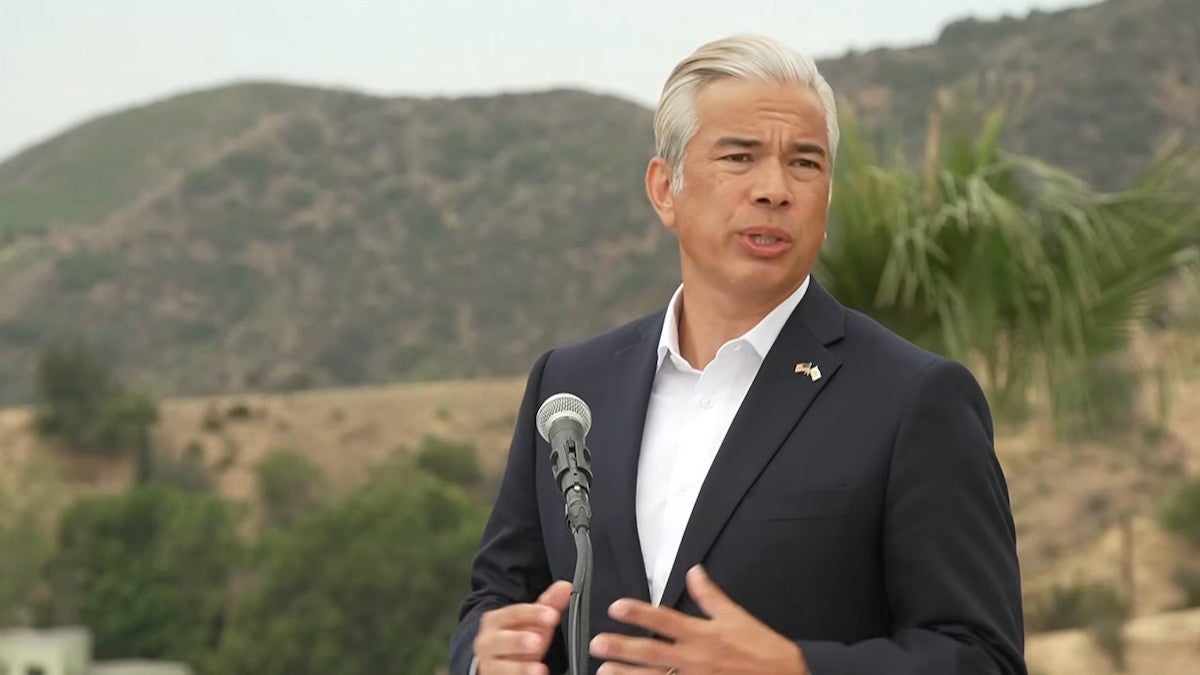
When California Attorney General Rob Bonta announced during a press conference Monday that he was leading a coalition of states to block Paramount’s proposed $110 billion merger with Warner Bros. Discovery, he framed the move as a fight to protect consumers and preserve competition in the entertainment business.
It may certainly be that.
But it also looks like something else: a political battle dressed up as an antitrust lawsuit. Bonta, who held his press conference outdoors with the iconic Hollywood sign as a backdrop, warned that the lawsuit needed to be “a check on billionaires,” hailed the need for “affordability” in jobs and said antitrust was a “check on a president trying to hand-pick winners and losers.” This was hardly a legal case.
When asked whether the lawsuit was politically motivated because it was brought solely by Democratic attorneys general, Bonta rejected the premise of the question, saying his office pursues antitrust cases “based on the facts and the law,” not politics. He noted previous merger challenges involving Ticketmaster-Live Nation and Nexstar-Tegna drew bipartisan support and said Republican attorneys general remain welcome to join the case.
And it’s not to say the case isn’t sound. Twelve (all Democrat) attorneys general undoubtedly believe there may be legitimate competitive concerns, and states certainly have the right to challenge mergers under federal and state law. But believing a merger raises concerns is different from a case having a realistic chance of convincing a federal judge to stop it from happening.
Analysts at the research firm Washington Analysis concluded the attorneys general had pleaded “a viable case,” but said the complaint was “light on evidence,” adding that future court filings would be more revealing in assessing the strength of the states’ claims.
That’s where the states’ case begins to look less like a potential courtroom victory and more like an attempt to draw a sharp contrast with the Trump administration.
After all, Trump’s Justice Department already conducted its own review of the proposed merger and chose not to sue (even if the approval had its own share of controversy). While federal approval doesn’t prevent states from bringing their own legal challenge, it does leave them trying to persuade a judge that Washington got one of the biggest media mergers ever totally wrong.
While not without precedent (just look at the failed Kroger-Albertsons merger), it’s still a steep hill to climb.
For his part, Bonta pointed to his track record. “We have won over 80% of the time,” he said. “We bring cases when we think we will win, and we think the facts and the law are on our side.”

The Paramount acquisition of Warner Bros. Discovery has always been mired in politics. With billionaire owner Larry Ellison looming as a right-wing bogeyman controlling far too many assets in media and entertainment than most people are comfortable with — including CNN, CBS News, the U.S. version of TikTok and two legacy Hollywood studios — politics is on everyone’s mind. And with Trump’s constant meddling in what should have been a hands-off business transaction, the political pushback on the left is understandable.
But Paramount’s central argument — that greater scale is necessary to compete against mega brands like Disney and Netflix, not to mention giants like Google (YouTube) and Amazon — isn’t just an easy talking point. It’s the same argument that has driven years of consolidation across the media industry.
This coalition of 12 states, on the other hand, is asking the court to focus on the shrinking number of Hollywood studios that are capable of producing films and TV programming. From a layperson’s standpoint, this seems like a coherent legal theory, but one that might feel increasingly disconnected from how audiences are consuming media in 2026. Raising the specter of Paramount controlling “half of cable” is not the threat Bonta might think.
Still, litigation can delay a merger. It can be expensive, especially with a self-imposed “ticking fee” Paramount must pay if the deal goes beyond Sept. 30. It can also create uncertainty for staffers, and if the states actually succeed in slowing the deal, they may accomplish part of what they set out to do even if they don’t end up winning.
But a delay is not a win.
The lawsuit’s greatest significance may ultimately be political rather than legal. Democratic attorneys general are able to signal a more aggressive approach to corporate consolidation than the conservative Trump administration is.
That’s a political move. Voters elect attorneys general not only to enforce the law but also to shape which matters should be enforced (seven of them are up for re-election later this year).
Still, if the question is whether this particular lawsuit is built to win — or built to make a political point — the evidence today points more toward the latter.
