
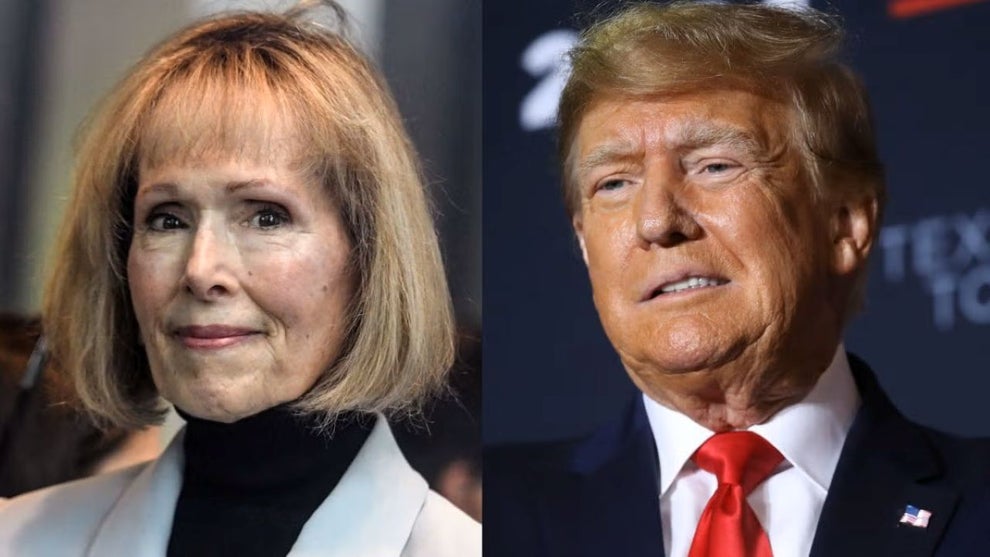
President Donald Trump on Tuesday asked the U.S. Supreme Court to review whether statements he made to reporters from the White House denying E. Jean Carroll’s sexual assault allegations are protected presidential acts, seeking to overturn the $83.3 million defamation judgment against him.
The petition frames the dispute as a constitutional question extending beyond Trump’s legal battle with Carroll, arguing that a president’s public responses to questions from the press about matters bearing on his fitness for office are official communications protected by presidential immunity.
A separate petition filed by the Justice Department asks the justices to revive the government’s effort to substitute the United States as the defendant under the Westfall Act, arguing Trump’s statements fell within the scope of his official duties and should not have exposed him to personal liability.

The case stems from statements Trump made in June 2019 after Carroll publicly accused him of sexually assaulting her in a Bergdorf Goodman dressing room in the mid-1990s. Trump denied the allegations in a statement distributed by the White House Press Office before repeating those denials a day later while taking questions from reporters on the White House lawn during a press availability that also covered the economy, foreign policy and national security.
Trump’s attorneys argue those exchanges with the press were not personal remarks but official presidential communications made in response to allegations directly implicating his ability to serve as president. The petition contends the U.S. Second Circuit Court improperly declined to decide that question after concluding Trump had forfeited his presidential immunity defense on procedural grounds, despite the Supreme Court’s 2024 ruling recognizing broad immunity for official presidential acts.
“This is the first case in our Nation’s history in which a court has imposed damages liability on a President for his conduct in office,” Trump’s petition states, warning that allowing the judgment to stand could chill future presidents’ willingness to communicate publicly while carrying out their official duties.
A Manhattan jury awarded Carroll $83.3 million in January 2024 after finding Trump defamed her by repeatedly denying her allegations and attacking her credibility. The U.S. Second Circuit Court of Appeals later upheld the verdict.
The latest filings come weeks after the Supreme Court declined to hear Trump’s appeal of a separate $5 million judgment involving Carroll. If the justices agree to hear either of the new petitions, the case could become yet another test of the scope of presidential immunity — and whether a president’s communications with reporters from the White House constitute protected official conduct or personal speech subject to defamation liability.
