
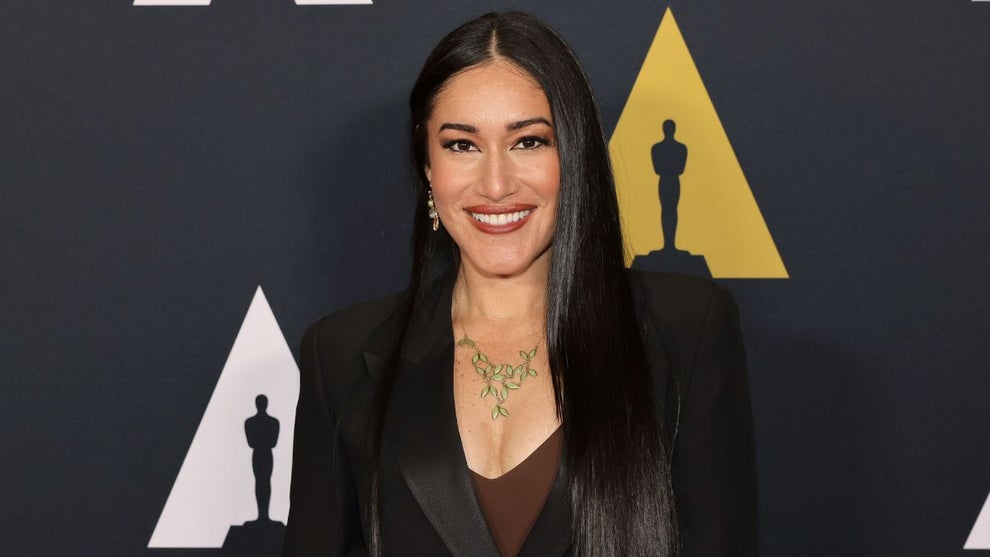
Director James Cameron and The Walt Disney Company are facing a lawsuit alleging the unauthorized use of an Indigenous actress’ likeness in the “Avatar” franchise without her consent.
In a complaint obtained by TheWrap, actress Q’orianka Kilcher alleges that Cameron used her facial features, taken from a published photograph when she was 14 years old, as the basis for the Na’vi character Neytiri in the “Avatar” franchise. Kilcher, who at the time had portrayed Pocahontas in Terrence Malick’s “The New World,” claims her likeness was extracted from a Los Angeles Times image and incorporated into early character design work.
“The plaintiff never consented to Defendants’ use of her likeness, either in Avatar or in any related product or promotion,” the filing states.
The lawsuit, filed Tuesday in U.S. District Court for the Central District of California, names Cameron, Lightstorm Entertainment, The Walt Disney Company, 20th Century Studios, Industrial Light & Magic, Weta Digital and other visual effects vendors, alleging Kilcher’s image was reproduced across multiple stages of production, including sketches, sculptures and digital models distributed across art departments and VFX pipelines, ultimately appearing in films, posters and marketing materials, sequels and merchandise.

“What Cameron did was not inspiration, it was extraction,” Kilcher’s lawyer Arnold P. Peter said in a statement. “He took the unique biometric facial features of a 14-year-old Indigenous girl, ran them through an industrial production process, and generated billions of dollars in profit without ever once asking her permission. That is not filmmaking. That is theft.”
Kilcher and Cameron reportedly met briefly at a 2010 charity event following the 2009 release of “Avatar.” According to the complaint, Cameron later invited her to his office, where she was given a framed sketch of Neytiri accompanied by a handwritten note reading: “Your beauty was my early inspiration for Neytiri. Too bad you were shooting another movie. Next time.”
“When I received Cameron’s sketch, I believed it was a personal gesture, at most a loose inspiration tied to casting and my activism,” Kilcher said in a press release accompanying the lawsuit. “Millions of people opened their hearts to ‘Avatar’ because they believed in its message and I was one of them. I never imagined that someone I trusted would systematically use my face as part of an elaborate design process and integrate it into a production pipeline without my knowledge or consent. That crosses a major line. This act is deeply wrong.”
The complaint alleges Kilcher only learned of the alleged use last year after a video interview with Cameron resurfaced online, in which he discusses Neytiri’s design. “The actual source for this was a photo in the L.A. Times, a young actress named Q’orianka Kilcher,” Cameron says in the interview. “This is actually her… her lower face. She had a very interesting face.”
Kilcher also alleges violations under California’s recently enacted deepfake-related statute, along with claims including misappropriation of likeness, invasion of privacy, defamation, negligence and interference with economic advantage. Her attorneys further argue that the alleged use of her likeness in scenes involving sexual content constitutes an unauthorized digital replica in an explicit context.
Kilcher disputes that she was unavailable during casting and claims she was never given an opportunity to audition for the role. Her legal team also alleges that her representatives attempted to secure her a reading for the project at the time.
The original “Avatar” film grossed more than $2.92 billion worldwide and remains one of the highest-grossing films in history. The franchise has since expanded into multiple sequels and is among Hollywood’s most commercially successful properties.
The complaint seeks compensatory and punitive damages, disgorgement of profits, injunctive relief and corrective public disclosure, including an order barring further use of Kilcher’s likeness.
Kilcher has appeared in TV series including “Yellowstone” and “The Alienist.”
Representatives for Cameron, Disney did not immediately respond to TheWrap’s requests for comment.
