
“I appreciate the pushback.” With those four seemingly innocuous words, Hank Green — one of the most beloved and respected education creators around — set off a bomb within the creator community about when AI should be used and how it should be disclosed.
During an episode of Green’s “Ask Hank Anything” earlier this month, the science and education creator used that four-word phrase, which commonly appears in AI responses, in a video discussing human language. That was enough for Green’s fans to suspect that he was reading from an AI-generated script. Green denied that he was reading from a script but admitted to using AI in his research.
That’s when things got ugly.
The backlash against his AI usage was so swift and strong that within days of the snafu, Green posted a long Reddit post about his use of the tech and announced he was slowing down production of his YouTube channels “Hank’s Channel,” “SMUSH” and “4×3” as he grapples with next steps. Green then announced his new rules for how he will be using AI in his work, assuring fans that no portion of any script will ever be written, edited or outlined by a large language model and that no images or music used in a video will be generated by an LLM.
The response, which comes at a time when companies are eagerly pushing AI tools that promise faster and cheaper content, shows how creators have found themselves on the front lines of the war over AI in entertainment. Though AI is everywhere these days, there is a growing contingent of people who seem repulsed by the technology. And these people aren’t old fogies. Around 37% of teenagers aged 13 to 17 said they feel embarrassed or cringe when they encounter AI-generated music and videos, according to a study from market research firm YPulse, and more than half worry about AI spreading misinformation and deepfakes.

The response has been varied, from Green’s apology to more thoughtful discussion of AI usage even if the topic has become a minefield. The level of AI acceptance also varies from platform to platform, as well as by creator and subject. But almost everyone agrees there needs to be more transparency.
“It’s finally opened up that can of worms, or just that conversation that I think everyone’s been scooting around for months, if not a year or two,” Dave Jorgeson, the co-founder of Local News International Media, told TheWrap.
Certain members of Gen Alpha have started saying “That’s AI” instead of saying “That’s BS.” At the same time as this backlash is growing, Meta and Alphabet — the parent companies behind Instagram and YouTube — both increased their capital expenditures during their latest earnings reports, citing increased spending on AI as a reason. Both companies saw a drop in the stock market after those announcements, despite posting impressive quarters.
Green’s fans have since calmed down with many praising his transparency and speed when it comes to addressing audience concerns. But the ordeal has led to a quiet reckoning among several in the creator industry as they grapple with how to use this new and increasingly omnipresent technology.
Balancing human and the machine
Ever since Jorgeson left the Washington Post to be independent, he’s made it a policy for LNI to not use AI in its videos. That means hiring a researcher for the company and having a human create all of LNI’s graphics.
“I’m very aware, especially on YouTube, of the audience’s feeling about it, which is mostly they don’t want any AI or at the very least generative AI,” he said. “There’s also a bigger conversation we have here too about the level of AI that people are using.”
Colin Rosenblum and Samir Chaudry, two creator experts behind the podcast “The Colin and Samir Show” as well as the newsletter The Publish Press, have a more lenient take on AI. However, the Green situation inspired them to meet with their team and come up with AI policies for their newsroom. They posted that entire conversation — disagreements and all — on their YouTube channel.
“[How creators should use AI] is very subjective to individuals right now, and there’s a lot of trades that people aren’t willing to make,” Chaudry told TheWrap. “What I would hate is for people to get shy about talking about this stuff.”

It’s not just Green who’s seen backlash. Several creators who participated in an “adult summer camp” hosted by OpenAI saw a wave of disapproval in the comments on their posts from the trip. The disapproval became so severe that a representative for OpenAI responded to the controversy, saying, “We welcome healthy debate as AI becomes more prevalent.”
AI usage is also impacting brand deals, one of the biggest sources of revenue for many creators. Dayna Carney, the founder of the social-first agency Dayna’s House, explained that the brands who work with her company are always looking for creators who produce authentic content. A huge reason for that preference comes down to the negative responses many audiences have to AI-generated content. Typically, the comment section for a creator-driven brand campaign is a gold mine for audience insights.
“When it’s AI, you don’t get that from the comments. The comments are just ‘This is AI’ and people arguing about what is and what’s not actual content,” Carney told TheWrap. “There’s a lot of sensitivity around it on both sides.”
How AI shows up on different platforms
How much AI is tolerated depends on a creator’s specific audience. For example, Green, a creator who has positioned himself as a reliable authority and whose work has appeared in many Gen Z classrooms, has an audience that sees AI usage as a betrayal. However, someone like Brandon B, a special effects creator who has over 16 million YouTube subscribers and has been outspoken about YouTube and Adobe’s AI tools for creators, may have an audience that’s more open to AI usage.
But which platform a creator typically posts on does have an effect on how audiences may respond to AI.
“Reels specifically and Instagram in general have had less of a sense of quality control [when it comes to AI],” Adam Bumas, head of research at Garbage Media, a creator-led news organization that was founded by several former BuzzFeed employees, told TheWrap. “Unlike YouTube, they emphasize the infinite scroll more. It’s a lot easier for an AI-generated Reel to proliferate when there’s less of an expectation that a user is going to be deciding what they see.”
AI also appears often on TikTok, especially AI-generated creators who try to hawk cheap goods to consumers through the TikTok Shop. But due to the overall ethos of TikTok, which values more candid and human day-in-the-life videos compared to other platforms, many TikTok users are quick to call out that content.

“AI has been ruthlessly trained to make its content look as professional as possible,” Bumas said. “Even if you train it to look as candid as a TikTok video is supposed to be, it’s going to be a lot harder than making it look serious and edited and professional.”
Perhaps surprisingly, content from AI-generated creators has lower engagement rates on Instagram than other shortform platforms, according to CreatorIQ. And YouTube Shorts used to have a massive “AI slop” problem, a phrase used to describe low-quality content that is often off-putting. The influx of AI slop largely came from the generative AI tools YouTube added to the platform, but YouTube has started to crack down on this type of content.
As for YouTube proper, the creator home for longform content has a user base that aggressively prefers content made by people rather than AI.
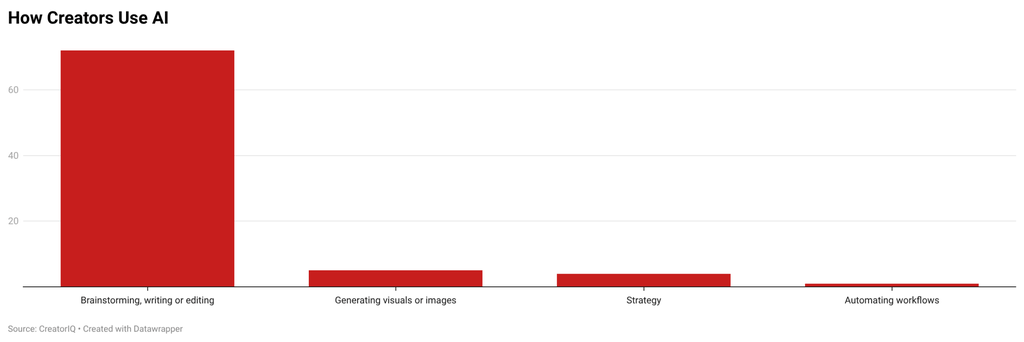
“Our State of Creators Report found that, out of over 5,000 creators, just 5% use AI for generating visuals or images, whereas more than 50% use AI for brainstorming, writing and editing,” Alex Rawitz, director of research and insights at CreatorIQ, told TheWrap. That report also found that AI adoption for creators is still primarily focused on backend processes. Nearly three-fourths (72%) of creators reported that they use AI tools for brainstorming, writing or editing. Only 4% used AI for strategy, and 1% used it to automate workflows.
Different AI limits for different creators
The way Jorgenson sees it, it’s nearly impossible not to use AI if you’re making any kind of content these days. If you search for something on Google, you’re exposed to AI summaries. Platforms like TikTok and YouTube use AI to automatically dub and subtitle videos. Even this article — which was written and researched with no AI usage outside of what Google automatically provides — relied on an AI service to transcribe interviews.
“We need to classify those things because there are tools where [AI] is super helpful, and it’s not affecting your critical thinking. It’s just helping your workflow,” Jorgenson said. “But we don’t have any ways to classify these different types of AI.”
Figuring out these gray areas was exactly the purpose of Rosenblum and Chaudry’s video, “We need to talk about the Hank Green situation.” Throughout the video, both hosts emerge as defenders of the technology as they explain why they use AI to help them outline videos or conduct early rounds of research. Rosenblum in particular defends this use of AI, citing that the years he’s spent developing his voice as a storyteller let him use the technology as a tool rather than a crutch or a machine that thinks for him.
But repeatedly, the Gen Z members of The Publish Press push back, pointing out the environmental concerns connected to AI, the lack of trust in the technology among their demographic and the fact that AI has replaced the roles of many entry-level workers.

“It’s hard for a 23-year-old on our team to believe this, but when I graduated college, Mark Zuckerberg was an aspirational person,” Chaudry said, pointing out that the climate of the 2000s and 2010s have given many Millennials a more optimistic outlook toward rapidly evolving technology. “The Gen Z people on our team, their predisposition is that it’s being imposed on them because they didn’t grow up in a world without it.”
Chaudry also highlighted a part of the Green story that hasn’t been covered as much: Green’s explanation that he only started to increase his AI usage so that he could create more content.
“That’s the broader question in the creator economy right now — the trade for efficiency. The difference between studios in the past and creator companies is that creator companies are rooted in talent,” Chaudry explained. “If you’re a true creative, you’re not scalable. You have perspective and taste, and you want to watch everything before it goes out. But, as you start growing your company, revenue starts to become a factor. You try and grow in revenue, grow in surface areas for advertising, grow in content formats, but as the creator, your desire is to still look at everything, watch everything and to be in the edits. That creates a situation where, of course, you’re going to look for efficiencies.”
No one TheWrap spoke to knew of other creators beyond Green and Rosenblum and Chaudry publicizing their AI stances in the wake of this discourse. However, all of them suspected that serious conversations about AI have been happening for nearly all creators behind closed doors.
@davejorgenson Was Meta really using your private Instagram photos for AI? Meta has axed a controversial feature that allowed users to modify photos from public Instagram accounts using AI. The feature, which was rolled out earlier this week along with a batch of other AI tools, “missed the mark” and is no longer available, according to the company. Earlier last week, Meta announced Muse Image, a new AI image generator built by Meta Superintelligence Labs, its dedicated AI unit. Meta promoted one feature that allowed individuals to generate images by @-mentioning public Instagram accounts that they wanted to reference. The feature, which wasn’t designed to alert a user if their photos were used in this way, prompted immediate backlash. This was made in collaboration with the @MediaWise ♬ original sound – Dave Jorgenson 🕺
A future hope for more transparency
Regardless of how tolerated or hated AI may become in the coming months, most people TheWrap spoke to emphasized that there should be more transparency about the topic overall, both from platforms and creators.
“People start to put their guards up when they see AI,” Carney said, noting that people often feel a sense of betrayal or anger when they learn a video they thought was real turns out to be AI. “When trust is broken, guards come back up and people exit out. That’s when things start snowballing.”
Jorgenson believes a scale could be a possible fix. For example, if a piece of content is given an AI rating of a 1, that could mean the creator used Google to assist in their research. But on the other side, a 10 would indicate a fully blown AI-generated video or post. Certain platforms are already doing some version of this with Facebook releasing badges to identify real users from AI ones and Spotify releasing labels for AI artists and removing their work from algorithmic or editorial recommendations.
“Maybe it’s not saying exactly what you have to do as a newsroom but basically giving designating levels to [AI usage]. Like if you’re going to use this much AI, you should just say it explicitly, versus having this vague policy of, ‘Oh, we don’t really use AI except for maybe this,’” Jorgenson said.
“I don’t think that deciding to integrate AI into your production — whatever you’re producing — is something you can do with zero reputational cost,” Bumas said. “That doesn’t even necessarily mean it’s a bad idea. There are a lot of circles where using AI tools is so expected as to be not even thought about. But I think it would be good to consider that maybe there are some costs here that creators ought to factor into the equation.”
