
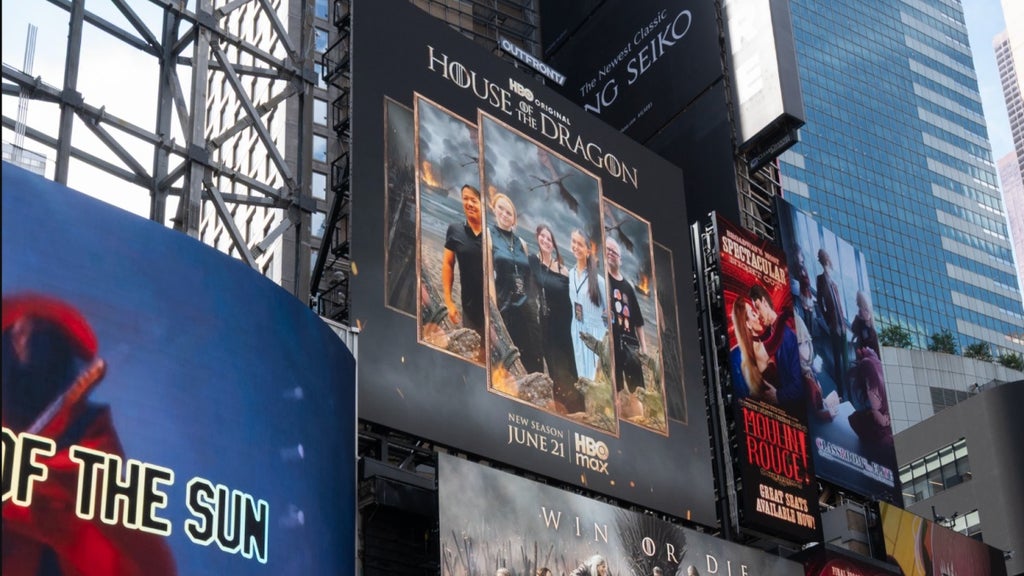
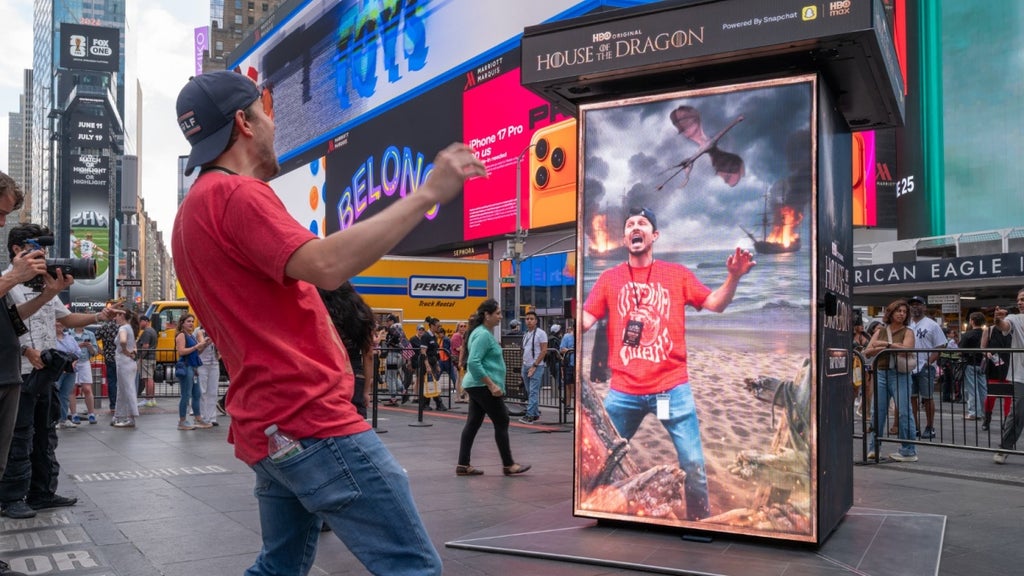
On Thursday, “House of the Dragon” fans could see themselves on a Times Square billboard, framed by the iconic Iron Throne.
At first glance, the collaboration between HBO, Snapchat and Outfront Media’s Duffy’s Duo billboards may seem random. But in reality, it’s the latest example of Hollywood’s deepening relationship with Snapchat.
In order to be part of the one-day-only experience, people had to get their photo taken by Snapchat’s first-of-its-kind four-sided augmented reality mirror. Appropriate photos were then broadcast to Outfront Media’s nearby billboard, which showcased a rotating group of people posing among AR-generated crowns and dragons. As part of the campaign, HBO Max also added the same AR Lenses displayed in Times Square to the Snapchat platform. This is in addition to the Sponsored Snaps, Snap Ads and Story Ads with behind-the-scenes Season 3 footage the streamer is rolling out on the app.
By now, it’s well known how nearly all of the major social media platforms interact with the TV and film industries. YouTube is the go-to home for trailers and has a video-on-demand option. TikTok and Instagram Reels are great at the short-form game, circulating buzzy clips from official channels. Instagram, X and increasingly Threads are helpful when it comes to announcements that don’t necessarily require video, like casting news.
While often missing from the broader social conversation, Snapchat has quietly become a vital way for Hollywood to raise awareness on upcoming films and shows among Gen Z audiences. The box office surprises of “Backrooms” and “Obsessions,” both fueled by enthusiastic younger viewers, illustrate just how important this demographic is and why Hollywood is so desperate to court them.

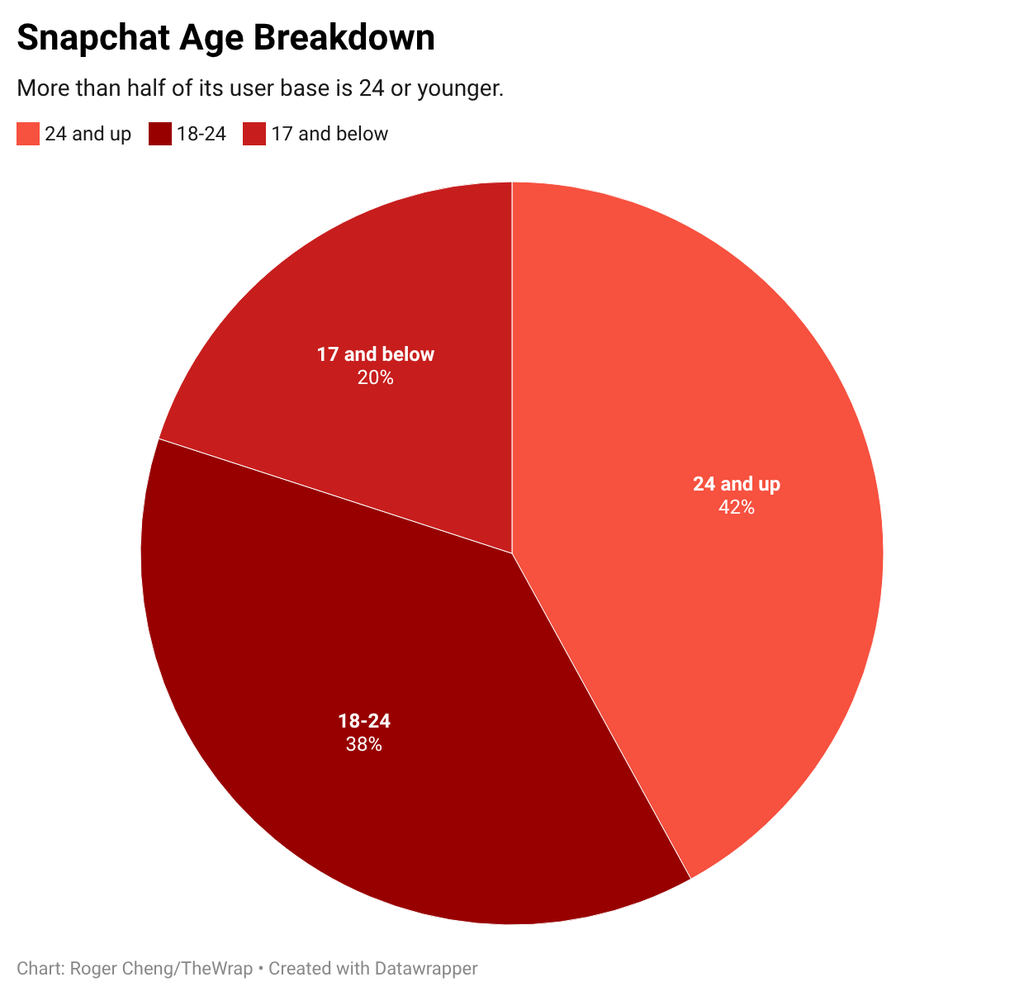
Snapchat has a line to the demo like few other platforms. During the first quarter, the company reported having 956 million global monthly active users, a 5% year-over-year lift. More than 38% of Snapchat’s users fall between the ages of 18 and 24, while users 24 years or older make up less than 42% of the app’s user base. (The other roughly 20% of users are under the age of 18 with more than 18% falling in the 13- to 17-year-old range.)
“We lean on that platform strongly for their reach against Gen Z,” Danielle Otero, executive vice president of global paid media and analytics at Lionsgate, told TheWrap. “They’re unique in that space, and they reach [Gen Z] on more of a one-to-one and more personalized basis than some of the other social platforms do.”
Lionsgate’s campaign for “Michael” included a virtual dance party that let users’ Bitmojis — customized avatars that look like users — perform Michael Jackson’s moonwalk together using augmented reality, an interactive technology that overlays digital information, like customized cartoon avatars, onto the real world. That AR Lens reached over 8 million users and engagement was 124% higher than the platform standard.
“Snapchat is not going to be a leaned back video experience. To me, our differentiator is that we drive engagement,” Laurel Duquette, the global director of media and entertainment at Snap, told TheWrap. “Snapchat drives these water-cooler fandom moments.”
Through its use of AR technology and an app design that encourages users to post frequently throughout the day, Snapchat has emerged as a unique player in our social media landscape, one that often results in consistent engagement. And, though it’s rarely discussed, Hollywood’s marketing arms have noticed. Here’s how some of the biggest players in film and TV are capitalizing on one of the youngest and most tech-focused platforms in the game.
Remember Snapchat?
It may seem like a silly question to ask, but considering how young Snapchat’s user base skews — and how it has faded as one of the “hip” social media platforms for older users — it’s worth a quick refresher course.
Snapchat started as an instant messaging app that let people share photos, videos and messages with close friends connected through their phone numbers. Like Instagram Stories, those posts disappear after they’re viewed. Because of the temporary nature of Snapchat’s content, the platform has always attracted a user base that posts more authentic content. You’re much more likely to see a picture of your friend right after waking up on Snapchat than on Instagram, a platform that prioritizes more highly produced and aesthetic content.
As the creator ecosystem has evolved, creators started to use Snapchat to grow their audiences and offer followers a look into their daily lives. Whereas creators may only post on TikTok a few times a day and on Instagram a few times a week, it’s not unusual for Snapchat creators to post dozens of Snaps daily. For creators with large followings, those can include a branded post much like what you’d see on TikTok or Reels. For public creators, Snapchat offers a feed called Spotlight that lets viewers scroll through creator-made content that functions similarly to TikTok. Viewers can also check out public creators’ Stories, which are often a collection of short videos that tell one story.
Brand engagement has also evolved alongside the platform. A huge part of the Snapchat experience is the use of Lenses, augmented reality filters that were released in 2015 and let users digitally change their faces or backgrounds. (The company pushed its AR capabilities further this week, releasing Snapchat Specs, an AR-enabled pair of glasses that costs over $2,000.) In 2016, Snapchat introduced Bitmojis, customized cartoon avatars that can be used in both video snaps and messages.
Then, in 2017, the platform introduced Snap Map, an option that gave users the ability to share their location with friends. As Snap Map has evolved, it has become more sophisticated, showcasing tourist attractions, restaurants and theaters alongside friends’ locations. Brands can create customized Lenses, Bitmojis and map features to share with users — and many in Hollywood have.
Snapchat as a consistent engagement driver
Because the design of Snapchat encourages users to post casually and often, successful campaigns on the platform are designed to capitalize on that audience behavior.
There’s often a collaborative element. Take Lionsgate’s “Michael” campaigns, for example. Not only did the AR Lens let users post their Bitmojis dancing, but the filter also let users post the Bitmojis of up to two of their friends dancing beside them. The campaign also included an AR Lens that let users try on Jackson’s iconic sunglasses, and the Snap Map highlighted Regal, Cinemark and Dolby Theatre locations across the U.S.
From a user journey perspective, Snapchatters could play around with different silly filters promoting the movie and then, when they want to see where their friends are or check out posts about a nearby restaurant, they could see exactly where “Michael” was playing near them.
“Snapchat allows you to be your most authentic self, because it is more of a one-to-one experience versus a one-to-many experience like some of the other social platforms,” Otero said. “We want to develop campaigns that allow the user to lean in and become a part of the overall marketing campaign within the Snap interface.”
Embracing Snapchat’s AR edge can lead to impressive results. The Lens for the live-action version of “Lilo & Stitch” became the highest performing entertainment Lens on Snap, generating over 68 million organic views. The campaign served as a good example of Snapchat marrying its tech with Disney’s 3D assets. It’s not difficult to imagine why someone may want to film and post themselves with a cute, furry blue ball of chaos. In the first quarter, AR Lenses were used on Snapchat more than 9 billion times a day on average with about 75% of users engaging with AR Lenses.
Several brands have also capitalized on the interactive component of the platform. “Stranger Things,” for example, launched a real-life game with Chips Ahoy! where players scanned packages of cookies to win exclusive Upside Down Lenses and prizes, like a guitar inspired by Eddie Munson. The Snap Map reached over 450 million global monthly active users in the first quarter.
Even Snapchat’s chat function has become a place to advertise. The chat feature is where users can directly message other users they’re connected to or post about topics that interest them, similar to a Discord server.
“People are coming to [the platform] 30-plus times a day — sometimes 40, it really depends on the age — to connect with their friends. It’s the primary source of communication,” Duquette said. “We’ve launched trailers in chat. Through a multi-pronged approach, we’ve found a lot of success driving meaningful results for clients.”
A theatrical partner actually made Snapchat history as a campaign for “Wicked” was the first-ever Sponsored Snap on the platform. Tied to the premiere of the first movie, a message from Jonathan Bailey was sent directly to the inboxes of all U.S. Snapchat users who were 18 years or older. Though this may seem intrusive on other platforms, Snapchat’s more casual user base doesn’t seem to mind it.
“We found that Snapchatters are really open to seeing those types of advertisements in chat. Ideally, they’re tailored to the Snapchatter,” Duquette said. “It’s opened up this new area of our platform where people can interact with brands and choose to opt in.”
Building customized AR experiences
Ideally, the Snapchat team tries to plan for major TV and film campaigns six months to a year before their premieres.
The campaigns for “Superman,” “Minecraft” and “Lilo & Stitch,” for example, all took about six months of planning. This longer tail lets the team figure out creative ways to introduce Snapchatters to a show or movie while keeping the specific quirks of that audience’s fan base in mind.
But because developing AR content is less time intensive that creating a video game or physical merchandise, Snapchat is also able to quickly adapt to overnight hits. That’s what happened in the case of “Kpop Demon Hunters,” a movie that was quietly put on Netflix and has since gone on to become the streamer’s most-watched movie ever, surpassing 600 million views.
“Snapchat is the best at being agile and quick. We could develop a lens using our tech in two days, get it live and create hype and organic support,” Duquette said. “That’s something we see other platforms do. But when we have partners that are like, ‘I don’t have the time or money to develop an AR lens,’ we can say, ‘That’s OK. This is something that we can turn around in a few days.”
“They understand how to leverage AR well within their platform, and they have partners that they work with regularly that help assist in the development process,” Otero said. “We’re definitely prioritizing them as a partner for reaching that younger Gen Z audience and starting early conversations about creative development for how we can integrate them into future campaigns.”
