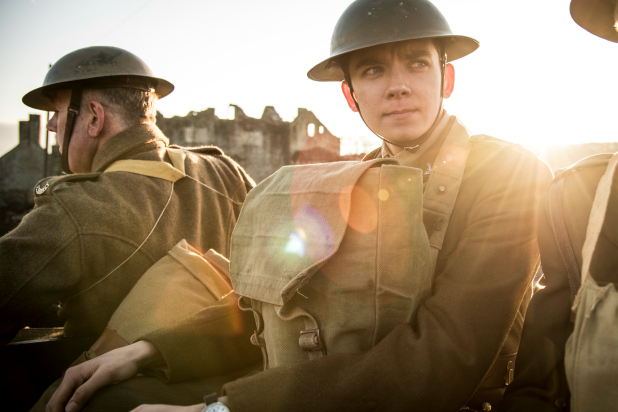
There’s no mistaking it. Saul Dibb’s “Journey’s End” looks, feels and plays exactly like the prototypical World War I movie, the kind we’ve all seen dozens of times already, if not more. But although that might read like some sort of insult, it’s not. It’s objectively true.
“Journey’s End” was originally written by English playwright R.C. Sherriff and first performed in 1928. Its intimate, suspenseful, and ultimately rather bleak portrayal of life and death in the trenches was adapted to the big screen by James Whale (“Frankenstein”) in 1930, and it has been remade and reinterpreted many, many more times over course of the last 90 years. The story and characters were so iconic that “Black Adder” did a whole season satirizing “Journey’s End,” and although it was hilarious, the episodes still managed to be earnestly mournful.
The new film, like most of the others, takes place in the British trenches in World War I, just yards away from the Germans. Tramping through the mud, the soldiers try to live like there’s some sort of tomorrow, but they know it’s only a matter of time before they will be asked to run over the wall, or before the Germans will come for them. Supplies are low, spirits are lower, and hope is AWOL.
Asa Butterfield (“The Space Between Us”) stars as Raleigh, a young soldier who only just arrived at the front, and who immediately requests to placed in the company of his old friend Capt. Stanhope (Sam Claflin), who is romantically involved with Raleigh’s sister. But the violence and terrors of continued warfare have frayed everybody’s nerves, and though once friendly and inspirational, Capt. Stanhope spends most of his time drowning his anxieties in liquor.
Raleigh, a child at heart (if not by age), is hardly a breath of fresh air for Stanhope’s company. To Stanhope, Raleigh is a reminder of how far he’s fallen, to be met only with suspicion and shame. The only person Stanhope truly trusts is Lt. Osborne (Paul Bettany), a former schoolteacher and the only person who seems capable of consistently keeping his head, a task which clearly weighs him down.
If there’s one thing director Dibb (“The Duchess”) understands, it’s muck. His characters trudge through slimy dirt in every scene, and their lives are equally mired as their boots. “Journey’s End” features scenes of wartime violence, but it’s mostly a character study staged in dimly lit underground bunkers, where the characters all find themselves huddled. One gets the distinct impression that they’d spend a lot of their time sitting in miserable silence if Raleigh hadn’t shown up, with no clue as to what awaits him or what’s in his company’s past. And one completely understands how little comfort he would be.
“Journey’s End” has been staged, and restaged, and inspired so many other similar stories that it’s now become difficult for the original to have a truly profound impact. Dibb dramatizes these events skillfully (Simon Reade wrote the adaptation of Sherriff’s play and novel) and has assembled a sturdy and dependable cast, but this new film doesn’t have a particularly new take on the material. It’s “Journey’s End,” told again, and told quite well. So whether or not it will astound you has a lot to do with how familiar you are with the source material.
Regardless of the baggage this story brings with it, or that anyone in the audience might have, there are moments of real beauty in Dibb’s version. Bettany gives an exemplary performance, soft yet steady. The highlight of this whole production is a moment that he shares with Butterfield, minutes before they have to climb the wall, probably to their certain doom.
Lt. Osborne, weary, wants to enjoy what will most assuredly be his last few minutes of peace by pretending the war does not exist and chit-chatting about nothing in particular. Raleigh can barely contain his excitement, or his nerves, and he wants to talk of nothing but their mission. Together they strive to have their half of the conversation, to each other’s frustration. They are together and apart, before and after, young and old, naive and wise, and they meet in the middle: Scared and scared.
There’s a word for a film like the new “Journey’s End,” and that word is “respectable.” There’s nothing about this production that falls flat; there’s nobody who doesn’t do their job. The film builds a fine and specific sense of place, the actors give performances we can believe in, and the drama is as tragic as one could reasonably expect.
Dibb’s adaptation will have less of an impact if you aren’t seeing this story play out for the first time, but if you are seeing it for the first time, it’s probably going to break your heart.
33 Classic World War II Movies, From 'Stalag 17' to 'Dunkirk' (Photos)
To celebrate Veterans Day, we take a look back at some of the most culturally and historically significant war films.
"A Walk in the Sun" (1945)
This film is based on the novel by Harry Brown and was directed by Lewis Milestone.
In 2016, the film was deemed "culturally, historically and aesthetically significant" by the United States Library of Congress, and selected for preservation in its National Film Registry.
Fox
"Battleground" (1949) A squad deals with being trapped in the besieged city of Bastogne.
MGM
"From Here to Eternity" (1953) The film is set in 1941 Hawaii and is about a private who is punished for not boxing on his unit's team. It stars Burt Lancaster, Montgomery Clift and Deborah Kerr.
Columbia
"Stalag 17" (1953) Starring William Holden and Don Taylor, a German POW camp barracks marketeer is suspected of being an informer when two American war prisoners are killed.
Paramount Pictures
"The Caine Mutiny" (1954) Starring Humphrey Bogart, Jose Ferrer and Van Johnson, it follows a U.S. Naval captain who shows signs of mental instability that jeopardizes the ship.
Columbia
"Bridge on the River Kwai" (1957) A British colonel cooperates to oversee a construction of a railway bridge for their captors after settling differences with a Japanese POW camp. It stars William Holden, Alec Guinness and Jack Hawkins.
Columbia
"The Guns of Navarone" (1961) A British team is sent to occupied Greek territory to destroy a massive German gun emplacement. It stars Gregory Peck, David Niven and Anthony Quinn.
Columbia Pictures
"The Longest Day" (1962) John Wayne and Robert Ryan star in the film following the events of D-Day.
20th Century Fox
"The Great Escape" (1963) Starring Steve McQueen and James Garner, Allied POWs plan for an escape from a German camp.
United Artists
"The Dirty Dozen" (1967) Starring Lee Marvin and Ernest Borgnine, a U.S. Army Major is assigned to lead convicted murderers to assassinate German officers in World War II.
MGM
"Where Eagles Dare" (1968) Starring Clint Eastwood and Richard Burton, allied agents stage a raid to free an American General.
MGM
"Battle of Britain" (1969) Michael Caine, Trevor Howard and Harry Andrews star in the film about the British Royal Air Force against the Nazi Germany Air Force.
United Artists
"Patton" (1970) The Francis J. Schaffner-directed film chronicles the careers of American general, George S. Patton.
20th Century Fox
"Kelly's Heroes" (1970) U.S. soldiers sneak across enemy lines to get their hands on Nazi treasure. The film stars Clint Eastwood, Don Rickles and Telly Savalas.
MGM
"Tora! Tora! Tora!" (1970) The film dramatizes the Japanese attack on Pearl Harbor.
"The Big Red One" (1980) Starring Lee Marvin, Mark Hamill and Robert Carradine, the film chronicles the story of a sergeant and his unit as they try to survive World War II.
United Artists
"Das Boot" (1981) Starring Jurgen Prochnow, Herbert Groenemeyer and Klaus Wennemann, the film chronicles the world of a WWII German U-boat.
Columbia
"Come and See" (1985)
This Soviet anti-war film was directed by Elen Klimov and was based on the 1978 book "I Am from the Fiery Village." The film focuses on the Nazi German occupation of Belarus as witnessed by a young Belarusian partisan teenager.
Mosfilm
"Empire of the Sun" (1987) Another Steven Spielberg-directed film stars Christian Bale and John Malkovich in the film about a young English boy who struggles to survive under Japanese occupation.
Warner Bros.
"A Midnight Clear" (1992) The film starring Peter Berg, Kevin Dillon and Arye Gross tells the story of the American intelligence unit which finds a German platoon wishing to surrender.
Columbia
"Saving Private Ryan" (1998) Starring Tom Hanks, Matt Damon, Tom Sizemore and Edward Burns, the film follows a group of U.S. soldiers that go behind enemy lines to retrieve a paratrooper.
DreamWorks
"The Thin Red Line" (1998) Terrence Malick's adaptation of James Jones' 1962 novel stars Jim Caviezel, Sean Penn and Nick Nolte, and focuses on the conflict at Guadalcanal.
"To End All Wars" (2001) Four Allied POWs endure hard treatment while they are captured by the Japanese during World War II. It stars Robert Carlyle and Kiefer Sutherland.
"Downfall" (2004) In the German biographical film, the final secretary of Adolf Hitler tells the story of the Fuehrer's final days.
Newmarket FIlms
"Flags of Our Fathers" (2006) Clint Eastwood directed this film also, starring Ryan Philippe, Barry Pepper and Joseph Cross. It follows the life stories of six men who raised the flat at the Battle of Iwo Jima.
Paramount Pictures
"Letters from Iwo Jima" (2006) Clint Eastwood directed the film about the battle of Iwo Jima between the U.S. and Imperial Japan.
Paramount Pictures
"Valkyrie" (2008) Tom Cruise, Bill Nighy and Carice van Houten star in the film that dramatizes the July 20 assassination plot against Adolf Hitler.
United Artists
"Inglorious Basterds" (2009) A group of Jewish U.S. soldiers plan to assassinate Nazi leaders in France. The Quentin Tarantino directed film stars Brad Pitt, Diane Kruger and Eli Roth.
Christopher Nolan recounts the heroic efforts to evacuate Allied forces surrounded by Nazis on the beaches of France at a critical moment in World War II.
Warner Bros.
1 of 34
Here are a few films that best shine light on the heroics of those who died while serving in the armed forces during WWII
To celebrate Veterans Day, we take a look back at some of the most culturally and historically significant war films.