
When Mark Thompson took over CNN in October 2023 as chairman and CEO, he was hired to lead the network into a post-cable future, not another ownership transition.
The former New York Times and BBC chief executive sought to move beyond the turbulence that followed the Warner Bros. Discovery merger upon his arrival, including the brief and tumultuous tenure of former CEO Chris Licht, and reposition the network for a media landscape increasingly shaped by cord-cutting, streaming and digital subscriptions. Thompson’s mandate was clear: modernize CNN’s business, accelerate its digital transformation and build a company less dependent on the shrinking economics of the traditional pay TV bundle.
Nearly three years later, that strategy remained intact. What changed was the environment surrounding it.
As the proposed $110 billion Paramount-Warner Bros. Discovery merger remains tied up in federal court following a temporary restraining order, Thompson faces a different challenge than the one dominating headlines. While investors and competitors debate CNN’s future ownership, Thompson must keep employees focused, continue investing in long-term initiatives and execute a multi-year transformation without knowing who ultimately will own the company or what priorities a future owner might set.
For any chief executive, prolonged uncertainty risks distracting employees, delaying long-term planning and raising questions about the company’s direction. The prospect of an acquisition that potentially upends all his carefully laid out plans remains a legitimate concern.
CNN, however, said the merger has not altered Thompson’s strategy.
“We are confident in our strategy and focused on delivering it, regardless of ownership,” a CNN executive told TheWrap. “Mark and the leadership team have deep experience building successful large-scale subscription businesses, and we are taking the necessary steps to ensure CNN thrives as a strong and sustainable business for decades to come.”
Former president of CNN/U.S. Jon Klein said that’s exactly the leadership approach periods of uncertainty demand.
“Leadership during periods of uncertainty isn’t about predicting what a future owner may or may not do,” Klein told TheWrap. “It’s about keeping employees focused on what they can control and continuing to execute the organization’s long-term strategy.”

A strategy that predates the merger
Much of the public discussion surrounding CNN has centered on the proposed merger. Internally, however, Thompson’s roadmap predates Paramount’s interest in the company by well over a year.
Within months of becoming CEO, Thompson recruited former New York Times executive Alex MacCallum to oversee CNN’s digital products and services. MacCallum had worked closely with Thompson at The New York Times, where they helped expand one of the industry’s most successful digital subscription businesses. CNN launched a paid digital subscription in October 2024, followed by its All Access streaming tier in October 2025, and said it planned to expand All Access into additional international markets later this year.
Alan Wolk, co-founder and lead analyst at TVREV, said Thompson’s approach reflects the broader reality confronting legacy TV news companies.
“I do think it makes sense for Thompson to keep pushing ahead with CNN’s digital transformation regardless of who is in charge because the future of CNN is not going to be as a cable network,” Wolk told TheWrap. “At a time when people immediately turn to digital sources for news, CNN must remake itself into a compelling digital player.”
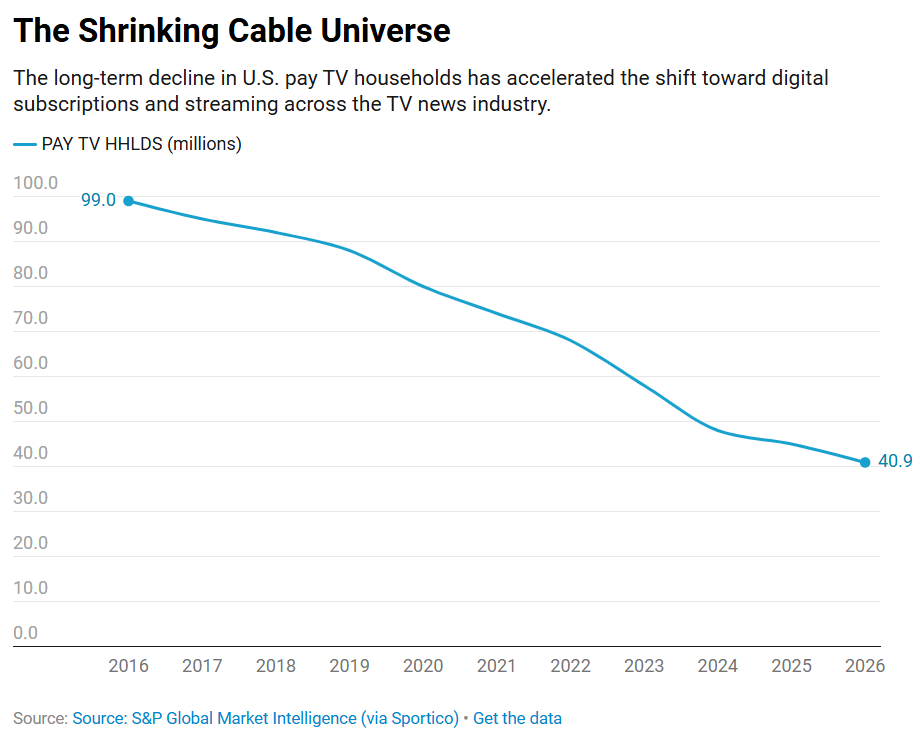
Those initiatives addressed a broader challenge facing virtually every legacy television company. As the chart above illustrates, the long-term decline in traditional pay TV subscriptions has forced networks that historically relied on affiliate fees and linear advertising to invest in subscription products, streaming services and direct-to-consumer businesses with more durable revenue potential.
That context matters because Thompson’s strategy wasn’t created in response to the pending merger. It was developed in response to structural changes reshaping the economics of TV news. While the proposed transaction could ultimately change CNN’s corporate parent, the company said it has not changed the strategy Thompson was hired to execute.
Corporate transactions naturally create uncertainty inside organizations, raising questions about leadership, investment priorities and long-term planning.
That’s precisely when leadership matters most, Klein said. Rather than allowing employees to become consumed by questions no one can yet answer, leaders need to reinforce the organization’s direction and keep attention focused on execution. CNN said Thompson has continued communicating regularly with employees while pressing ahead with the strategy he introduced after becoming CEO.

The newsroom keeps moving
The nature of the news business may also work in Thompson’s favor. Breaking news doesn’t pause because a merger is awaiting court approval, and television newsrooms continue operating around the clock regardless of corporate developments.
Klein described that environment as “a fire hose,” arguing that the relentless pace of journalism naturally keeps attention on reporting rather than ownership speculation. CNN said that focus has allowed it to continue executing previously announced digital initiatives, including the planned international expansion of CNN All Access.
Much of the public discussion surrounding the proposed merger has focused on what a combined Paramount–Warner Bros. Discovery might look like and how CNN could fit alongside CBS News under one corporate roof. The deal could also place CNN within a new corporate leadership structure, raising broader questions about investment priorities, newsroom strategy and how the combined company’s news assets would ultimately be managed.
Those questions took on added significance as Paramount has reshaped CBS News under Editor-in-Chief Bari Weiss — changes that have resulted in lower ratings and questions about the organization’s journalistic integrity. But any changes remain hypothetical while the merger faces continued legal challenges.
For Thompson, the assignment is more immediate. Whether the merger ultimately closes will determine who owns CNN. His success, however, may ultimately be measured less by the outcome of the merger than by whether he can keep CNN’s digital transformation on course while the company’s ownership remains uncertain.

›