
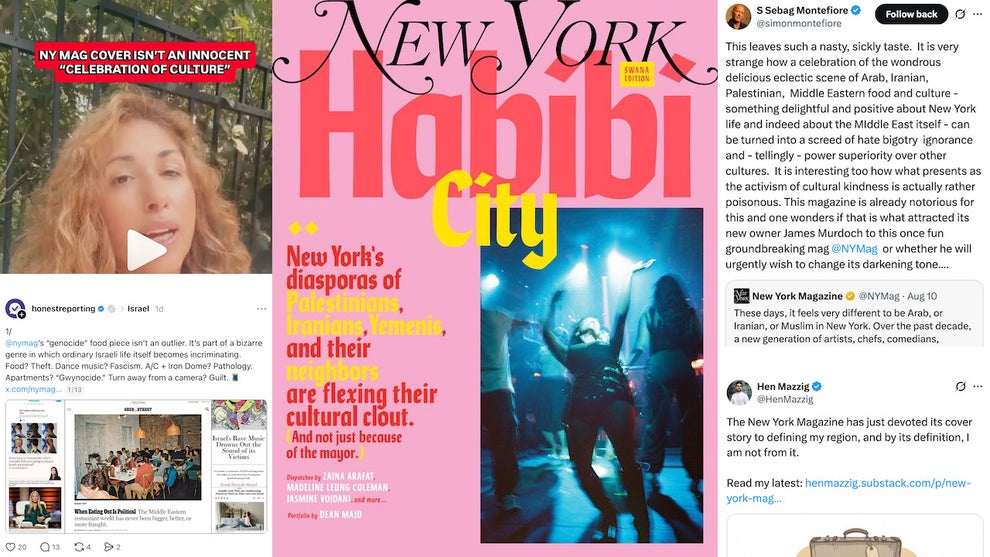
New York Magazine is facing criticism over its new “Habibi City” issue celebrating New York’s growing South Asian and North African cultural scene, with several prominent voices objecting to the package’s treatment of Jewish and Israeli identity.
The centerpiece article was criticized for grouping Zionism with “xenophobia” and “Islamophobia,” while another story in the package – a feature about Middle East cuisine – referred to Israel as “the land mass currently called Israel.”
Advocacy and influencer account End Jew Hatred criticized the issue, arguing that the coverage allows “Jewish identity to be erased in favor of a political loyalty test.”
“This isn’t harmless ‘cultural clout.’ Jewish identity is not theirs to erase, and Jewish history will not be rewritten to fit a political narrative,” the account stated.
Hen Mazzig, a Mizrahi Jew of Iraqi and Tunisian descent who frequently writes on antisemitism, said the magazine articles excluded people like him.
“The New York Magazine has just devoted its cover story to defining my region, and by its definition, I am not from it,” Mazzig wrote on X.
British historian and author Simon Sebag Montefiore additionally wrote on X that the package left a “nasty, sickly taste,” arguing that what could have been a celebration of New York’s Arab, Iranian, Palestinian and broader Middle Eastern cultural scene instead became what he called a “screed of hate bigotry ignorance.”
In a statement to TheWrap, New York Magazine editorial leadership said they are “aware of the wide range of responses to the piece” and “welcome and acknowledge good faith discussion and criticism.”
“Our latest cover story is an exploration of a New York subculture that is making its presence felt, both culturally and politically, in new ways over the last few years,” the statement read. “As with other communities forged by common experiences of conflict, there is an irreducible political dimension to any coverage of this subject. We have endeavored to capture the tensions and live debates that exist within these communities, including how they relate to Israel. We are aware of the wide range of responses to the piece, including critiques from some in the Jewish community. We take these comments seriously, and, as always, we welcome and acknowledge good faith discussion and criticism about our journalism.”
The centerpiece, written by Zaina Arafat and published Monday, chronicled what the magazine described as a cultural “SWANA-ssance” in New York. SWANA is an acronym for Southwest Asia and North Africa.
Arafat traced the emergence of a network of restaurants, cafés, literary events, parties and political organizations that have helped make the community an increasingly visible force in the city. She argued that the movement accelerated following the Oct. 7, 2023, Hamas attack on Israel and Israel’s subsequent war, describing a cultural ecosystem that grew out of protests and organizing against Israel’s military action in Gaza.

The story said being part of the SWANA community came to encompass a set of shared beliefs, including support for Palestinian human rights, the belief that Israel’s actions in Gaza following Oct. 7 constitute genocide and a commitment to social justice and social welfare.
Arafat presented SWANA as an alternative to the term “Middle East,” describing it as offering a “decolonial framework” for understanding the region and its diaspora.
New York City Mayor Zohran Mamdani also figured prominently in the piece, with Arafat pointing to his election as perhaps the strongest evidence of New York’s “SWANA-ssance.”
Though the Ugandan-born Indian American Muslim is not himself from the region, Arafat wrote that Mamdani is “deeply embedded in its culture.” The story pointed to his campaign visits to businesses owned by members of the community and his relationships with community leaders. Mamdani is married to Syrian American artist Rama Duwaji, and the piece noted that both are vocally pro-Palestinian.

The article also quoted the Mamdani campaign’s senior adviser Zara Rahim, who argued that the cultural shift expanded New Yorkers’ ability to envision a Muslim candidate leading the city.
Near the end of Arafat’s centerpiece, she wrote that members of the community continue to encounter “xenophobia, Islamophobia and Zionism,” grouping Zionism with the other two.
The issue also included a Grub Street story by Madeline Leung Coleman examining how the politics surrounding Israel and Gaza have increasingly intersected with New York’s Middle Eastern restaurant scene.

Coleman traced the rise of what became known as “New Israeli cuisine” during the 2010s, when Israeli chefs and restaurants received widespread attention in New York, before examining how dining choices and restaurant identities became more politically charged after Oct. 7.
The piece discussed Palestinian restaurant Ayat, including a tourist-style map on its menu that depicts the territory of Israel under the heading “Discover Palestine.” Coleman described Israel in that passage as “the land mass currently called Israel.”
The pro-Israel media advocacy group HonestReporting also took aim at the package, specifically criticizing Coleman’s characterization and arguing that the wording treats the country’s identity as provisional.
View on Threads
The New York package itself included Jewish participation in the cultural scene it described. Arafat wrote about Arab Jewish singer Laura Elkeslassy and noted that Jews, including anti-Zionist Israelis, have participated in events at Barzakh Café, a Crown Heights gathering place featured prominently in the piece.
Arafat also acknowledged tensions over how Israelis and Jews fit within the SWANA framework, writing that while Israel is geographically part of the region, whether Israelis identify with or are accepted within the broader community can depend on politics and ethnic background.
The centerpiece ultimately argued that the community has gained a degree of cultural visibility and political influence that would have been difficult to imagine in the years following the Sept. 11 attacks, when many Arab and Muslim New Yorkers felt pressure to keep a lower profile.
Actor Arian Moayed, one of the people interviewed for the piece, recalled that having meaningful cultural “narrative power” once seemed impossible.
Arafat described the community’s growing influence as both a cultural renaissance and a form of resilience, invoking the Arabic concept of “sumud,” or steadfastness and perseverance.
