
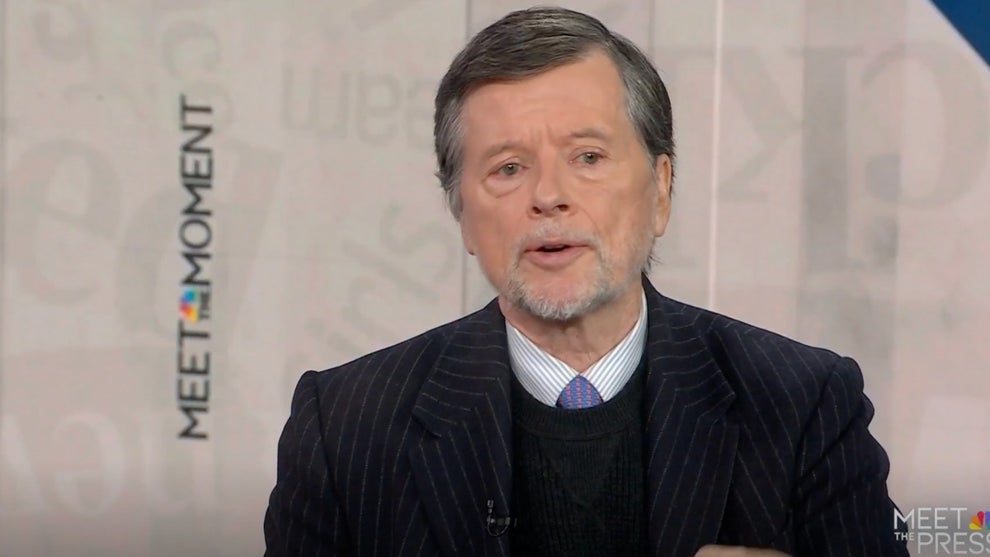
The drafters of the U.S. Constitution “would be abjectly disappointed” by the state of the United States in 2026, Ken Burns told “Meet the Press” host Kristen Welker on Sunday — especially since the legislative branch has effectively “abdicated so much of the power.”
The “American Revolution” documentarian and Welker discussed the fragility of democracy in honor of the 4th of July. “It’s really true, and I’ve found that in film after film after film. You know, we made a film a few years ago called ‘The U.S. and the Holocaust,’” Burns said.
“If you wanted to be in the most cosmopolitan place on Earth, where everything — architecture and cinema and painting and music and thinking — was going on, Berlin in 1932 would be the best place,” he continued. “The next January, not so much. And so you see how quickly the veneer of civilization can be pierced. And the founders understood that. They were really trying to reverse-engineer all sorts of things.”

One of their tactics 250 years ago was to make the executive branch Article II of the Constitution.
“The executive’s the manager who carries out the wishes of the Congress. So I think if the founders came here, they would not be surprised at all that somebody was seeking more authoritarian power,” Burns explained. “They would be abjectly disappointed that Article I, the legislative branch, had abdicated so much of the power, because that’s what they thought would be the bulwark against the inevitable thing.”
People were “subjects” before they became citizens, he further noted. “Jefferson said all – in [the Declaration of Independence], ‘All experience has shown that mankind are more disposed to suffer while evils are sufferable.’ Meaning all of human history, we’ve put up with the authoritarian rule. It doesn’t work. It doesn’t provide for human happiness. And here’s our idea of how to put this forward.”
Welker also asked how Burns thinks the founding fathers would feel about the country today: “They’d be totally impressed in lots of ways. They’d be stunned maybe, and shocked at how much rights have been extended to people, and glad about it. I mean, George Washington knew slavery was wrong. Thomas Jefferson knew slavery was wrong. And the scholar Annette Gordon-Reed said, ‘How could you continue with something if you knew it was wrong?’ And she said, ‘Instead of throwing Jefferson out,’ — she’s an African American scholar — she says, ‘Well, that’s the human question for the rest of us. Do we act on flaws of our own? Yes, we do.’ And so it’s a generous idea.”
“I think they’d be incredibly impressed at what we’ve been able to achieve and see the levels of division that would seem familiar to them and be disappointed in us that we hadn’t figured out what the larger thing was,” Burns said. “There are people — we’re not in a happy state right now. We have a lot of people who are keeping us alive to our grievances. It is in the interests of authoritarians to keep people uneducated, distracted by conspiracy and superstition. And our founding, that pursuit of happiness, was not pursued of material goods in a marketplace of things but lifelong learning in a marketplace of ideas.”
Welker’s show also included interviews with presidential historian Doris Kearns Goodwin and Lonnie Bunch, secretary of the Smithsonian Institution, who each emphasized the spirit of hope.
“We’re living in a tough time right now, but history can give us perspective, it can gives us solace. I really think it can give us hope. Just imagine what it was like to live through the Civil War; more than 600,000 people were dead. Or live through the Great Depression; one out of four people out of work, the banking system collapsed; or to live through the early days of World War II, when it was unclear that Hitler might conquer the rest of the world,” Goodwin said.
“The important thing to know is that in each one of those times, the people who lived then, they didn’t know the end of their story. They were like us. They were anxious. They were fearful. They didn’t know that the Union would be restored and emancipation would be secured,” she added. “They didn’t know that the Great Depression would come to end with demobilization for the war. They didn’t know the Allies would win World War II. So they lived with the same worries that we are, but somehow we showed strength, and we emerged with greatest strength from each one of those troubles. So remembering the troubled times right now, and how we came out of them, that’s the progress that we’ve made as a country.”
