
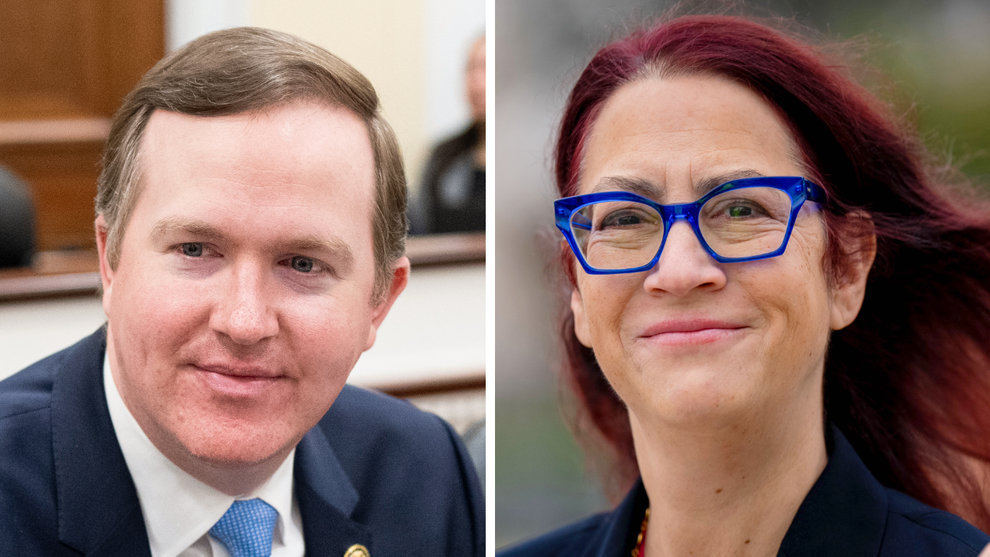
Six members of the House of Representatives, three Democrats and three Republicans, have formed the new Congressional American Film & TV Production Caucus as they prepare to introduce a new bill proposing a federal film and TV production incentive to bring entertainment jobs back to the United States.
The caucus consists of members that TheWrap previously reported are running point on the incentive, including Rep. Brian Jack (R-Ga.) and Rep. Laura Friedman (D-Calif.), who took part in a press conference with the new U.S. Film and TV Production Coalition on Tuesday alongside the Motion Picture Association, various Hollywood unions and actor Jon Voight.
Other members include Democrats Linda Sanchez of California and Tom Suozzi of New York and Republicans Nathaniel Moran of Texas and Nicole Malliotakis of New York, all of whom are members of the House Ways & Means Committee, where the legislation for the incentive is expected to be first introduced in the coming days.

“We’re launching this caucus to show that bringing film and television production back to the United States isn’t a partisan fight. Film and television work is leaving this country because 65 other nations decided to compete for these hundreds of thousands of good-paying jobs. A national film tax credit is how we bring that work home, and this caucus is a key step to build support for it,” said Friedman.
“For too long, we’ve watched jobs in the film and television industry move overseas to the detriment of local communities across America who were the backbone of American storytelling,” said Moran. “The American Film & TV Production Caucus is committed to bringing that production back home—back to our sound stages, our small businesses, our caterers, carpenters, electricians and camera crews who make this industry run in all of our 50 states.”
While language is still being ironed out, Congressional insiders tell TheWrap that the proposed federal tax incentive will have a base tax credit of 20% of all qualified labor expenditures, including above-the-line talent like directors and actors. That rate can increase to as much as 30% if productions qualify for certain uplifts, including if a production is relocating back to the U.S. from another country and if it is shooting in a FEMA-designated disaster area.

According to a study commissioned by the MPA and published Tuesday, such a tax credit would bring back as many as 143,500 entertainment jobs annually to the U.S. and increase annual production spending in the country to $36 billion by 2035, compared to the around $16 billion if it is not implemented.
According to ProdPro, production spending in the U.S. in 2025 fell 20% to $12.1 billion, narrowing the gap between the U.S. and the U.K., which saw production spending increase by 15% to just shy of $7 billion. While 31 U.S. states offer tax incentives, other countries like the U.K. and Canada offer federal incentives on top of provincial and local ones, providing a layer of tax credits that has led to steady production flight.
While lobbying for a federal incentive has been going on in Congress for more than a year, insiders told TheWrap this summer that House Republicans were waiting for Trump to give his approval. That came last month following the latest visit to the White House by Voight and his production partners Steven Paul and Scott Karol, which resulted in Trump giving his support on social media.
“Republicans and Democrats [should] get together, and immediately craft Legislation to save the Movie, Television and Entertainment Business in America. Congress should approve, immediately, a Federal Production Incentive to create Entertainment Jobs in America,” he wrote on social media.