

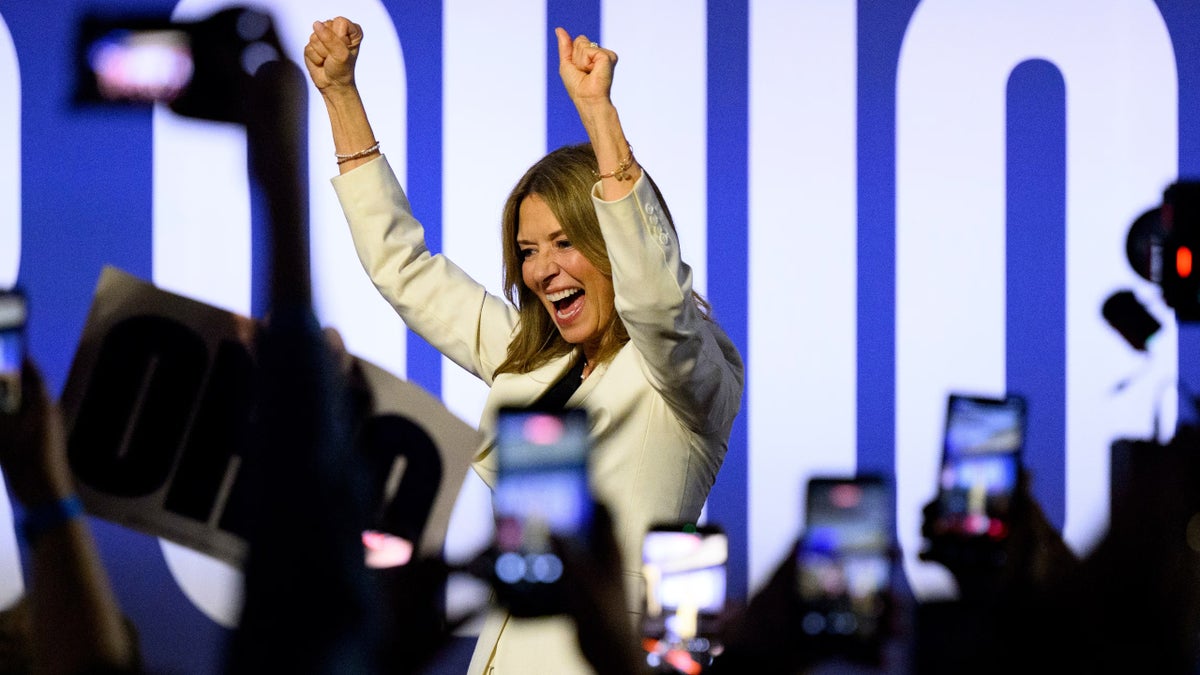
It wasn’t only Democrats who triumphed at the ballot box in the stunning midterm elections this week. Women candidates all across the country rose up and won top office after years of losses for women in Supreme Court decisions and the normalization of abuse by Donald Trump.
The results overnight were remarkable in an election that put 116 women in House seats, seven women in the Senate and nine new women in the governors’ mansions.
These wins include a bunch of historic firsts worth celebrating:
- The first Black woman governor in Keisha Lance Bottoms in Georgia
- The first Native American woman governor, Deb Haaland in New Mexico
- The first Latina governor in Texas in Gina Hinojosa
- The first Native American woman elected to the U.S. Senate, Minnesota’s Peggy Flanagan
It is a stunning reversal for women who have endured backsliding to their rights, the reversal of DEI protections and public indignities in the backlash to #MeToo and rise of Trump 2.0.
Who could not take pride in Ohio governor Amy Acton’s decisive win after her opponent Vivek Ramaswamy so shamefully mocked her childhood rape with his ad featuring her estranged mother?
Whose heart didn’t swell a little when newly elected Texas governor Gina Hinojosa brought her son to the stage during her acceptance speech and told him he and his brother were the reason she ran in the first place?
The numbers are as impressive as the emotional triumphs:
Seven women won (3 Democrats, 4 Republicans) Senate contests, and 2 more women are in uncalled races, according to Rutgers’ Center for American Women and Politics (CAWP), which tracks these statistics.
116 women (100 Democrats, 16 Republicans) have won House seats, at least 26.7% of the chamber. Of those, 92 are incumbents, 16 won open seats, and 8 defeated incumbents.
In the governor’s races, nine women are newly elected to the office, including 15 women (12 Democrats, 3 Republicans) total. Of those, 6 are incumbents, 8 won open seats and 1 defeated an incumbent.

Fifty more women are in 39 uncalled races, and the current record is 127, set in 2024. So a new high water mark is very likely.
What happened? Actions have consequences, and it’s heartening to see that women candidates refused to be deterred by the drive to push them down with the loss of abortion rights in the Supreme Court in 2022 and bearing the brunt of economic hardship in this second Trump administration, along with daily injuries — like calling a woman journalist “Piggy” or a meme stuffing CNN’s Kaitlin Collins in a trash bin.
It seems many were motivated by precisely that.
Annie Andrews, a Democratic Senator-elect from the reliably Republican state South Carolina, wrote on X:
“South Carolina, you have shown the nation — in an era of partisan divides, of vitriol and namecalling, in a politics dominated by billionaires, special interests, and insiders in Washington — that we will not bow down. We will not back down. And we will chart our own course.”
That defiance rang across so many acceptance speeches of the night. Said Hinojosa in the once-solid red state of Texas: “We shocked the world tonight…. We showed that anything is possible.”
Andrews, the first woman elected to the United States Senate from South Carolina and the first Democrat to win a U.S. Senate election in South Carolina since 1998, is a pediatrician who got involved in politics after the Parkland high school shooting in 2018, which convinced her to join the gun safety advocacy group Moms Demand Action.
And even women candidates who did not win came close to overturning decades of Republican norms in the most conservative states of the country. Cyndi Munson, an Asian-American Millennial who ran on a campaign of fixing Oklahoma’s schools and working for the people, performed better than any Democratic gubernatorial candidate in the deeply red state in decades. N’Kiyla Jasmine Thomas, a DSA candidate for the Senate from Oklahoma, outperformed every Democrat in the state since 1990 against a conservative Republican.

Which leads me to my next point.
These wins are built on the shoulders of other women who put themselves in the crosshairs and fought – and lost – before. They paved the way, gave courage to others and declined to apologize for going the distance.
I’m thinking of course of Hillary Clinton, whom I interviewed in the wake of her presidential defeat and asked how she pushed forward. I’m thinking of Anita Hill, whose testimony about the sexual harassment of Clarence Thomas did not stop him from rising to the Supreme Court, who kept her dignity and integrity and pressed on. I’m thinking of Stacey Abrams, who continued to fight for voter registration in Georgia after losing the governor’s race in 2019. And I’m thinking of activist Shannon Watts, who founded Moms Demand Action to demand change in gun laws, and inspired a wave of other moms to run for office.
What about the women who embraced Trump, or did so and then changed their minds? They are now the ones receding from the stage.
Susan Collins losing her Senate seat in Maine after three decades building a power base in Washington D.C. screams “rebuke.” So many voters remember her approval of Brett Kavanaugh for the Supreme Court despite damaging testimony about his abusive past, and her fatuous acceptance of his promise that Roe v. Wade was established law. The right to an abortion fell soon thereafter.
Lindsey Graham’s sister, Darline, lost a winnable seat in South Carolina.
And the Trump female coterie that has disappeared is legion: Attorney General Pam Bondi, Ambassador Kimberly Guilfoyle, Homeland Security Secretary Kristi Noem, Marjorie Taylor Green. There’s a lesson there too.
I’ll put in a word for Hollywood women, who are suffering the same backsliding as women across the country. Statistics show women receding behind the camera, in front of the camera and in the executive suites. That, however, can change.
It is a stunning reminder that things don’t stay the same. That actions beget reactions. And also, that you cannot permanently put women back in another century. Women will stand up for themselves, claim their rights and assert their abilities.
That proved true in historic fashion on Election Night.
Note for my women readers: Please join us for the Power Women Summit, which celebrates all things leadership and women, on Dec. 1! Info here.
