

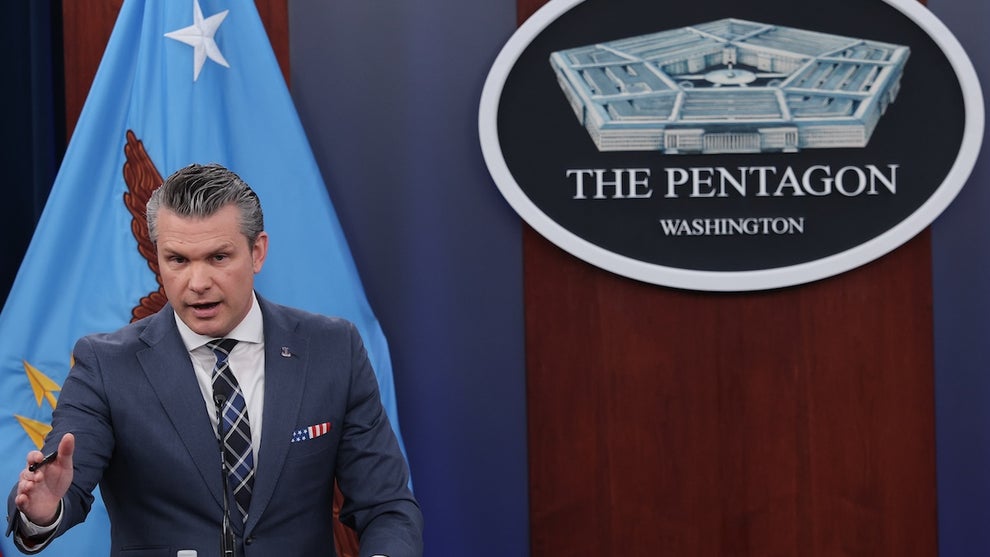
The Defense Department released new restrictions for journalists at the Pentagon on Monday, closing the existing media workspace and prohibiting reporters from entering the building without an escort.
The restrictions come three days after a federal judge ruled that the Pentagon’s press restrictions enacted last October were unconstitutional, violating the First and Fifth Amendments. Dozens of news outlets surrendered their press passes last fall rather than complying with the new policy, including the New York Times, which sued the Defense Department in December.
On Friday, Judge Paul Friedman of the U.S. District Court vacated the policy and ordered the Pentagon to restore access to Times reporters. The reporters were set to return to the media workspace on Monday.
“The new policy does not comply with the judge’s order,” a New York Times spokesman told TheWrap. “It continues to impose unconstitutional restrictions on the press. We will be going back to court.”

Sean Parnell, the Pentagon’s chief spokesman, wrote in a Monday memo that the Pentagon will close the Correspondents’ Corridor, the workspace long used by the press corps, and require all journalists seeking physical access to the military building to have an escort.
Parnell said there will be a “new and improved press workspace” in an annex outside the building but on Pentagon grounds. He offered no timetable, saying it “will be available when ready.”
Dan Lamothe, who covers the Pentagon for the Washington Post, noted the lack of “clarity on when [the] different space will open” and questioned “how the Pentagon will reassign the rooms and booths where journalists worked.”
The Pentagon framed the policy announced Monday as necessary to uphold security, which was also the rationale for changes last fall.
“The court removed every provision that allowed the Department to screen press credential holders for security risks and every provision that allowed the Department to deny, revoke, or suspend a press credential based on security considerations — while simultaneously ordering the Department to immediately reinstate press credentials for the New York Times,” Parnell wrote.
Defense One’s Meghann Myers noted on X that “reporters always passed background checks, like all PFAC holders, to get their badges.”
“The only thing this administration did is attempt to punish reporters who sought information beyond public affairs offices,” she added.
News outlets objected to the October restrictions suggesting that reporters asking questions of unauthorized officials could be considered soliciting them to break the law.
Under that Pentagon policy, Friedman wrote Friday, “essential journalistic practices that the plaintiffs and others engage in every day — such as asking questions of Department employees — could trigger a determination by the Department that a journalist poses a security or safety risk.”
The Defense Department has said that it plans to appeal the judge’s Friday ruling.

The Pentagon Press Association, which represents journalists covering the military, said that “the Pentagon’s announcement today is a clear violation of the letter and spirit of last week’s ruling” and that it “is consulting with our legal counsel and will advise members once this process is complete.”
“Press freedom is guaranteed by the U.S. Constitution and an informed public
is vital to a democracy,” the PPA continued. “Judge Paul Friedman specifically ruled that the department was to restore access ‘especially in light of the country’s recent incursion into Venezuela and its ongoing war with Iran.’”
“At such a critical time, we ask why the Pentagon is choosing to restrict vital
press freedoms that help inform all Americans,” the group added.

While Times journalists were set to return to the Pentagon Monday, it has been unclear whether reporters from the dozens of outlets that also rejected the Pentagon’s policy — including CNN, Fox News and the Washington Post — would regain access following the ruling in the Times’ suit.
Several right-wing outlets and influencers agreed to the Pentagon policy last fall and were provided credentials along with workspaces.
Pentagon reporters have continued aggressively covering the military from outside the building, though some have been permitted inside in recent weeks for for Iran-focused news conferences. Hegseth has taken the opportunity in such news conferences to bash the media and accuse them of rooting against the president, part of the administration broader wartime assault on the press.
Still, news organizations sought to regain space in the Pentagon, as had been customary for decades. Journalists find it useful to work out of the Pentagon to get timely information and have the opportunity to question officials.
On Monday, both the Associated Press and Reuters told TheWrap they were seeking reinstatement, and presumably others were hoping to regain their previous access. But now the Pentagon is upending any such expectations with new limits for the press corps.
