

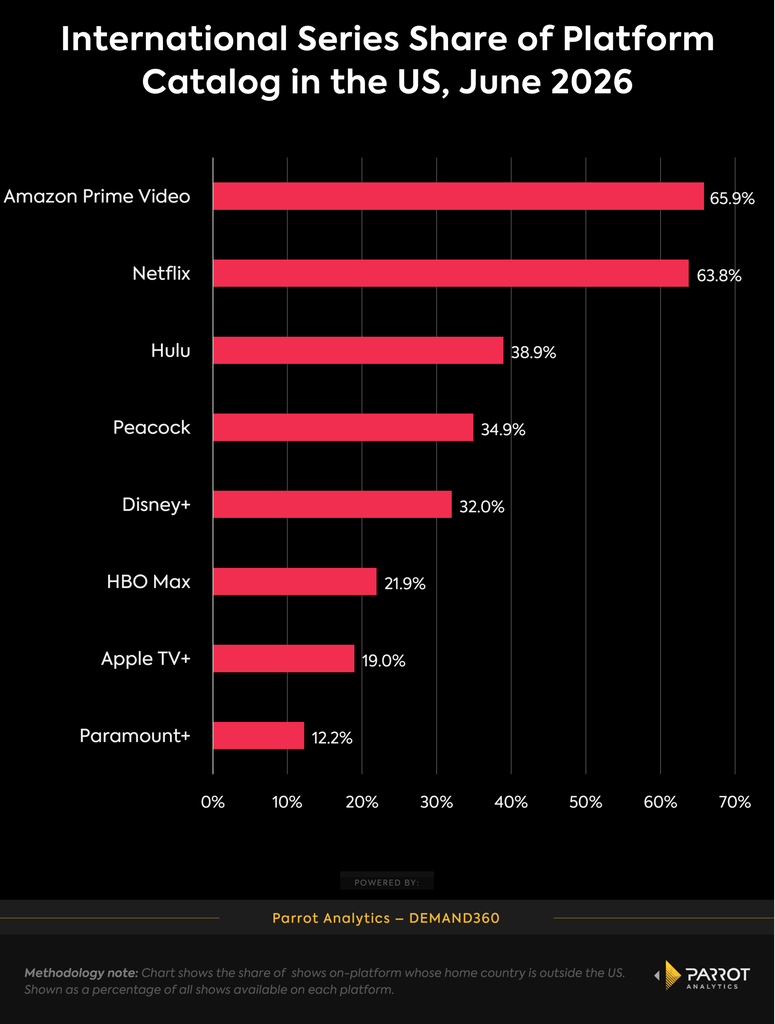
When it comes to importing international content for U.S. subscribers, Amazon Prime Video and Netflix operate in a league of their own. Non-US titles account for nearly two-thirds of the total series catalog on both Prime Video (65.8%) and Netflix (63.8%). A massive gulf separates these market leaders from the rest of the industry, where international content as a share of total catalog drops off significantly — from Hulu at 38.9% down to Paramount+ at just 12.2%.
However, looking under the hood reveals two very different approaches to international programming from the market leaders. While nearly half of foreign shows on Netflix in the U.S. come from Asia, Europe is where the largest share of foreign titles are sourced on Prime Video.
Fully 35% of Prime Video’s international series in the U.S. originate from the U.K. By anchoring its non-U.S. offerings in British productions, Prime minimizes cultural and language barriers for American audiences while maintaining high catalog volume.

Netflix, by contrast, takes a broad-spectrum approach to continental Europe. British titles make up just 10% of its international supply, with the streamer spreading its bets across non-English powerhouses: Spain (6%), France (4%), the Nordics (3%), and Italy (3%).
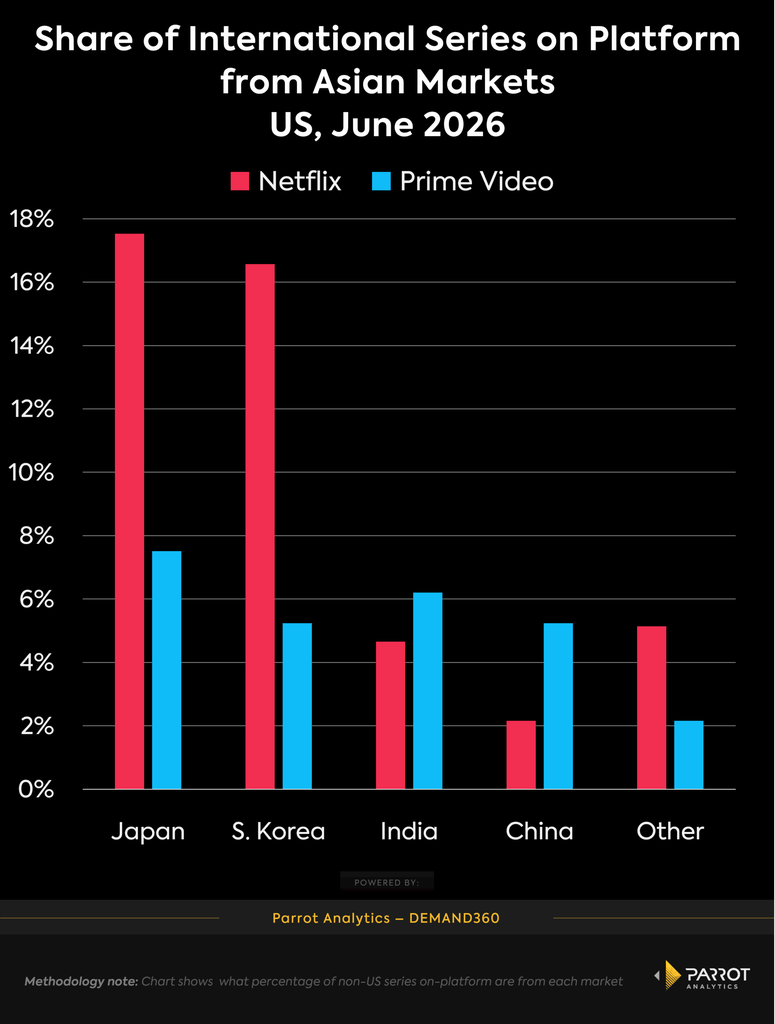
The difference in approach is also clear across Asia. Nearly 35% of international titles on Netflix in the U.S. are from either Japan or South Korea. This is more than twice the share of titles on Prime Video from these markets. Prime Video takes a different path in Asia and focuses on the Indian market. A greater share of international titles on Prime are from India than South Korea, for example.
While the domestic competition is still largely tethered to U.S.-centric pipelines, Netflix and Prime Video have recognized that domestic growth requires a global catalog. But their methods for achieving this are fundamentally different.
Netflix has built a high-volume, multi-regional machine hoping to engineer global crossover hits out of places like Korea and Spain. Prime Video, conversely, is playing a game of specificity, leaning heavily on low-friction U.K. imports for domestic retention, while making precise, localized bets in India to support Amazon’s broader global e-commerce ecosystem.
The good news for both platforms is that audiences for international content skew younger, so these programming choices are helping to win over the next generation of customers.
