

In a majority of markets around the world, audiences are consuming less imported content from the U.S. But viewers haven’t necessarily been swapping in domestic shows to fill the void. In a majority of countries, the share of demand for domestic content also fell from 2022 to 2025. Instead, imports from countries other than the U.S. are booming. As global audiences become more open to imported content from new markets, the obvious question is what types of content are best suited for cross-border appeal, and who is actually watching?
There is actually a clear generational divide when it comes to openness to foreign content. Young audiences are the ones leading the charge and most readily embracing direct international imports. In the U.S., Gen Z and Millennials make up a dominant 67% of the audience for imported series. By contrast, the audience for domestic U.S. series skews significantly older, with over 50% belonging to Gen X and older generations. For these older viewers, direct foreign imports, even massive global hits like “Squid Game” or “Lupin,” can sometimes face cultural or subtitle-driven adoption hurdles.
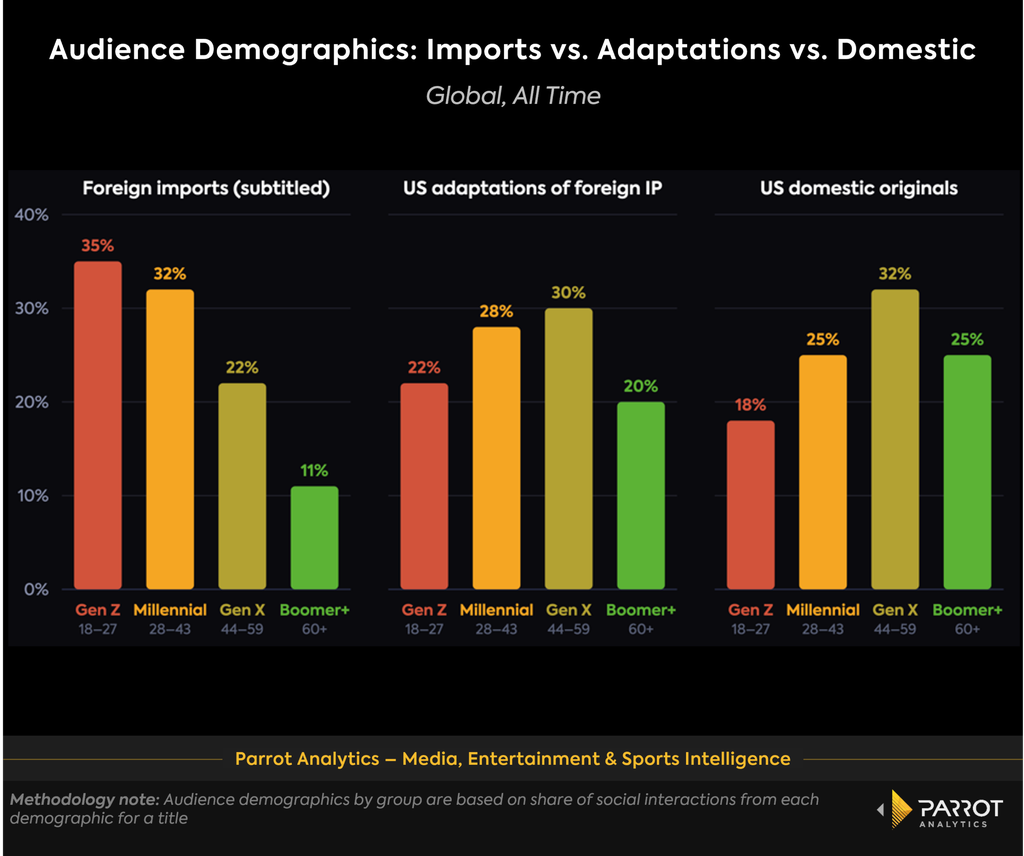
This is where format adaptations can effectively bridge the gap. When we look specifically at U.S. adaptations of foreign IP, the age of the audience falls somewhere between imports and domestic series. Take “The Good Doctor,” for example. The audience for the U.S. adaptation is 33% Gen X and older, but the original Korean series draws only 7.3% of its audience from that same older demographic. Adaptations are a proven way for foreign IP to break through with older audiences who may be less likely to engage with a direct import.
When it comes to the types of content best able to transcend borders, not all scripted genres are created equal. Drama is broadly translatable, but specific subgenres like action and sci-fi are exceptional at reaching far beyond their home markets. Pre-school age kids’ content stands out as a category that has the potential to travel well. “Bluey,” “PAW Patrol” and “Masha and the Bear” are just a few examples of kids’ shows that have a global impact well beyond their home market.

Conversely, comedy routinely struggles to travel. Language barriers, specific cultural norms, and localized joke references often fail to land overseas. Comedy adaptations offer a strategic play that takes a successful format and swaps in the characters, jokes, and context required to translate to a specific market. BBC’s “Ghosts” is a perfect example of how to execute this successfully, with each international adaptation adjusting its core ensemble to feature ghosts entirely specific to that country’s history.
For genres that inherently struggle to cross borders, there are strategic workarounds that lean into audience demographics rather than format changes. Romance, for instance, traditionally travels less well than action or sci-fi. But when we look at the romance series that boast high travelability and buck this trend, series with teen/coming-of-age elements are 50% more common among high travelability titles compared to low travelability romance titles.

Because young audiences are the age group most aggressively driving demand for imported content, targeting them directly is one of the most effective ways to help a traditionally domestic-bound genre travel further.
As the global content landscape becomes increasingly borderless, success requires more than just a good story. Whether utilizing localized adaptations to capture older demographics or injecting coming-of-age themes to export romance, understanding the intersection of genre and generational demand is key to maximizing global reach.
