
Thanksgiving football is no longer just a Thursday tradition. This year, the NFL is spreading five games across three days, with Netflix and Prime Video joining CBS, Fox and NBC in a holiday slate that shows that you truly can’t get enough professional football on TV.
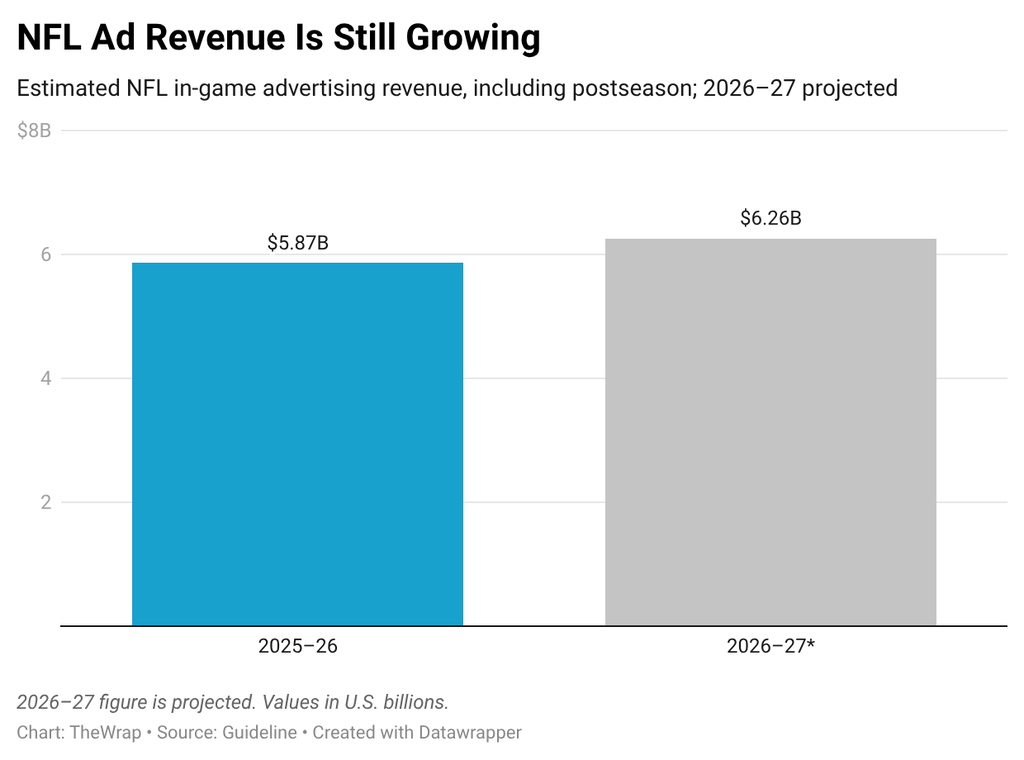
The streamers, networks and advertisers certainly want more. The advertising dollars flowing to the NFL help explain why. NFL games generated $5.87 billion in advertising revenue during the 2025-26 season, up 6.8% from the previous year, according to advertising intelligence firm Guideline. The company projects $6.26 billion this season, even as Madison & Wall expects U.S. TV advertising, excluding political spending, to shrink 2.4% in 2026.
The expanded Thanksgiving lineup is the most graphic example of just how dependent the various broadcast and streaming players are on the NFL as one of the few dependable sources of large live audiences. For Netflix and Amazon, football presents opportunities to attract advertisers, subscribers and shoppers. For CBS, Fox and NBC, it offers a way to protect businesses threatened by declining television audiences.
All of this serves to up the leverage the NFL has over, well, everyone and gives it extra ammunition as it seeks to renegotiate its contracts with each of the media partners in the coming year. The need for the various streamers and networks to devote even more of their content budget to a single league is a question that hangs over most of the entertainment industry.
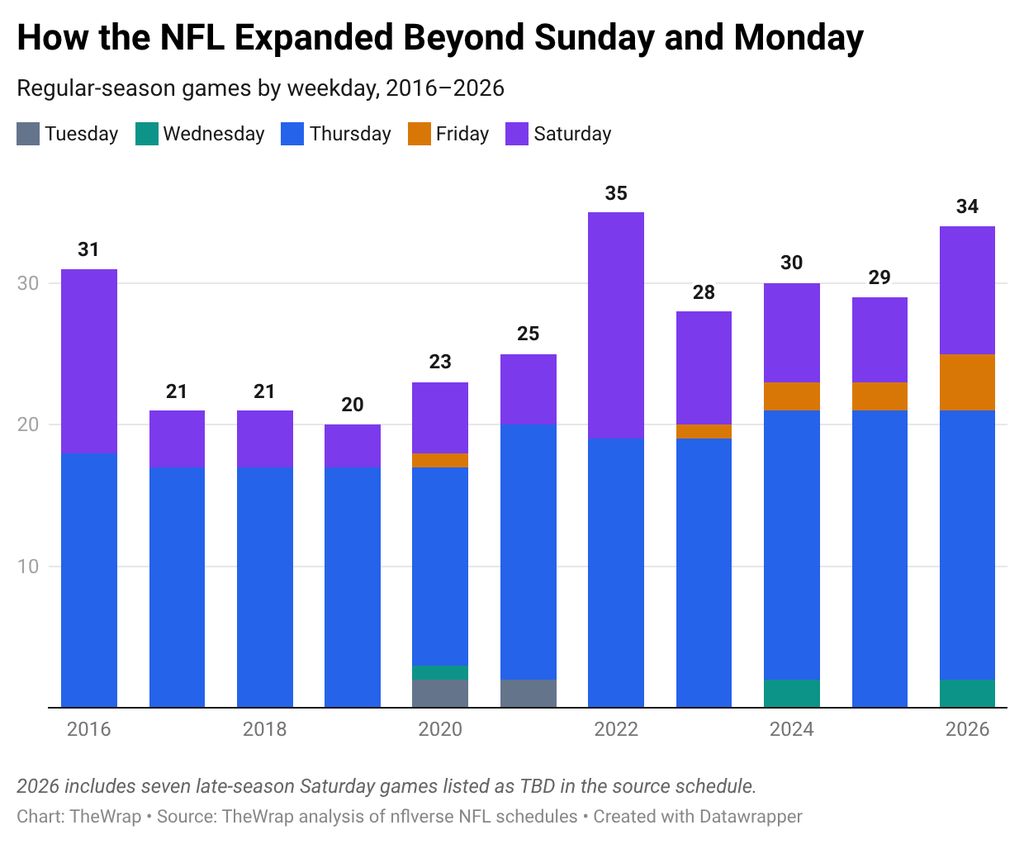
For the NFL, it’s the league’s way of establishing dominance over the week and intrinsically linking itself to one of the major U.S. holidays. The slate opens Wednesday with Netflix’s Packers-Rams matchup, followed by the traditional Thanksgiving Day tripleheader and Prime Video’s Broncos-Steelers game on Black Friday.
Grace Senko, the league’s vice president of media strategy and business development, told TheWrap that several years of Thanksgiving audience growth and the success of its Black Friday game helped drive the decision. With families already gathering Wednesday, the league saw the game as “a natural extension of Thanksgiving,” she said. Senko added that the NFL will remain selective about expanding into other nontraditional windows.
Football takes a bigger piece of advertising
Sports are expected to account for 31.8% of U.S. television advertising spending this year, according to Emarketer, reflecting advertisers’ growing emphasis on live programming.
Dan Cohen, executive vice president of Octagon Media Rights Consulting, said he sees two forces behind the NFL’s growing importance: football’s strength and the struggles of traditional television.
“Both, but the second reason is doing more of the work,” Cohen told TheWrap when asked whether media companies are becoming more dependent on the league because football is growing or because other programming is losing value.
“Some advertisers are expanding their sports investment, while others are reallocating existing budgets to prioritize premium live programming,” Marty Blich, executive director and head of sports partnerships and investments at WPP Media U.S., told TheWrap.
Luke Stillman, managing director at Madison & Wall, said football is capturing a larger share of a shrinking television advertising market.
The challenge for media companies is how they can still afford to keep paying the NFL’s rich licensing fees while maintaining a budget for other quality scripted and unscripted programming.
The trick is in how each player takes advantage of all those eyeballs.
Amazon turns football into an advertising pipeline
Since Prime Video began carrying Thursday Night Football in 2022, the package has attracted 80 advertisers new to the NFL, according to Billy Davis, head of U.S. live sports sales at Amazon Ads.
The number of advertisers participating in Thursday Night Football is up 6% year over year this season, including increases of 19% among financial services advertisers and 12% among automotive brands.
Amazon uses football to introduce advertisers to its broader business, including Prime Video, Fire TV, Twitch and its retail platform.
“Once those brands are here, they see the power of a pan-Amazon marketing campaign rather than simply a media plan,” Davis told TheWrap.
Amazon can also connect advertising exposure to purchases. Davis said brands using interactive video ads during Thursday Night Football, which allow viewers to add products to their shopping carts with a remote, have seen purchase rates 27% higher than those using standard media.
That connection becomes particularly relevant on Black Friday, when Prime Video will carry Broncos-Steelers as part of a larger sports lineup that also includes basketball and golf.
More than 100 advertisers are participating in Amazon’s Black Friday sports advertising lineup this year, Davis said, while the number of advertisers new to the company’s live-sports offerings has increased 25% from last year.
The game also reaches consumers who don’t regularly watch football on Prime Video. Last year, a quarter of its Black Friday NFL audience hadn’t watched an NFL game on the service earlier that season, while 30% had skipped the Thanksgiving Day games.
Netflix bets on football to bring in subscribers
Netflix is taking a different approach, concentrating on a limited number of major live events rather than carrying NFL games every week.
Its first Thanksgiving Eve game, featuring the Packers and Rams and a U2 halftime performance, builds on a relationship that began with Christmas Day football in 2024.
During Netflix’s October earnings call, co-CEO Ted Sarandos described live sporting events as an important way to attract members and support the company’s advertising business.
“They stand out, they drive new membership, they add fuel to our ad revenues, they please our existing members, and they just generally enhance the value of Netflix,” Sarandos said.
Co-CEO Greg Peters said during the company’s July earnings call that six of its 10 biggest days for new-member sign-ups over the previous five years were tied to live events.
Research firm Ampere Analysis estimated that Netflix gained approximately 430,000 U.S. subscriptions around Christmas last year, when it carried NFL games and released new episodes of “Stranger Things.” The estimate reflects the combined impact of those releases, not football alone.
Broadcasters have more to protect
Unlike Netflix and Amazon, CBS, Fox and NBC are using football largely to defend established TV businesses. Senko said live programming has become more valuable to traditional television as other shows move to streaming.
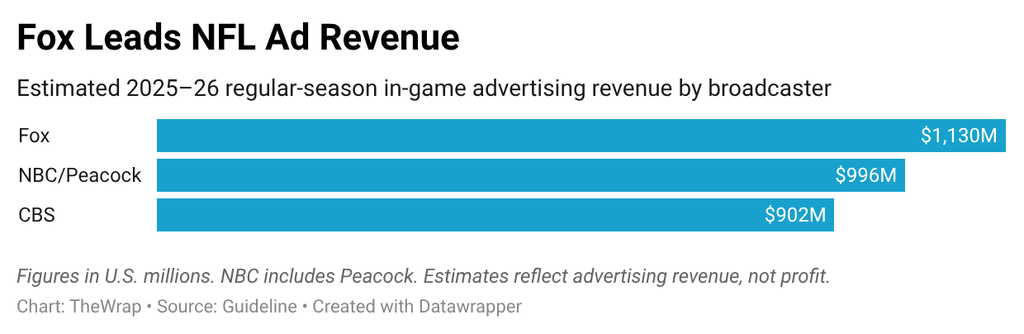
The financial stakes are substantial. Guideline estimated that Fox generated approximately $1.13 billion in regular-season NFL advertising revenue during the 2025-26 season, while NBC and Peacock accounted for another $996 million. CBS generated approximately $902 million from its regular-season package.
“Traditional broadcasters offer established scale and reach, while streaming platforms bring additional capabilities around audience targeting, data and measurement,” Blich said.
CBS demonstrated football’s promotional value last Thanksgiving, when the Chiefs-Cowboys game drew a record 57.2 million viewers. The Duke-Arkansas basketball game that followed averaged 6.8 million viewers, the largest regular-season college basketball audience in more than three decades. The figures don’t establish how many viewers stayed after football, but illustrate the advantage of scheduling other programming around the NFL.
“The broadcasters use the NFL to protect reach,” Cohen said. “They need the largest weekly audience to keep their ad pricing, their payments from cable and satellite carriers and their affiliate stations.”
Fox is approaching Thanksgiving with a different promotional opportunity. Its Eagles-Cowboys game will air on the broadcast network and stream through Fox One and Tubi, the company’s free, advertising-supported streaming service.
Fox is also using the matchup to promote Fox One through a marketing campaign on Tubi, allowing viewers to watch the game for free while introducing them to its paid streaming offering.
NBCUniversal, meanwhile, is building an entire day of live programming around the Macy’s Thanksgiving Day Parade, the National Dog Show and its primetime NFL game on NBC and Peacock.
According to Nielsen data provided by NBCUniversal, last year’s Thanksgiving night NFL game averaged a record 28.4 million viewers across NBC, Peacock and Telemundo, while the parade drew 34.3 million viewers across NBC and Peacock.
NBCUniversal said its Thanksgiving night editions of “The Tonight Show” and “Late Night” last year delivered their largest audiences since September’s NFL Kickoff Game.
The company said Monday that it has attracted nearly 50 new advertisers across its holiday programming this year, with advertising revenue for the broader holiday lineup increasing 30%. Those figures cover NBCUniversal’s holiday programming as a whole, not NFL games alone.
Football has also demonstrated its ability to attract Peacock subscribers. Research firm Antenna estimated that the service gained approximately 3 million sign-ups around its exclusive Chiefs-Dolphins playoff game in January 2024, although that figure doesn’t establish how many subscribers remained afterward.
Can the rest of television keep up?
Streaming accounted for 49.6% of U.S. television viewing in August, compared with 17.5% for broadcast, according to Nielsen. Yet NFL games averaged 18.7 million viewers during the 2025 regular season, the league’s second-highest average since tracking began in 1988, although changes in Nielsen’s methodology contributed to some of the reported growth.
Streaming companies can use football to attract subscribers and advertisers beyond the games themselves. Traditional broadcasters have a more immediate need: protecting the audiences and revenue they already have.
The NFL’s growing value is good news for the companies carrying its games. It doesn’t necessarily mean the rest of television is getting any healthier.
