
"The Hurt Locker" isn’t taking the mortar rounds being fired at it sitting down.
"In my experience over the past year, the overwhelming majority of veterans, not just of this war but of past wars, have been very positive and supportive of the film that we made," screenwriter and producer Mark Boal told TheWrap on Friday. 
Boal (pictured) was responding to criticism that rather than being an accurate depiction of the life of soldiers in Iraq, the film is an example of what the Los Angeles Times termed “Hollywood hokum.” (See accompanying story: "Oscar Race Gets Dumb and Ugly.")
The criticisms come in the final days of the Oscar campaign, and on the heels of a controversy over emails sent out by one of the film’s producers, Nicolas Chartier.
The Times story resurrected topics that had been discussed — and seemingly dismissed — at the time of the film’s June 2009 release, if not its September 2008 Toronto Film Festival premiere.
“The Hurt Locker” has been well-received by many veterans and servicemen, including Robert M. Gates, the U.S. Secretary of Defense, whose spokesperson has said Gates thinks director Kathryn Bigelow’s film is “the most authentic” ever made about Iraq.
But in the Times story, some soldiers say that elements of the movie are over-sensationalized and disrespectful to the armed forces.
In the most dramatic charge, the Times wrote that “the production had driven a Humvee into a Palestinian refugee camp in order to film angry crowd scenes.”
The source was a serviceman who was not on the set but who said he’d been told about it by “a Jordanian official.”
“That is categorically false,” Boal told theWrap. “Nothing remotely like that ever happened. There is no scene like that in the movie. We never shot anything like that. And there was never any scene like that in the script.”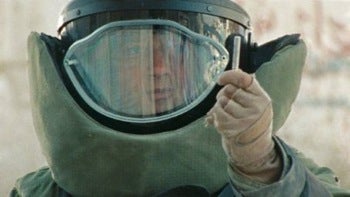
In the instances when the production used Humvees, he said, the vehicles were on loan from the Jordanian government, which created specific routes to which travel was restricted.
Boal wrote the script after a journalistic embed with a bomb-disposal unit in 2004. The film does not purport to tell a true story, but it does aim to accurately capture the look and feel of a chaotic war.
Other complaints about the film that have been raised in the Times story and in online forums over the past months are that its central character, played by Jeremy Renner, is too much of a maverick; that its depiction of bomb-disposal techniques is not accurate; and that it makes errors as simple as putting its soldiers in uniforms that were not used in 2004, when the movie was set.
To these, Boal said, “As I have said many times, the movie is not a documentary. We made creative decisions, and I hope people understand that those decisions were made respectfully and conscientiously.”
Putting the soldiers in uniforms that weren’t worn until after 2004, he said, was done simply to make things more comfortable for viewers, who might otherwise wonder why the men they saw onscreen were dressed differently from the ones they watched on the evening news.
As for the techniques of defusing bombs, he says, “It’s not a training film. The idea was to capture the flavor of the job without getting so detailed that we would jeopardize operational security. If I showed the different techniques that were used in the field for every bomb, we would not be having this conversation.”
Prior to the Times’ story, USA Today, the Wall Street Journal and the Associated Press had run extensive articles based on interviews with current soldiers and veterans. The majority concluded that despite the movie’s liberties, it accurately captured the sense of a soldier’s life in Iraq.
USA Today, whose story was in the works for months, quoted 10 servicemen, eight of whom had positive things to say about “The Hurt Locker.”
“The Hurt Locker” was made without the cooperation of the Department of Defense. "The filmmakers’ interest in drama and excitement exceeded what we felt were reasonable realistic portrayals," Philip M. Strub, the Pentagon’s special assistant for entertainment media, told the Times.
Films made with the cooperation of the Department of Defense include “Black Hawk Down,” “Top Gun,” “The Hunt for Red October” and “Patton.” Those made without DoD help include “Platoon,” “Apocalypse Now,” “Coming Home,” “Three Kings,” “An Officer and a Gentleman,” “Full Metal Jacket,” “Crimson Tide” and “Forrest Gump.”
“The Hurt Locker” has proved extremely popular on military bases, according to the merchandise director for the Army & Air Force Exchange Service.
In a way, the late-in-the-game charges of factual inaccuracy are reminiscent of attacks levied against Oscar front-runner “A Beautiful Mind” in awards season in 2002, though in that case the charges were more serious because the film purported to be a biography of John Nash rather than a work of fiction.
The charges didn’t work; the film was named Best Picture.
The campaign against that film, which was never pinned on a single competitor, led to an outcry within the Academy, and to tightened rules regulating campaigns – which is why Chartier is now in hot water over his overly aggressive emails.