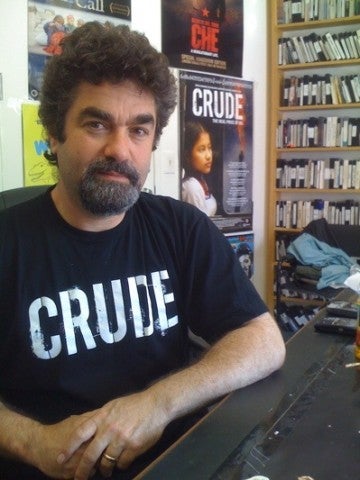
 After waging a months-long First Amendment battle, documentary filmmaker Joe Berlinger is resigned to the fact that he may have to turn over unused footage from his 2009 documentary “Crude” to Chevron.
In May, New York Federal Court Judge Lewis A. Kaplan ordered Berlinger to comply with the oil company’s subpoena for 600 hours of film. The filmmaker said that protesting Chevron’s request has cost upwards of $200,000 — much of it coming from his own pocket.
At the close of an appeals hearing in U.S. District Court in Low Manhattan on Wednesday, Berlinger said he still believes that the costly legal battle was worth it.
The filmmaker said that regardless of the outcome, the case revealed the need for stronger federal shield laws to protect journalists from being forced to reveal confidential and non-confidential information.
Berlinger was also hopeful that the he will not be forced to turn over the full 600 hours of footage that Chevron has subpoenaed.
“I am cautiously optimistic that the real skin that I put in the game, I will get out of this,” Berlinger told TheWrap. “I have invested a year of my daughter’s college education into this case. I strongly believe that independent documentary filmmaking is the last true bastion of independent reportage and I do no want to see shield laws further weakened.”
A formal decision on Berlinger’s appeal could come as early as next week, court observers said.
“Crude" documents a $27 billion environmental lawsuit filed by the residents of the Amazon Rainforest against Chevron. In the civil suit, members of five indigenous tribes argue that they should be compensated for oil and toxic waste contamination left over from when Texaco, which was acquired by Chevron in 2001, operated oil fields in Ecuador.
Chevron says it plans to use the unreleased footage to prove that the plaintiffs' lawyers engaged in various forms of misconduct.
“This is not as clear cut a case as people have perhaps presented it to be,” Kent Robertson, a spokesperson for Chevron, told TheWrap. “This is more about fraud being exposed than it is about the First Amendment.”
Wednesday’s hearing was scheduled to last 42 minutes but went on nearly two hours. Based on the questions asked by the appeals court judges, it seemed likely that the lower court’s order would be substantially reduced, according to Michael C. Donaldson, who filed an amicus brief on behalf of organizations such as the New York Times and CBS in support of Berlinger.
Attorneys for the plaintiffs in the Ecuadorian case also lobbied against releasing the “Crude” footage on Wednesday.
“The fact that the plaintiff’s attorneys were resolute in opposing any of the footage being handed over, seems to suggest that there is something there that they would prefer be kept under wraps,” Robertson told TheWrap.
Berlinger said that he did not object to handing over relevant film to Chevron, but was upset by the broad scope of lower court decisions forcing him to give the oil company access to hundreds of hours of footage. He believed that doing so would violate the precedent established by Gonzales v. NBC, a 1998 superior court decision which found that under certain conditions journalistic privileges extend to non-confidential information.
“I do not want to create a worse precedent for filmmakers than exists with Gonzales, but I was happy that there was a serious discussion about narrowing scope of footage so that it was only the relevant film I would turn over,” Berlinger said. “The judges were probing about those issues as they listened to our argument. I felt there was some sympathy for these issues.”
Berlinger said he also hoped that the court would impose limitations on how Chevron could use his footage. Specifically, he said he did not want a repeat of the Chevron produced 13-minute video with former CNN correspondent Gene Randall that was designed to look like an objective news report on the oil spill.
Berlinger maintained that he still had concerns that turning over even a portion of the film to Chevron would violate the confidentiality arrangements he had with several sources.
For its part, Chevron seemed amenable to having the more limited access to Berlinger’s footage.
“That seems like a workable solution, and we would certainly be open to something along those lines,” Robertson told TheWrap.
But the oil company was far from conciliatory in its official statement, in which it lobbed a broadside at Berlinger’s journalistic bona fides.
“We fully support freedom the press and journalists’ rights,” Robertson said in a statement, “But ‘Crude’ is not the work of a true journalist. In ‘Crude,’ Mr. Berlinger cut material from the theatrical version for the DVD release at the instruction of the plaintiffs’ legal team. In doing so, Mr. Berlinger did what no journalist would do — he allowed his subjects to edit out possible misconduct on their part.”
In response, Berlinger denied that he was yielding to pressure in excising certain scenes from the film’s DVD release and shot back at the company’s integrity.
“Chevron has denied that there is pollution in the Amazon, but if there is pollution, then they deny that it is harmful; if it is harmful, they then deny it is their responsibility,” Berlinger told TheWrap. “Now they are denying that I am a journalist. When ‘60 Minutes’ aired a highly critical story about the pollution case, they attacked ‘60 Minutes’ and created their own mock news report to counter '60 Minutes' criticism. Chevron mischaracterizes how, when and why the scene in ‘Crude’ was deleted.
"The film speaks for itself, as have the countless journalists who have praised ‘Crude’ for its fairness and balance, which probably makes these reviews of ‘Crude’ propaganda in the eyes of Chevron.”