
He gave the standout performance in one of the year's best-reviewed movies, but will awards voters understand that it's OK to write down Andy Serkis' name on the line that says "Best Supporting Actor?"
We heard this question before, of course — back when Serkis got some Oscar buzz by playing the twisted and conflicted character Gollum in the final two "Lord of the Rings" movies.

That time, it came to nothing.
And now it's once again a significant query in the aftermath of the release of "Rise of the Planet of the Apes."
In the film, which topped the box office over the weekend, British actor Serkis cements his status as the lord of performance-capture by turning in a carefully calibrated and compelling performance as Caesar, a chimpanzee who develops extreme intelligence through medical testing, and eventually leads an ape revolt.
"I'd like to think that it could be understood as being no more than acting," said the 47-year-old Serkis, who made his first performance-capture splash as Gollum. He then played the title role in Peter Jackson's remake of "King Kong," soon he'll appear as Captain Haddock in Steven Spielberg's "The Adventures of Tintin: Secret of the Unicorn."
"I don't see that there should be any kind of special category or anything like that," he told TheWrap. "The performance is acting. That's always been my attitude."
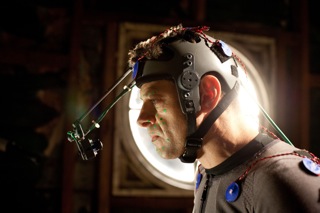
Also read: Hey, Hey, It's the Monkeys: 'Apes' Rises to Big $54M at Weekend Box Office
Since "Apes" was released on Friday, some have been asking again if Serkis could at land an Oscar (or at least a nomination) for the performance, in which his movements and facial expressions were used by special-effects technicians at Weta Digital to create Caesar.
Time's Richard Corliss called it "a performance so nuanced and powerful it may challenge the Academy of Motion Picture Arts and Sciences to give an Oscar to an actor who is never seen in the film."
At Awards Daily, Sasha Stone called Serkis' work "the performance of the year (so far)," and added,"finally, motion-capture has delivered on its promise to create seamlessly emotional, realistic performances."
Stone, though, concludes that performance-capture remains a threat to actors, "which is why the Academy will continue to be reluctant to recognize a motion-capture performance over a live-action one."
At least one Academy member, director Rod Lurie, has tweeted about the topic: "I wasn't buying into this 'Andy Serkis for best supporting actor' business," he wrote after seeing the film. "But I am now. His performance is 'Holy S—' stuff in APES."
Still, an informal survey of Academy members indicated very little optimism that the actors' branch will actually recognize Serkis' subtle and gripping performance, which is certainly the heart and soul of the film.
The consensus: Voters aren't comfortable considering traditional acting alongside performances in which the actor's face is digitally replaced by special-effects wizards, regardless of how closely that digital replacement is based on what the actor does.

My guess is that Serkis (right) will get more consideration than, say, "Avatar" actress Zoe Saldana, for whom James Cameron campaigned two years ago in an attempt to persuade voters that she deserved a nomination. And at least one critics' group, I expect, will recognize Serkis' achievement.
But as for the Academy, it may well prove too tradition-bound to take the plunge.
Serkis himself wasn't entirely comfortable talking about his own awards prospects when TheWrap caught up with him over the weekend. But he is messianic when it comes to the process of performance-capture, and why it should be considered no different from live performance.
In David Lynch's 1980 film "The Elephant Man," he pointed out, John Hurt was nominated for Best Actor for a role in which his face was completely obscured by prosthetic make-up that transformed him into the monstrously deformed John Merrick.
"It was a magnificent performance in which he was totally unrecognizable," said Serkis. "His artistry was enhanced by the brilliant team of special make-up artists. And for some reason, people somehow have an easier time understanding that layer of enhancement than when it comes to pixels.
"I think it's important that people really understand it — and if it takes an award as a way of charting that progress toward understanding, then so be it."
The progress that has been made in performance capture in recent years, he added, has helped actors take real control in the process. When he played Gollum in the "Lord of the Rings" films in the early 2000s, he acted on set with his fellow cast members, but then had to retreat to a small motion-capture studio to recreate his performance — and Gollum's facial expressions were completely animated by effects technicians to match Serkis' facial expressions.
By "King Kong" in 2005, improvements in the process allowed him to control the facial performance himself; the technology became more sophisticated with head-mounted cameras that captured facial expressions in "Avatar" (on which he did not work).
On "Planet of the Apes," for the first time, Serkis and his fellow ape actors were able to shoot their parts on the live-action stages and locations alongside the other actors, even in broad daylight.
"The technology has become more invisible, and created a stronger interface between the director and the actors," Serkis said.
"At this point, it’s no different than any acting role you take on. You do the research into primate behavior, chimpanzee behavior in particular. You learn the physicality, the body language and so on, and you can use the monitor in real time to see your performance: If Andy lifts his right hand up, then Caesar lifts his right hand up."
While the facial expressions are not translated in real time in the monitor, Serkis said he understands how his facial muscles work well enough to know exactly how each movement he makes will be translated into the digital ape character.
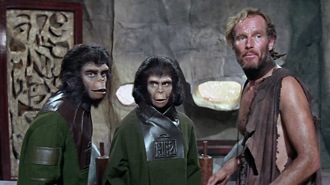
"But that sounds technical," he cautioned. "Actually, it's just born out of acting. It's born out of the emotional connection between myself and James Franco. With performance-capture replacing prosthetic makeup on movies like this, you're not having to fight through latex, as they did in the 1968 version [of 'Planet of the Apes,' left]. You're able to play the underlying intention in an incredibly subtle and very pure way."
So why haven't other actors – and, more to the point, voters – embraced performance capture as real acting worthy of awards consideration?
"I think there's still a reasonable amount of fear," he said. "You don’t physically appear on screen as yourself, and I guess some actors would probably object to that, because they feel that their greatest tool is their face. They think it doesn’t present truthfully what the intention of their performance is, which couldn’t be further from the truth.
"And my answer is this: Every single actor's onscreen performance is enhanced to some degree by what you wear, by the makeup team that works on your face, by the shot size, by the way the director moves the camera around what you're doing.
"The truth of the matter is, if the performance doesn't live and breathe and feel and connect and feel dramatically powerful the moment that it's shot, like in a live action shoot, then it's never going to get any better by layering pixels on top."
In addition to "Apes," "Tintin" and Peter Jackson's two upcoming films of "The Hobbit," for which Serkis is reprising his role as Gollum and also doing second-unit directing, the actor has recently launched The Imaginarium, a London-based lab dedicated to all facets of performance capture.
The Imaginarium, Serkis said, will produce its own films; stage live theater performances in which dancers, musicians and actors can project real-time avatars onto screens; engage in research and development; and create an academy to teach actors, cinematographers and other technicians about the process.
"It should be part of the actor's toolkit," he insisted. "It's a very pure form of acting, and I don’t see any limitations. I see it as a portal to playing diverse and extraordinary characters."
Are you listening, Academy?