Hannah Arendt’s old adage about evil has grown banal from overuse, though it finds interesting new ripples in Emmanuel Marre’s “A Man of His Time.” Not that the central anti-hero is particularly malevolent — he’s simply a middle-aged mediocrity who turns to Vichy collaboration to reboot a stalled career. More ignominious still, he barely gets far, stalling out again at lower middle-management, just another interchangeable cog in a machine that doesn’t need him, will go on without him and will crush him all the same.
Premiering in Cannes’ competition, this odd-duck docudrama marks a decided change of pace for a filmmaker whose previous study in anomie was titled “Zero Fucks Given.” Here, one senses that Marre cares an awful lot — and carries no small burden — following a character based on his own great-grandfather.
Henri Marre (Swann Arlaud) stumbles into the film already slightly soused. France has fallen, and a new government is coalescing in the spa town of Vichy under the octogenarian Maréchal Pétain. There’s work to be had for unscrupulous men — even those coming off a recently collapsed business venture that ended in professional disgrace. Unfortunately for Henri, there is rather less work for ideologues, as dyed-in-the-wool Pétainistes raise eyebrows in a government born of defeat and staffed by cynics who prefer the reliability of fellow rogues. Not five minutes in, our awkward arriviste has badly overplayed his hand.

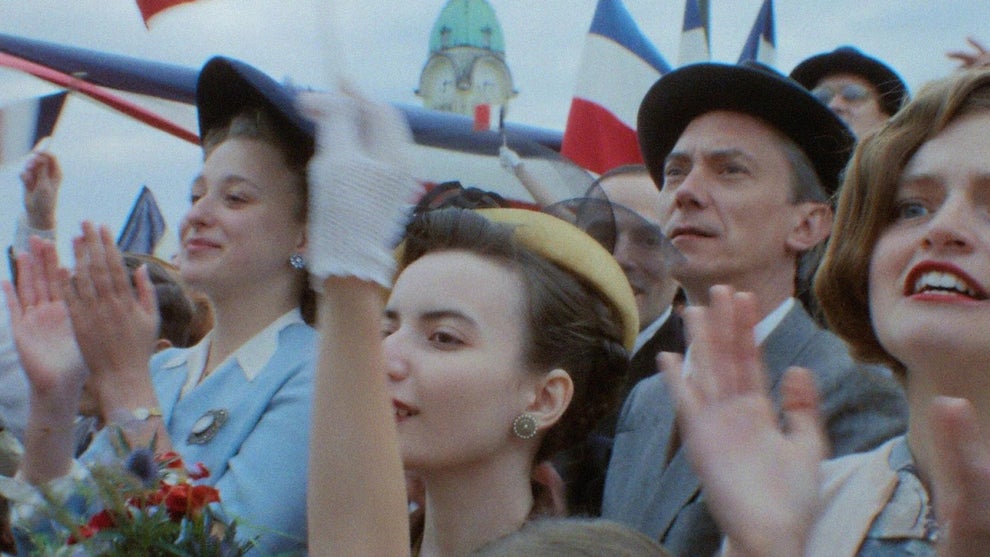
Henri’s great-grandson, though, has already got us hooked — tracking his protagonist as he poorly works the room with visual language that feels wildly discordant with the period. (For clarity’s sake, we’ll use the first name for the character and the surname for the filmmaker.) Marre follows Henri like a nightclub photographer, using a handheld camera and harsh on-camera flash, subjects washed out in its immediate glare and swallowed by pools of shadow. The aesthetic calls to mind early-2000s party shoots, or the deep seediness of Girls Gone Wild, and it comes as part of the filmmaker’s wider plan to bridge the eight decades separating the two Marres.
In certain key respects, the film employs a similar logic to “The Zone of Interest,” collapsing then-and-now with an aesthetic far removed from the standard historical drama. Whereas Jonathan Glazer used eerie distancing to accent alienation, Marre wants his viewers to recognize something all too familiar — especially because the film’s many discourses about appeasement and fascist rapprochement are hardly limited to the past. (A wink the film’s English subtitles make toward international viewers with a line about “making France great again” that doesn’t quite match the French dialogue spoken on-screen.)
Much of that dialogue was improvised on the spot, as Marre apparently wrote a detailed script then forbade his actors from learning much of it. Running 155 minutes, the film plays as a grim picaresque, following Henri from Vichy — where the new government has overtaken the local thermal baths, giving gray bureaucrats the chance to plot new trade routes from the shvitz — then to Paris, and ultimately to Limoges, where he is made sub-prefect for a politico already on the outs, at a ministry of, shall we say, secondary importance.
Less rise-and-fall than lurch-and-plant, the film uses its caught-on-the-fly quality to accent the mundane. The gears of fascism were turned by unexceptional stiffs just punching the clock, and even within these systems there were winners and losers.
But even the hapless can feed atrocity — a fact that crystallizes through the film’s extended middle section following Henri at work. He sits behind his desk placing calls, issuing orders, and competently administrating what we gradually come to realize is the transport of people. That Marre shoots his bumbling middle-manager with an extraordinarily familiar shorthand of handheld cameras and rapid zooms only sharpens the film’s ironic bite. This is “The Office: Genocide.”
“A Man of His Time” relays a dark subject with a playful spirit, leaning into anachronistic music cues setting archival footage against Opus’ “Live is Life,” or having characters break into dance to “Popcorn” by Hot Butter. But it turns mournful when focusing on Henri’s domestic life. He has four children and a wife — played by Sandrine Blancke — who lets us into her emotional life through a series of letters, read in voiceover and drawn from the real family archive. For all his limited political talent, Henri leaves his mark on the world all the same, with a moral stain that has outlasted everything else about him, and a uniquely marred legacy.
