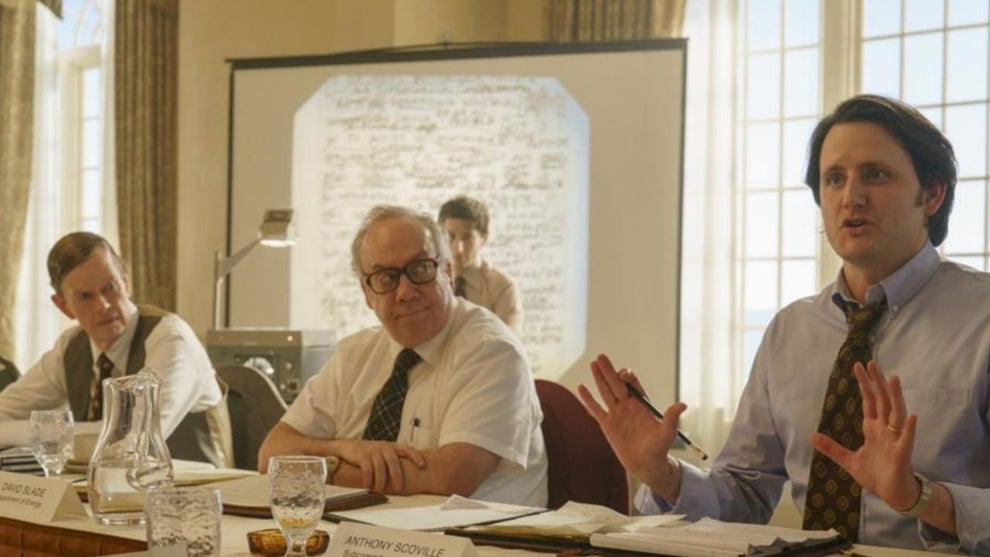
On Oct. 30, 1980, 20 experts got together at the Don CeSar Hotel in St. Petersburg, Fla., to address the impact of CO2 emissions on the climate. What they managed to prove is what every social scientist already knows: If there’s a chance for people to get in their own way, they’ll knock each other over to grab it.
This, ultimately, is the statement Tom McCarthy (“Spotlight”) aims to make with “A Statement.” And unlike his hapless protagonists, he handily succeeds.
The movie is based on true events documented by journalist Nathaniel Rich in his 2019 book “Losing Earth: A Recent History,” but McCarthy and his collaborators, including co-writers Thomas Bidegain and Noé Debré, dig so deep into the data that they create a sort of scientific experiment themselves. Nearly every line of dialogue was lifted verbatim from the panel’s hundreds of pages of transcripts, and it’s delivered in a setting that feels almost forensically accurate.
The most optimistic member of this cohort is moderator Tom Jorling (Paul Rudd), who has gathered everyone to alert the world to the growing environmental emergency. He’s organized four sessions over two days, during which the group can hash out the language, reach a consensus and bring their pronouncement straight to Congress.

He has not, however, accounted for the impact of each personality. MIT nuclear engineer David Rose (John Turturro), for example, arrives with reams of evidence that society is unable to shift fast enough to make changes worthwhile. Energy Department representative David Slade (Paul Giamatti) is ready to pour cold water on any ideas he knows Congress will reject. Ecologist George Woodwell (Dylan Baker) and environmentalist Rafe Pomerance (Evan Peters) cannot stomach the thought of compromise, while meteorologist John Perry (Jason Clarke) sees himself as a practical gadfly, the one sane voice amid so much overreaction. Meanwhile, public health scholar Annemarie Crocetti (Amy Ryan) observes in dismayed silence, simultaneously overlooked and appalled by the men peacocking around her.
It is almost inconceivable that a funny, suspenseful and entirely engaging film could be made out of the transcripts of bureaucrats arguing over words like “prudence,” “jurisdiction” and “mandates.” But wisely, McCarthy leans so far in that he allows us to become participants as well.
We can smell the smoke in the amber ashtrays, see the dust hovering around the slide projector, taste the lukewarm letdown of a chafing-dish meal. Anyone who’s been in a never-ending meeting or had to hide their annoyance at a misguided colleague will feel this experience in their bones. But it’s to McCarthy’s credit that anyone who hasn’t will, too.
In many ways, he approaches the project like a play, keeping the setting tight and bringing in the highest-level performers to distinguish each role. It’s no coincidence that the most experienced actors handle this difficult task with the greatest ease. Turturro, Clarke and Giamatti are particularly compelling as three versions of men whose flaws blind them in different ways. In contrast, Peters and Tatiana Maslany (as a legal scholar) don’t settle in as comfortably; they play their parts rather than embodying them.
Then again, none of the women are fully integrated into the film, an unfortunate irony given the blatant sexism their characters experienced in real life. McCarthy’s intention to acknowledge this egregious treatment is clear each time one of them hesitantly raises her hand or is silenced by an interruption. But when he takes them out of the meeting, he fumbles, turning them into representations and plot devices. This is particularly true for Bernadette (Nina Arianda), the stenographer tasked with both enlightening and kissing awkward young scientist Robert (Noah Robbins).
Mostly, however, he gets the details just right. This is never easy; too many contemporary dramas set during the ’70s and ’80s make a joke out of how old-fashioned everything feels. In contrast, production designer John P. Goldsmith and costume designer Melissa Toth do a fantastic job recreating a very specific moment with legitimate sincerity. Sure, the ever-present cigarettes and emissions-spewing muscle cars make a point. But it’s the layered approach that’s most impressive: the heavy hotel curtains, rumpled short-sleeve button-downs, limp lunch salads.
Best of all, though, are the timeless truths that emerge from this era-specific artifact, through the interpersonal dynamics and self-serving perspectives that each member brings to the table. Nearly 50 years on, it’s clear that climate change was inevitable. So the question McCarthy winds up handing us is even bigger: Is there any hope for human nature?
