In his book “The Four Loves,” author C.S. Lewis offers a famed quote about the gift of friendship, writing “Friendship is … one of those things which give value to survival.”
Despite the assumed emphasis on offspring and progeny in Lauren Miller Rogen’s “Babies,” the film is a celebration of the nonfamilial bonds that make life worth living. Putting scenarios and conversations too rarely explored in film on screen makes this project feel genuinely revelatory and one of a kind, even if many will find themselves relating to the ways societal expectations crystallize into albatrosses of condemnation. If this is one’s first time thinking of these questions, welcome to the party. If you have been harboring similar sentiments to Miller Rogen, bask in the vindication.
Not unlike the ways infants have their own fits and starts as they learn to soothe themselves to sleep in their early days, Miller Rogen’s film has a similar stop-and-go quality, as it is comprised of snapshots of three main couples. It can sometimes feel that one vignette ends just as it begins to get interesting, but this rhythm means that the film can make its collage of characters all feel fleshed out, and the democratization of importance is a cornerstone of the movie’s thesis.
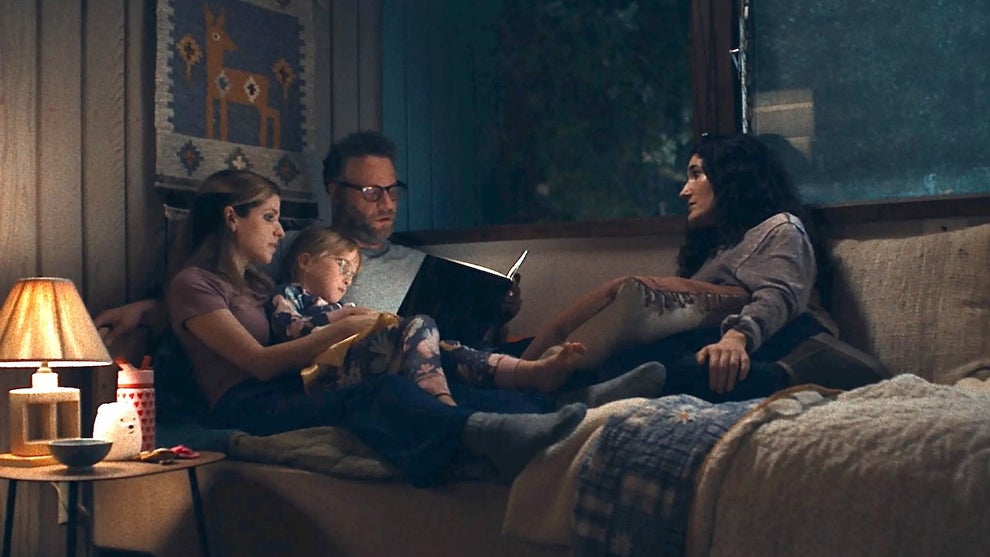
Annie (Anna Kendrick) and Aaron (Seth Rogen, who married to filmmaker Miller Rogen) play a happily married couple who are at that stage in life where the question of “Are you guys having kids?” feels less like honest inquiry and more like pointed suggestion. They hover between jealousy and gratitude, being the only ones without kids in their friend group that includes couples Eliza (Kate Berlant) and Luke (Dan Stevens) and Becky (Issa Rae) and Ethan (Zach Cherry). They mourn the fact that they are not able to have the same experiences as their friends, evidenced in one moment where Luke and Ethan strip down to their swimsuits to join their kids in the pool at a party while Aaron is left alone at the grill. For every pang of envy, Aaron and Annie enjoy being able to smoke weed in the house and have sex in their living room – not just their bed – should they choose to spice up their coital life.

Questions about parenting become more front and center when Eliza announces that she’s leaving Luke and asks if she and their daughter, Eve (Delaney and Parker Evans), can stay with Aaron and Annie. The experience becomes a way for the couple to prototype in real time about which type of empty nesters they’ll be: the kind that get to see their kids grow old or the ones that never build a nest in the first place.
There is a maturity in the way Miller Rogen writes these characters that is refreshingly subversive from how these types of marital dramas tend to play out. These are all people who love each other, and yet the film never crescendos to the type of arguments or vitriol that feel forced for the sake of drama. Editor Joi McMillon often fades scenes into black to then focus on a new couple, and the lack of streamlining is an inspired choice, uniting the couples in the similar questions they ask, even while highlighting the differences in their home situations. There’s an equally touching subplot involving Annie’s father (David Strathairn, soulful and gregarious even in a smaller role), whom Annie encourages to go out on dates while he’s in the midst of caring for her mother with Alzheimer’s. Strathairn’s character is a reminder of how age never has to be a reason not to start again, and that happiness is often on the other side of the courage to break free from convention.
A surface-level read of the film would be to say that Miller Rogen and her husband crafted “Babies” to act as their cinematic middle finger to those in their lives who keep pestering them about why they have not had kids. A closing monologue given by Annie is where the film pontificates the most, where Miller Rogen’s own thoughts are apparently translated to the screen with little artifice to cushion.
However, the film is far more subversive and invitational than that. There is an idolization of not just marriage but having kids that is built within the rhythms of our world. The film does not seek to shame those who would want to have kids but instead asks why other types of families are not revered in the same way.
By the time the film ends, the genius of Miller Rogen’s script clicks into place: We can build families anywhere, and it’s to our detriment if we prioritize the nuclear, biological family to such an extent that we forget others in our community. Ultimately, “Babies” is an invitation to love the ones who make life worth living, exploring a subject matter that we see far too little of on screen, and crafted lovingly by the hands of a filmmaker who is far too gracious, thoughtful and witty to lecture.
