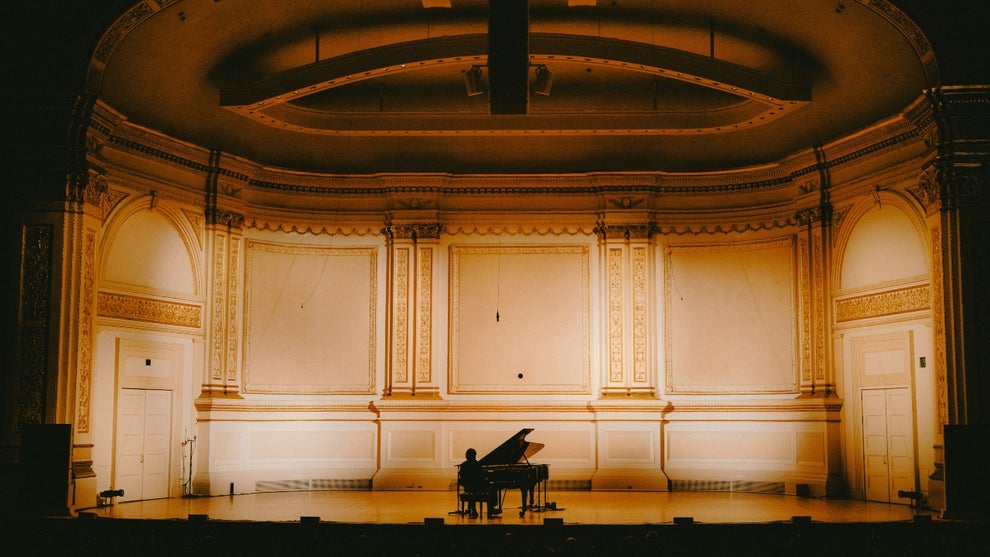
Paul Thomas Anderson’s “Cameron Winter at Carnegie Hall” documentary might just be the best-looking and best-crafted home video ever made.
I do not mean that literally; Anderson and his crew captured the Geese frontman’s solo show on Dec. 11, 2025 with enough cameras to supply a whole borough of tourists, capturing the arresting set on lush and full 16mm and 35mm. In other words, it was a whole production, but there is an intimacy and warmth to this presentation akin to the types of videos one might record of their friends or family unexpectedly breaking into song.
That kinship and forbidden sense of discovery ripple throughout each of the 75 minutes that make up this documentary, resulting in a musical experience where the language of spiritual revival seems the most appropriate framework to employ. By keeping the film lean, focused, but most importantly curious, the film becomes not just an exercise in rote documentation but one of invitational stewardship: may we all strive to record beautiful scenes of our lives with this kind of creativity.
Indeed, from the start, it is evident that Anderson wants to cut right to performance, eschewing any sort of introduction to who Cameron Winter is – something that could have been easily accomplished if Anderson and his crew decided to do person-on-the-street interviews with any member of the sold-out crowd. Yet the film keeps any setup to a minimum, focusing on ambient sounds (and not dialogue) above all else.
In these first few moments, we hear the rhythmic beeping of eager attendees getting their tickets scanned, the pitter-patter of all types of footwear prancing upon the wooden floors, the shuffling of bodies as they try to find seats. Not unlike the crowd that showed up a year ago, Anderson knows what the people are here to see, and these beats serve as a kind of sonic palate cleanser. Winter himself also wastes no time, and after nestling himself comfortably in the Steinway grand piano, he begins his concert.

It is the gift of perspective that Anderson and his crew offer to this stationary performance that makes the film throb with a kind of urgency that can be so hard to capture in music documentaries. As the camera crew had permission to film from all angles, the film itself never settles for just one presentation. It gives the doc a novelty and edge because even if you were one of the lucky few to see Winter live, even if you were in the very front, there is no way you can see it from the perspective Anderson shows.
His camera might zoom in with affection and precision on Winter’s face while he sings “Love Takes Miles,” to the point where you can see his tufts of hair quiver, or it might shift focus to the upper rafters, looking at Winter from afar as if he’s a target that needs to be taken out by a sniper.
You can feel Anderson and his crew being led by curiosity that, by default, will not stay still. They seem to view Winter’s stationary performance (he only gets up from the piano occasionally to stretch or drink water) as a creative challenge to unlock its dynamism. Depending on how a particular song might be lit, the team also shifts focus in ways that emphasize Winter’s isolation on stage but also his role in the larger audience collective. It can feel like the cinematic equivalent of a campfire, with Winter’s soulful tunes being the hearth that keeps us warm amidst the “carnivals of pain in life.”
Anderson’s film is focused and thoughtful, but also a little dangerous in its unpredictability within the concert film structure, which lends the movie its alluring power.
It reminded me in many ways of what I appreciate about liturgical faith traditions. Liturgies, from their call-and-response dynamics to the recitation of common prayer, on the surface can seem limiting. Yet it is within that straitjacket, within the rehearsal of order, that the divine can work. This film models, in its own alchemical way, that very act of taking a concert and exploring the multitudes of experience within it. The film’s close-ups on Winter, where he’s often hunched over the piano as if he’s praying, feeling like he’s performing for an audience of one, speak further to this idea that what we’re witnessing is someone coming to terms in real time with who they are as an artist and creative.
The other beauty of liturgy is the call to participate; there’s a role for people in the service, and “Cameron Winter at Carnegie Hall” is at its best when it reminds us that the act of listening to good music is not a passive experience of consumption.
In Winter’s song “Try As I May,” he croons “Try as I may / To love what fits in my hand / I don’t, I don’t.” In the context of this concert film, those lines feel tinged less with regret than overflowing love. With this project, Anderson, his collaborators, and Winter have made a work — clearly born out of love — that cannot fit in any one hand. We, as the audience, are invited to grasp at what they have made.
May we take hold of it and try to cherish it well.
An exclusive North American 35mm tour of “Cameron Winter at Carnegie Hall“ begins on Nov. 20.