


The future of cinema, entertainment and mass media is hinging on a four-word promise: 30 films per year.
That is what David Ellison has repeatedly vowed Paramount Skydance will deliver to theaters if it can complete its merger with Warner Bros. Discovery. Among creatives who spoke to TheWrap in the past week, skepticism still abounds that the studio could make good on such a lofty goal.
“In the old days at Warner Bros. they released almost that many movies, but I don’t know if the marketplace can bear that,” said one veteran producer, pointing to the cost of making and releasing 15 films a year per studio. “Is it possible to make that many movies with the right team? Yes, and it would be fantastic. But financially, I don’t understand that part.”
Whether Paramount is serious about its commitment — and whether it’s even feasible — is the question that’s divided Hollywood over the $110 billion deal, which promises to radically transform the entertainment industry.
It’s enough to get the three largest theater chains in the country to back the deal, further pressuring the dozen state attorneys general to find a resolution to their antitrust lawsuit to block it. So far, that pressure has not swayed California AG Rob Bonta, who told TheWrap that Paramount must “stop leaking and stop misrepresenting through their leaks” if they wish to hold settlement talks.

To fulfill their output promise, insiders and analysts told TheWrap that Paramount will need to get several new and existing divisions of both studios’ theatrical arms running under their post-acquisition structure, including key ones like DC Studios and New Line, as well as ramp up its slate with a smart selection of indie films. Even if that goes off without a hitch, the high output isn’t a guarantee if Paramount can’t shake off the box office inconsistency that has plagued it across multiple leadership groups.
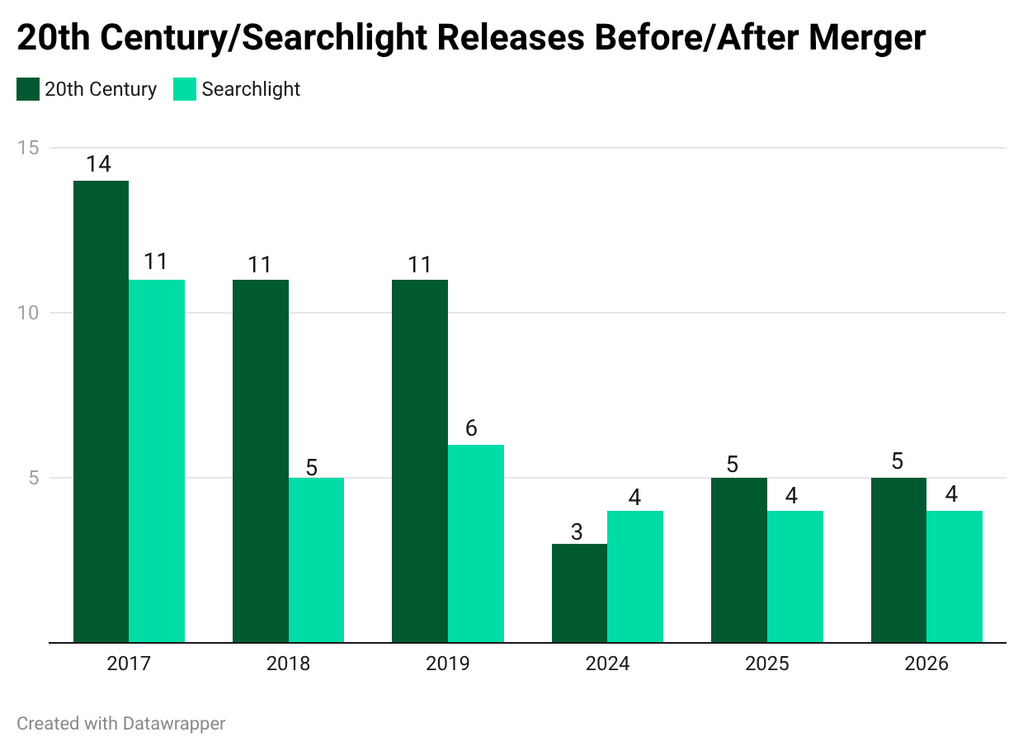
History also hasn’t been kind to big combinations. The last major merger, Disney’s acquisition of Fox in 2019, left 20th Century Studios and Searchlight releasing a dramatically lower number of films per year, even as Paramount has said it would put its commitment down in writing — terms many in Hollywood are skeptical about.
“No, there’s no way,” said one filmmaker tersely, pointing to the insufficient amount of projects that Paramount currently has in development and pre-production.
In a statement, Paramount said it “remains hopeful and is committed to good faith discussions with [AG] Bonta’s office for an efficient resolution of our pending litigation.”
“Any such discussions will be limited to the AG’s office and authorized Paramount leadership. We appreciate the heightened interest in this merger, however, any reports inferring knowledge of the details otherwise are speculation, not fact. Paramount will not comment further on this matter,” the statement continued.
Details of the agreement
Multiple insiders with knowledge of Paramount’s talks with theaters have told TheWrap that the written agreements the studio is willing to make with exhibitors would guarantee 30 films annually for three years. It’s a length that Cinema United, the trade group representing the theater owners, balked at in previous talks with Paramount earlier this summer, but it’s one that Paramount is offering because the established Warner Bros. slate it has inherited would make it easy to fulfill that pledge.
Currently, Warner Bros. has 20 films that it plans to release in 2027, including an untitled New Line horror film placeholder set for March 12 and two announced but undated films from its recently launched specialty division Clockwork: “Nasty,” a gymnastics drama from “If I Had Legs I’d Kick You” filmmaker Mary Bronstein and star Rose Byrne, and “Ti Amo!,” Sean Baker’s follow-up to his Best Picture Oscar winner “Anora.” It is unclear at this time whether those Clockwork titles will have a wide release.
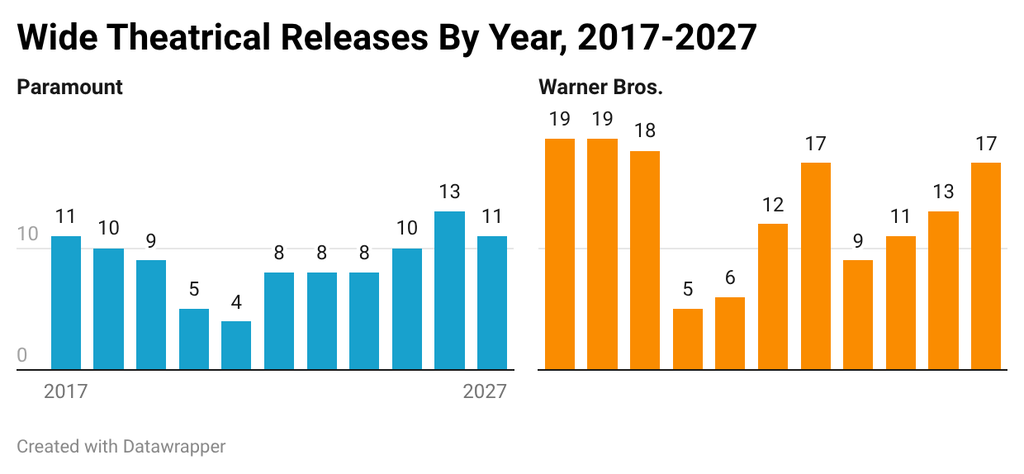
Combined with the 11 films Paramount currently has for 2027, which includes new “Sonic the Hedgehog” and “A Quiet Place” films greenlit prior to Skydance’s acquisition of Paramount last year, that’s one year of the pledge already fulfilled even before Paramount dates films like the Skydance-era project “High Side” starring Timothée Chalamet and an untitled prison drama from “La La Land” director Damien Chazelle starring Daniel Craig and Cillian Murphy.
The future starts getting murkier in 2028. Combined, the two studios have 17 films currently dated – 10 Warner, seven Paramount – including an animated DC film “Dynamic Duo” and a Taylor Sheridan-written adaptation of “Call of Duty,” both set for a June 30 release.
The following year remains wide open, and Paramount and its merger proponents argue that if the merger goes through now instead of going to trial next March, the studio can start work on filling 2029 out faster.

Tapping the indie scene
A good part of filling out its lineup would involve the independent space. According to an insider with knowledge of Paramount’s talks, the studio has said it is willing to include a pledge that 30% of its annual slate would come from indie film acquisitions.
Paramount has already taken steps to ramp up its acquisitions pipeline by hiring former Tango Entertainment exec and producer Lia Buman — whose filmography includes Nia DaCosta’s directorial debut “Little Woods” and Charlotte Wells’ Oscar-nominated drama “Aftersun” starring Paul Mescal — as the chief of that division and its revived Republic Pictures label. On paper, a robust acquisitions division would set Paramount-Warner apart from Disney-Fox, as the theatrical output from Searchlight Pictures dropped from 22 films in its final three pre-merger years from 2017-19 to 12 films from 2024-26.
But one executive in the specialty space told TheWrap that it takes time to get a foothold in what is becoming an increasingly competitive corner of the theatrical market. The executive did not know Buman and could not speak to her experience, but said that Republic Pictures would need to hit the ground running with not just a slate of indie films that can click with the Letterboxd crowd but with effective and bespoke marketing strategies for each one.
“A24 and Neon did not become what they are overnight. It took years of building trust with their core audience,” the executive said. “Warner Bros. is also building up their own specialty team with some former Neon guys like Christian Parkes who are really good, but that will probably fold if the merger goes through. Wouldn’t it just be better for theaters and indie producers if they stay separate and both get involved in acquisitions?”
Maintaining key WB relationships
Another challenge Paramount would face while trying to meet that promise is preserving the creative and executive relationships that allowed Warner Bros. to release multiple hits in 2025. Current Warner film chiefs Michael De Luca and Pam Abdy have built a reputation of championing filmmakers’ creative visions and standing by them, whether they become hits like Ryan Coogler’s “Sinners” or flops like Maggie Gyllenhaal’s “The Bride!” Warner has even picked up Gyllenhaal’s next project, an adaptation of the eco-thriller novel “Creation Lake.”
Paramount insiders said that the studio plans to keep Abdy and De Luca at Warner in a merged system alongside other top creative execs at the studio like New Line Cinema’s Richard Brener and DC Studios’ James Gunn and Peter Safran, who have said after meeting with Ellison that he is “pretty open to what we’re doing” with the superhero franchise.
Paramount also has a working relationship with key outside production partner Legendary Pictures, whose films include Warner’s “Dune” trilogy and “A Minecraft Movie” as well as Paramount’s “Street Fighter.”

But Paramount may be inheriting a headache with DC if more of its films perform closer to this summer’s bomb “Supergirl,” which grossed just $126.3 million worldwide, rather than 2025’s $618.7 million hit “Superman.” The next two films on DC’s slate are the Batman villain mid-budget horror title “Clayface” this October and the “Superman” sequel “Man of Tomorrow” next summer.
If both of those films significantly underperform, would a major retool of DC follow suit? If so, that’s one less source of major tentpole output that Paramount would be able to rely on even as Warner’s trove of popular IP is a major reason why Ellison is seeking this acquisition. With the “Mission: Impossible” series on ice and a third “Top Gun” film announced by Paramount but in early development, the studio is trying to build out a franchise stable that is headlined by the “Scream,” “Sonic the Hedgehog” and “A Quiet Place” series, though it could be joined by Activision’s “Call of Duty” if Peter Berg and Taylor Sheridan’s 2028 film is a success.
Consistency is key
But the biggest obstacle that could keep Paramount and Warner from maintaining or exceeding their current output as a merged studio is one that both studios are facing right now: consistency. Even Universal and its specialty wing Focus Features, studios that are enjoying immense success at the box office with three $1 billion hits including “The Odyssey” and the historic horror success “Obsession,” are combining for 24 theatrical releases this year. 2027 will likely be the same as Universal currently has 12 films dated with Focus yet to start constructing its slate.
Paramount and Warner, on the other hand, have not enjoyed as high a level of consistency as Universal in recent years. While Warner Bros. had an excellent $1.8 billion-plus total at the domestic box office in 2025, its 2026 films have combined for a mere $344 million so far with its highest-grossing film being Emerald Fennell’s “Wuthering Heights” with $84 million domestic and $241.7 million worldwide.
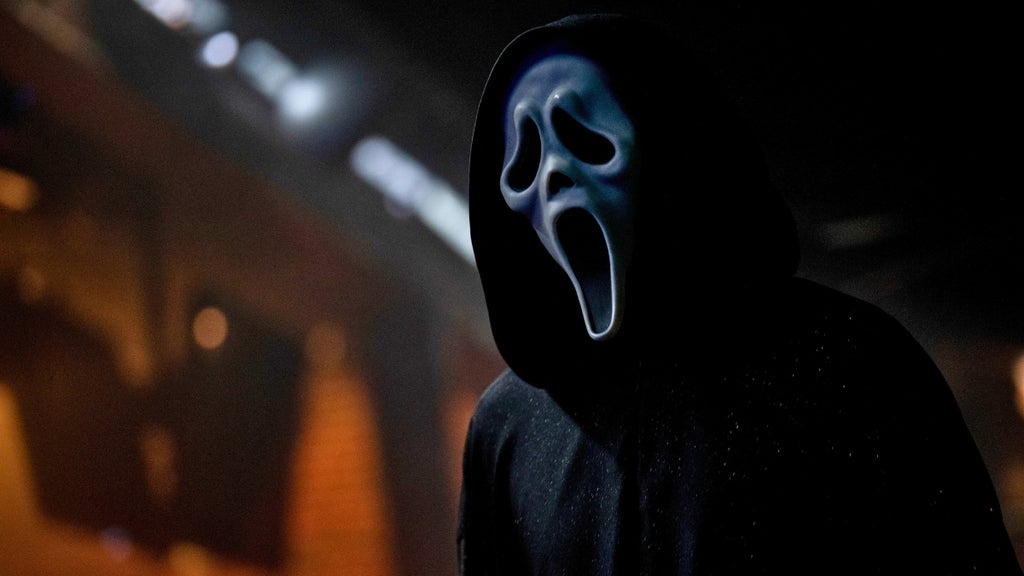
Paramount is only doing slightly better with approximately $365 million grossed so far this year in North America, largely off of Spyglass’ “Scream 7” and Miramax’s “Scary Movie,” both of which cleared $100 million. Both studios are hoping for a strong finish to the year with movies like “Street Fighter” and “Ebenezer” at Paramount while Warner is turning to “The Cat in the Hat” and “Dune: Part Three” this holiday season, but this will likely be a down year for both studios.
And as Exhibitor Relations analyst Jeff Bock asked: what happens to the film industry and to this 30-film pledge if and when Paramount and Warner, combined as one entity with a projected $79 billion post-merger debt, has a slump year like the one Warner is having now with pricey flops?
“Studios put out 12-16 films a year because that is what they can stably put out and, depending on quality, get a good return on while competing against what other studios have in theaters,” Bock said, noting that Paramount has consistently struggled under different owners, peaking in 2022 with more than $2.6 billion grossed worldwide thanks largely to “Top Gun: Maverick” but seeing declining box office receipts since.
“It has a lot of work to do just to get its own film division running hot again, and now they want to do all of that and say they can run Warner Bros. as good as or better than they’re being run now?”
